I was going to post a link to the FDA probe into a possible link between vaping and seizures but decided to post this video instead because it’s cooler.
Author: SupremeCmdr
Lock them up — RadaJonesMD
Last night, the heated debate on vaccination reached a boiling point. On March 26, 2019, in Rockland County, NY, unvaccinated children were barred from public places. Not only schools. Restaurants, supermarkets, worship places. They’re practically on house arrest. What about doctor’s offices and the ER? I don’t know. This is unprecedented. Rockland County is a 300K…
Long-term Effects of Metformin on Diabetes Prevention: Identification of Subgroups That Benefited Most in the Diabetes Prevention Program and Diabetes Prevention Program Outcomes Study
CONCLUSIONS – Metformin reduces the development of diabetes over 15 years. The subsets that benefitted the most include subjects with higher baseline fasting glucose or HbA1c and women with a history of GDM.
You can access the abstract and full study online at this link to the Diabetes Journal.
The commentary article at this link is also an interesting read.
More Evidence for a Prevention-Related Indication for Metformin: Let the Arguments Resume!
Dual Receipt of Prescription Opioids From the Department of Veterans Affairs and Medicare Part D and Prescription Opioid Overdose Death Among Veterans: A Nested Case–Control Study
Among veterans enrolled in VA and Part D, dual use of opioid prescriptions was independently associated with death from prescription opioid overdose. This risk factor for fatal overdose among veterans underscores the importance of care coordination across health care systems to improve opioid prescribing safety.
Full abstract at this link.
Nonalcoholic Fatty Liver Disease: A Spectrum of Disorders — Podcast
Audio. Annals On Call – Nonalcoholic Fatty Liver Disease: A Spectrum of Disorders: Dr. Centor discusses nonalcoholic fatty Liver disease with Dr. Meagan Gray, Assistant Professor of Medicine, University of Alabama.
A Study in Aging
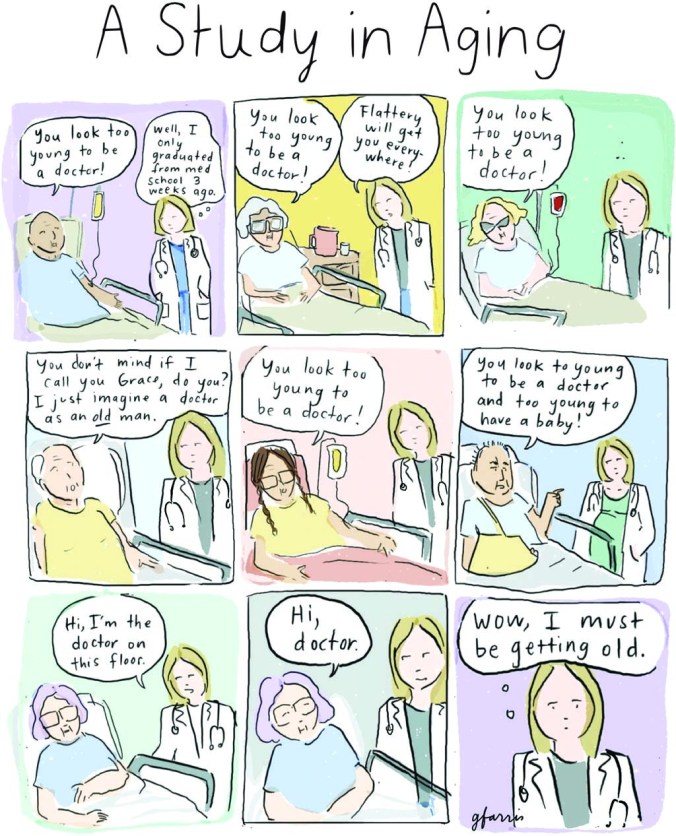
Reprinted from Annals of Internal Medicine.
Energy Drinks Induce Acute Cardiovascular and Metabolic Changes Pointing to Potential Risks for Young Adults: A Randomized Controlled Trial
ABSTRACT-Background. Case reports suggest a link between energy drinks (EDs) and adverse events, including deaths.
A1c test MISSES Many Cases of Diabetes
Must read if you’re an underwriter. Here.
The new study included 9,000 adults without a diabetes diagnosis. The participants got both an A1c test and an oral tolerance glucose test, and the researchers compared the results. The researchers found the A1c test didn’t catch 73 percent of diabetes cases that were detected by the oral glucose test. “The A1c test said these people had normal glucose levels when they didn’t,” Chang Villacreses said.
Does Marijuana Have Any Bad Side Effects?
Read a quick history lesson here.
Read about psychosis risk here.
Pass the doobie please.
Regardless of the century, physicians throughout the ages have known that real medicines carry risks. Any truly medicinal substance is able to give a little whack to one or more bodily processes. The goal is to whack the body back into normal functioning. That’s basically what medicine is all about – strategically whacking our physiology. But anything capable of whacking (which is to say any real medicine) is capable of harming at least a few of the many patients who would take it. This fact is so non-negotiable that we have a name for doctors who claim to have discovered effective medicines that don’t have any risks: we call them quacks.
Nuts Linked With Lower CV Risk in Diabetes
Nuts Linked With Lower CV Risk in Diabetes
More info: https://www.medpagetoday.com/primarycare/dietnutrition/78173


You must be logged in to post a comment.