Cannabis and Arrhythmia Risk, Stroke and Race, Why Weight Loss Drugs Stop Working

Within 180 days, 42 medical cannabis users and 107 control participants developed arrhythmia, most commonly atrial fibrillation/flutter. Medical cannabis users had a slightly elevated risk for new-onset arrhythmia compared with nonusers (180-day absolute risk, 0.8% vs 0.4%). The 180-day risk ratio with cannabis use was 2.07 (95% CI, 1.34-2.80), and the 1-year risk ratio was 1.36 (95% CI, 1.00-1.73). Adults with cancer or cardiometabolic disease had the highest risk for arrhythmia with cannabis use (180-day absolute risk difference, 1.1% and 0.8%).

Medical Cannabis for Chronic Pain Tied to Arrhythmia Risk – Medscape – January 12, 2024 — https://www.medscape.com/viewarticle/medical-cannabis-chronic-pain-tied-arrhythmia-risk

The overall incidence of stroke and ischemic stroke (IS) decreased among both White and Black people over the past two decades, results of an updated analysis of stroke trends in a representative US population showed.

However, the study showed persistent racial disparities, with incident stroke rates 50%-80% higher in Black people than in their White counterparts. Incident stroke also occurred at an earlier age in Black patients than in White patients (mean age, 62 years vs 71 years, respectively).

The findings were published online on January 10, 2024, in Neurology.

New Data on Stroke Incidence Rates by Race – Medscape – January 12, 2024 — https://www.medscape.com/viewarticle/new-data-stroke-incidence-rates-race

And my favorite Saturday morning medical update…

But studies also have shown that once people stop taking these drugs — either by choice, because of shortage, or lack of access — they regain most, if not all, the weight they lost. Arguably more frustrating is the fact that those who continue on the drug eventually reach a plateau, at which point, the body seemingly stubbornly refuses to lose more weight. Essentially, it stabilizes at its set point, said Fatima Cody Stanford, MD, MPH, MPA, MBA, an obesity medicine physician at Massachusetts General Hospital and associate professor at Harvard Medical School in Boston.

Every study of weight loss drugs done over the past 40 years or so shows a plateau, Stanford told Medscape Medical News. “If you look at the phentermine/topiramate studies, there’s a plateau. If you look at the bupropion/naltrexone studies, there’s a plateau. Or if we look at bariatric surgery, there’s a plateau. And it’s the same for the newer GLP-1 drugs.”

The reason? “It really depends on where the body gets to,” Stanford said. “The body knows what it needs to do to maintain itself, and the brain knows where it’s supposed to be. And when you lose weight and reach what you feel is a lower set point, the body resists.”When the body goes below its set point, the hunger hormone ghrelin, which is housed in the brain, gets reactivated and gradually starts to reemerge, she explained. GLP-1, which is housed in the distal portion of the small intestine and in the colon, also starts to reemerge over time.

Why Do GLP-1 Drugs Stop Working, and What to Do About It? – Medscape – January 12, 2024 — https://www.medscape.com/viewarticle/why-do-glp-1-drugs-stop-working-and-what-do-about-it

That’s it for this Saturday. Time to go to the Y and read a book later.

When Worlds Collide

Remember when I posted about Oklahoma producing 64 times more marijuana than licensed users consume – The Oklahoman? Or about Rooms for Rent – Airbnb Crashes? Well, here’s a post about the best of both worlds.

If you noticed something about the people who were arrested I noticed the same thing. Mostly male.

But Both Are Legal…right? – Updated

“We found that alcohol and THC together significantly reduced, and in some cases prevented, the ability of the prefrontal cortex in drug-exposed rats to undergo plasticity in the same way that the brains from control animals can,” said Linyuan Shi, a graduate student in the Gulley lab. “The effects were apparent in rats exposed to either drug alone, and they were most pronounced with co-exposure to both drugs. We also found the impaired plasticity was likely due to changes in signaling caused by gamma-aminobutyric acid, a chemical messenger in the brain. When we used a chemical that enhances GABA, it could rescue the deficits we saw in the animals that had been exposed to the drugs.”

Carl R. Woese Institute for Genomic Biology, University of Illinois at Urbana-Champaign. “Combined use of alcohol and THC can affect rat brains, study finds.” ScienceDaily. ScienceDaily, 30 November 2023 — https://www.sciencedaily.com/releases/2023/11/231130121946.htm

I’m glad I am not a rat.

Young adults who simultaneously use alcohol and marijuana (SAM) consume more drinks, are high for more hours in the day, and report more negative alcohol-related consequences.

On SAM use days, participants consumed an average of 37% more drinks, with 43% more negative alcohol consequences, were high for 10% more hours, and were more likely to feel clumsy or dizzy, compared with non-SAM use days.

Simultaneous Marijuana, Alcohol Use Linked to Worse Outcomeshttps://www.medscape.com/viewarticle/996595?icd=login_success_gg_match_norm&isSocial

Hmmm…

But Both Are Legal…right?

“We found that alcohol and THC together significantly reduced, and in some cases prevented, the ability of the prefrontal cortex in drug-exposed rats to undergo plasticity in the same way that the brains from control animals can,” said Linyuan Shi, a graduate student in the Gulley lab. “The effects were apparent in rats exposed to either drug alone, and they were most pronounced with co-exposure to both drugs. We also found the impaired plasticity was likely due to changes in signaling caused by gamma-aminobutyric acid, a chemical messenger in the brain. When we used a chemical that enhances GABA, it could rescue the deficits we saw in the animals that had been exposed to the drugs.”

Carl R. Woese Institute for Genomic Biology, University of Illinois at Urbana-Champaign. “Combined use of alcohol and THC can affect rat brains, study finds.” ScienceDaily. ScienceDaily, 30 November 2023 — https://www.sciencedaily.com/releases/2023/11/231130121946.htm

I’m glad I am not a rat.

Substance-Induced Psychosis Tied to Schizophrenia Risk

Individuals who visited the ER for substance-induced psychosis had a 160% greater risk of developing a schizophrenia spectrum disorder (SSD) compared with the general population, new research shows. Three years after an initial ER visit, 18.5% of those with substance-induced psychosis were diagnosed with an SSD. Cannabis-induced psychosis was associated with the greatest risk.

Eve Bender. Substance-Induced Psychosis Tied to Schizophrenia Risk – Medscape – Oct 04, 2023 – https://www.medscape.com/viewarticle/997093

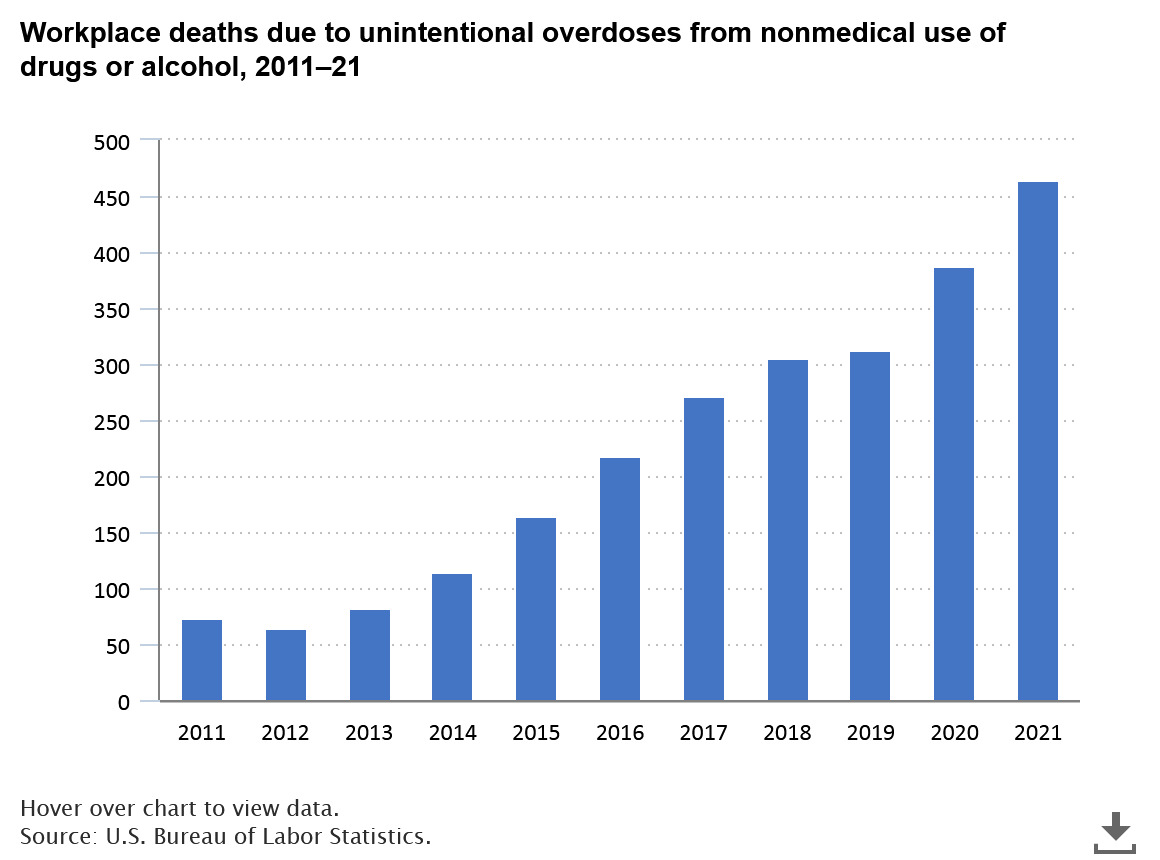
Scary Charts – 08.20.23

There were 464 workplace fatalities from unintentional overdoses due to non-medical use of drugs or alcohol in 2021. This is a 19.6-percent increase from 2020 when there were 388 fatalities and is the ninth consecutive annual increase. Unintentional overdoses from non-medical use of drugs include overdoses from stimulants such as methamphetamine and from narcotics such as fentanyl.

Unintentional overdoses rose for the ninth consecutive year in 2021– https://www.bls.gov/opub/ted/2023/unintentional-overdoses-rose-for-the-ninth-consecutive-year-in-2021.htm

Source: Bureau of Labor Statistics, U.S. Department of Labor, The Economics Daily, Unintentional overdoses rose for the ninth consecutive year in 2021 at https://www.bls.gov/opub/ted/2023/unintentional-overdoses-rose-for-the-ninth-consecutive-year-in-2021.htm (visited August 20, 2023).

Emphysema More Common in Marijuana Smokers Than Cigarette Smokers

“We know what cigarettes do to the lungs,” said study author Giselle Revah, M.D., a cardiothoracic radiologist and assistant professor at the University of Ottawa in Ottawa, Canada. “There are well researched and established findings of cigarette smoking on the lungs. Marijuana we know very little about.”

To find out more, Dr. Revah and colleagues compared chest CT results from 56 marijuana smokers with those of 57 non-smoking controls and 33 tobacco-only smokers.

Three-quarters of the marijuana smokers had emphysema, a lung disease that causes difficulty with breathing, compared with 67% of the tobacco-only smokers. Only 5% of the non-smokers had emphysema. Paraseptal emphysema, which damages the tiny ducts that connect to the air sacs in the lungs, was the predominant emphysema subtype in marijuana smokers compared to the tobacco-only group.

Radiological Society of North America. “Emphysema more common in marijuana smokers than cigarette smokers.” ScienceDaily. http://www.sciencedaily.com/releases/2022/11/221115113940.htm (originally accessed November 15, 2022).

Journal Reference

Luke Murtha, Paul Sathiadoss, Jean-Paul Salameh, Matthew D. F. Mcinnes, Giselle Revah. Chest CT Findings in Marijuana Smokers. Radiology, 2022; DOI: 10.1148/radiol.212611

The mean age of the MJ smokers in the study was 49.

The mean age of the tobacco smokers in the study was 60.

Oklahoma producing 64 times more marijuana than licensed users consume – The Oklahoman

“The supply-to-demand ratio of regulated medical marijuana supply to regulated medical cannabis demand is 64:1,” the report states. “Using a general assumption that units of supply should not exceed two times the units of demand, the medical marijuana program has no less than 32 times more regulated marijuana necessary than licensed patient demand.”

The significant oversupply is likely funneling large amounts of marijuana out of state and adding to the illegal market, according to authority officials.

Oklahoma producing 64 times more marijuana than licensed users consume, report shows — https://www.oklahoman.com/story/news/state/2023/06/21/marijuana-oklahoma-overproducing-64-times-omma-report/70343452007/

The Truth behind the medical marijuana industry.

At least we know there may be a positive longevity effect to all of this excess supply.

What the Scientists Who Pioneered Weight-Loss Drugs Want You to Know – Wired Magazine

What happens is that you lose your appetite and also the pleasure of eating, and so I think there’s a price to be paid when you do that. If you like food, then that pleasure is gone. The craving for food for some people is taken away when they take GLP-1 drugs.

So you don’t eat through GLP-1 therapy because you’ve lost interest in food. That may eventually be a problem, that once you’ve been on this for a year or two, life is so miserably boring that you can’t stand it any longer and you have to go back to your old life.

What the Scientists Who Pioneered Weight-Loss Drugs Want You to Know – https://www.wired.com/story/obesity-drugs-researcher-interview-ozempic-wegovy/

Just another GLP-1 receptor agonist post. See Tirzepatide (another GLP-1 receptor agonist post) for more on the new miracle weight loss drugs that were originally developed to treat duodenal ulcer disease (bet you thought it was diabetes).

The entire article is worth reading.