Poisoning Deaths Involving Opioid Analgesics — New York State, 2003–2012

Comparison of opioid analgesic-related mortality between those enrolled or not enrolled in Medicaid shows considerably higher death rates and a more rapid increase in mortality among Medicaid enrollees. The consistently higher age-adjusted death rates for poisonings involving opioid analgesics among Medicaid enrollees (after stratifying data by sex) suggest that differences in age and sex distributions do not underlie these Medicaid/non-Medicaid differences. Other factors, such as the greater prevalence of mental illness and substance abuse in the Medicaid population (6), might contribute to the observed differences.

via Poisoning Deaths Involving Opioid Analgesics — New York State, 2003–2012.

Maybe the title should be Socioeconomic Status and Death.
Austerity Kills: Economic Distress Seen as Culprit in Sharp Rise in Suicide Rate Among Middle Aged – naked capitalism

Austerity Kills: Economic Distress Seen as Culprit in Sharp Rise in Suicide Rate Among Middle Aged | naked capitalism.

Suicide rates for adults between 40 and 64 years of age in the U.S. have risen about 40% since 1999, with a sharp rise since 2007. One possible explanation could be the detrimental effects of the economic downturn of 2007-2009, leading to disproportionate effects on house values, household finances, and retirement savings for that age group. In a study published in the American Journal of Preventive Medicine, researchers found that external economic factors were present in 37.5% of all completed suicides in 2010, rising from 32.9% in 2005.

US Income and Wealth Inequality Facts – FT Alphaville and naked capitalism

Public opinion surveys consistently show pessimistic views of the economy for the broad mass of people. Growing numbers believe the Great Recession led to a permanent change in the economy, which is probably something less than true – with few exceptions, these wage and income trends have been consistent since the late 1970s. But the other questions in this Rutgers poll appear right on the mark. Almost eight in ten Americans knew somebody laid off between 2008-2012. For leading indicators like low unemployment, affordable higher education, and job and retirement security, the majority of Americans think they will never see positive progress for many years. Just 16 percent of respondents thought job and career opportunities would be better for the next generation, a figure nearly four times lower than from 1999.And we can chalk this up to the wisdom of crowds, because the public happens to be right. It is harder to get a job out of college. It is harder to avoid the trap of underemployment. It is harder to prosper in the career you want. It is harder to save amid stagnant wages. It is harder to grow as an economy when the gains flow to the top. It is harder to secure enough reserves for a dignified retirement.

via Fed Survey of Consumer Finances Shows Americans Understand Their Lousy Economic Condition | naked capitalism.

Facts are facts and these are the facts.

The charts are ugly.  But they tell us what we already know.

US income and wealth inequality facts of the day | FT Alphaville.

The Federal Reserve has just released its Survey of Consumer Finances for the year 2013.

These surveys occur every three years, so this is the first comprehensive update we have gotten about the distribution of income and wealth in the US since the economy hit bottom four years ago.

The most striking finding is that the median American family earned 5 per cent less in 2013 than in 2010 after inflation even though the average American family took home 4 per cent more.

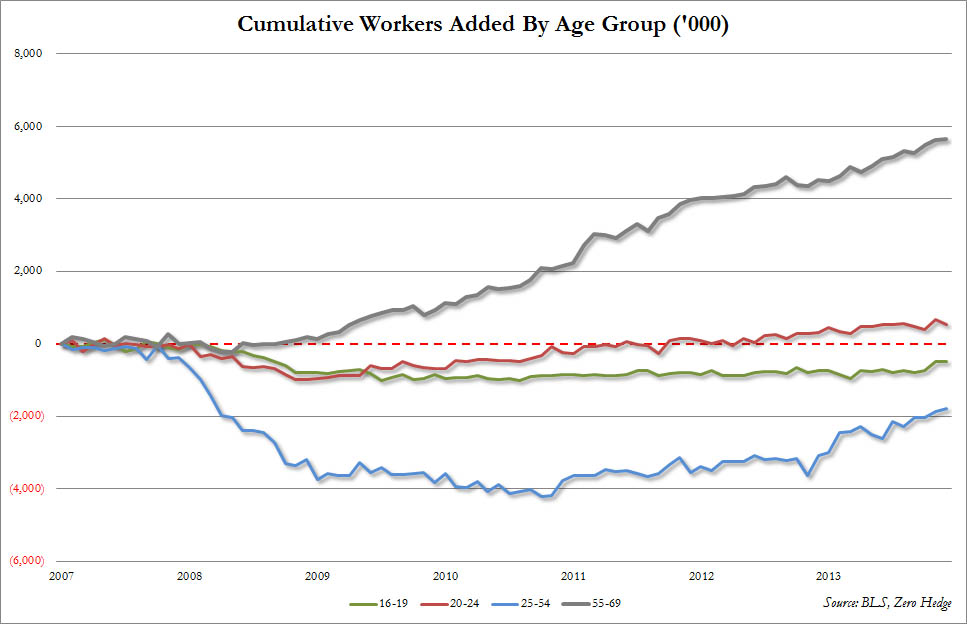
Mish’s Global Economic Trend Analysis: Employment Perspective in Pictures: Only 25% of Decline in Fulltime Employment Attributable to Aging Workforce

Mish’s Global Economic Trend Analysis: Employment Perspective in Pictures: Only 25% of Decline in Fulltime Employment Attributable to Aging Workforce.

“The job of the leader isn’t just to make decisions, it’s to make sense.”

John Seely Brown

The Scary Charts in Mish’s article paint a vivid picture of where this country and economy are headed.  It’s not a pretty picture.

It’s Official: The Boomerang Kids Won’t Leave – NYTimes.com

It’s Official: The Boomerang Kids Won’t Leave – NYTimes.com.

One in five people in their 20s and early 30s is currently living with his or her parents. And 60 percent of all young adults receive financial support from them. That’s a significant increase from a generation ago, when only one in 10 young adults moved back home and few received financial support. The common explanation for the shift is that people born in the late 1980s and early 1990s came of age amid several unfortunate and overlapping economic trends. Those who graduated college as the housing market and financial system were imploding faced the highest debt burden of any graduating class in history. Nearly 45 percent of 25-year-olds, for instance, have outstanding loans, with an average debt above $20,000. (Kasinecz still has about $60,000 to go.) And more than half of recent college graduates are unemployed or underemployed, meaning they make substandard wages in jobs that don’t require a college degree. According to Lisa B. Kahn, an economist at Yale University, the negative impact of graduating into a recession never fully disappears. Even 20 years later, the people who graduated into the recession of the early ’80s were making substantially less money than people lucky enough to have graduated a few years afterward, when the economy was booming.

Read the entire article for a lesson in how to put a positive spin on our new Culture of Dependency.  Watch the slideshow of a dose of reality.  Then read the reader comments and decide for yourself if this “new and permanent life stage” is truly a “potentially thrilling economic evolution”.

Or not.

Remote Life Insurance Underwriters Jobs – Ketterling Group – Charlotte, NC | Indeed.com

There seem to be more life underwriting positions opening up around the industry.  But as I suspected, there are some disturbing trends entering our business and profession.  The ad below is pulled from Indeed.com.  The bold highlights are mine.  These positions are part-time positions.  Compensation is fee based.

To say this disturbs me would be an understatement.

Remote Life Insurance Underwriters job – Ketterling Group –Charlotte, NC | Indeed.com.

Remote Life Insurance Underwriters
Ketterling Group – Charlotte, NC
  • Position is eligible for remote work.

Our client is the market leader in medical information services that help our clients make informed decisions and improve the lives of those they serve.

About the opportunity: Our client’s Underwriting Department is seeking experienced Life and LTC Underwriters to do medical summarizations, as well as provide full underwriting, quick quotes and support other lines of underwriting business. This is a part-time (fee based) 30 – 35 hour a week position Monday – Friday. Plus, weekends and overtime as business needs demand. There is opportunity for growth into salaried positions.

Professional Abilities:
Proven track record of critical thinking capabilities
Commitment to excellence while maintaining required productivity levels
Ability to think ‘outside the box’ and determine areas of process improvements
Focused on continued education and professional growth
Team player and detail oriented

5+ years of life underwriting in a home office environment
Proven ability to work in a virtual office setting
Must be able to work independently and efficiently
Knowledgeable in Microsoft Office products
Well versed in internet applications
Excellent verbal and written communication skills
Strong computer skills, including the ability to work with multiple systems
Experience
Undergraduate degree and/or equivalent professional work experience
Completion of insurance related coursework and/or accreditations 
CareerBuilder – 1 day ago