EL PASO, Texas — The massive Covid-19 surge in El Paso County went from extremely bad to critically worse on Saturday as all-time highs were shattered for a half-dozen critical markers: New cases, active infections, positivity rate, and hospitalizations – along with ICU and ventilator usage.
The health department reported a record 1,216 new cases on Saturday, as well as 75 unreported cases from earlier, increasing the total number of additional cases reported to 1,291. The number of active infections jumped to just shy of 11,000 at a record-level of 10,911.
There were a record 715 patients in El Paso hospitals due to Covid-related illness as of Saturday morning, representing nearly 2% of hospitalizations nationwide. El Paso hospitals have seen a staggering 203% increase in Covid patients over the past two weeks. In addition, record numbers of virus patients Saturday required intensive care (199) and the use of ventilators (85).
South Dakota, which had the most attendees, saw coronavirus cases surge within weeks of the rally’s Aug. 16 close, with the seven-day rolling average going from 84 on Aug. 6 to 214 on Aug. 27. The numbers remained elevated into October: The first day of the month, the seven-day rolling average was 434. The state is second in the nation in cases per capita behind North Dakota, with numbers high enough for the Harvard Global Health Institute to recommend stay-at-home orders.
The authors speculated on two possible causes of the lower prevalence of SARS-CoV-2 infection in the blood group O population. The first is that anti-A and anti-B antibodies may have an effect on neutralizing SARS-CoV viruses and that anti-A and anti-B are present on mucosal surfaces in some individuals lacking the corresponding ABO blood group. The second is that the association between ABO blood groups and levels of von Willebrand factor, which is higher in non-O individuals and is tied to an increased likelihood of arterial and venous thrombosis, could have an indirect or unknown impact on susceptibility to infection, according to the authors.
The ice rink provides a venue that is likely well suited to COVID-19 transmission as an indoor environment where deep breathing occurs, and persons are in close proximity to one another. An Italian study estimating the rate of SARS-CoV-2 emission by infectious persons based on viral load in the mouth showed that during heavy exercise, a high viral emission rate can be reached during oral breathing (6). The higher proportion of infected players on the index patient’s team might result from additional exposures to the index patient in the locker room and on the player bench, where players sit close to one another.
Atrubin D, Wiese M, Bohinc B. An Outbreak of COVID-19 Associated with a Recreational Hockey Game — Florida, June 2020. MMWR Morb Mortal Wkly Rep 2020;69:1492–1493. DOI: http://dx.doi.org/10.15585/mmwr.mm6941a4external
A high dose of favipiravir, however, had a potent effect. A few days after the infection, the virologists detected hardly any infectious virus particles in the hamsters that received this dose and that had been infected intranasally. Moreover, hamsters that were in a cage with an infected hamster and had been given the drug did not develop an obvious infection. Those that had not received the drug all became infected after having shared a cage with an infected hamster.
Favipiravir: A new and emerging antiviral option in COVID-19
Favipiravir was first used against SARS-CoV-2 in Wuhan at the very epicenter of the pandemic. Then, as the pandemic spread to Europe, this drug received approval for emergency use in Italy, and currently has been in use in Japan, Russia, Ukraine, Uzbekistan, Moldova, and Kazakhstan. Approval has also recently been granted in Saudi Arabia and the UAE. Thereafter, Turkey, Bangladesh, and most recently Egypt have also seen recent commercial launches. In June 2020, favipiravir received the DCGI approval in India for mild and moderate COVID-19 infections. As of the 23rd of July, 2020; there are 32 studies registered on clinicaltrials.gov to assess the utility of this drug in the management of COVID-19 (3 completed, 12 recruiting).1
This article provides an overview of the clinical evidence on the poorer clinical outcomes of COVID-19 infection in patients with diabetes versus patients without diabetes, including in specific patient populations, such as children, pregnant women, and racial and ethnic minorities.
In the article above the researchers reviewed nearly 90 studies.
Novel diabetes subtype characteristics. Overview of distribution and characteristics of subtypes generated by clustering based on clinical parameters in the Swedish ANDIS cohort.
Type 2 diabetes (T2D) is defined by a single metabolite, glucose, but is increasingly recognized as a highly heterogeneous disease, including individuals with varying clinical characteristics, disease progression, drug response, and risk of complications. Identification of subtypes with differing risk profiles and disease etiologies at diagnosis could open up avenues for personalized medicine and allow clinical resources to be focused to the patients who would be most likely to develop diabetic complications, thereby both improving patient health and reducing costs for the health sector. More homogeneous populations also offer increased power in experimental, genetic, and clinical studies. Clinical parameters are easily available and reflect relevant disease pathways, including the effects of both genetic and environmental exposures. We used six clinical parameters (GAD autoantibodies, age at diabetes onset, HbA1c, BMI, and measures of insulin resistance and insulin secretion) to cluster adult-onset diabetes patients into five subtypes. These subtypes have been robustly reproduced in several populations and associated with different risks of complications, comorbidities, genetics, and response to treatment. Importantly, the group with severe insulin-deficient diabetes (SIDD) had increased risk of retinopathy and neuropathy, whereas the severe insulin-resistant diabetes (SIRD) group had the highest risk for diabetic kidney disease (DKD) and fatty liver, emphasizing the importance of insulin resistance for DKD and hepatosteatosis in T2D. In conclusion, we believe that subclassification using these highly relevant parameters could provide a framework for personalized medicine in diabetes.
Subtypes of Type 2 Diabetes Determined From Clinical Parameters — Diabetes 2020 Oct; 69(10): 2086-2093. https://doi.org/10.2337/dbi20-0001
Not just potential for personalized medicine in the treatment of diabetes but perhaps a framework for better risk stratification and selection in life insurance.
Intakes of Folate, Vitamin B6, and Vitamin B12 in Relation to Diabetes Incidence Among American Young Adults: A 30-Year Follow-up Study
RESULTS During 30 years (mean 20.5 ± 8.9) of follow-up, 655 incident cases of diabetes occurred. Intake of folate, but not vitamin B6 or vitamin B12, was inversely associated with diabetes incidence after adjustment for potential confounders. Compared with the lowest quintile of total folate intake, the multivariable-adjusted hazard ratios (95% CI) in quintiles 2–5 were 0.85 (0.67–1.08), 0.78 (0.60–1.02), 0.82 (0.62–1.09), and 0.70 (0.51–0.97; Ptrend = 0.02). Higher folate intake was also associated with lower plasma homocysteine (Ptrend < 0.01) and insulin (Ptrend < 0.01). Among supplement users, folate intake was inversely associated with serum C-reactive protein levels (Ptrend < 0.01).
CONCLUSIONS Intake of folate in young adulthood was inversely associated with diabetes incidence in midlife among Americans. The observed association may be partially explained by mechanisms related to homocysteine level, insulin sensitivity, and systemic inflammation.
Intakes of Folate, Vitamin B6, and Vitamin B12 in Relation to Diabetes Incidence Among American Young Adults: A 30-Year Follow-up Study — Diabetes Care 2020 Oct; 43(10): 2426-2434. https://doi.org/10.2337/dc20-0828
Folate is a B vitamin that occurs naturally in foods such as green leafy vegetables, citrus fruit, and beans. So eat your greens and beans. Taking a supplement can’t hurt either. My multivitamin has plenty of folate.
Researchers headed to the streets in New York City; New Haven, Connecticut; and New Brunswick, New Jersey, and tracked the behaviors of unsuspecting passersby. They also analyzed the movements of 15 million cellphone GPS data points, and surveyed 800 people about their practices. They found that women are far superior at wearing masks, social distancing, and hand washing, and are more likely to stay home and limit contact with family and friends. Women also are more likely to rely on advice from medical experts.
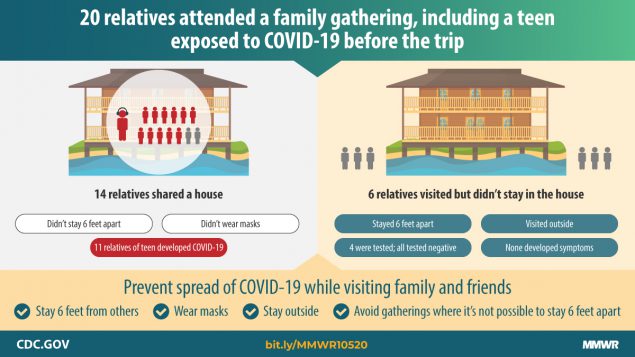
There is increasing evidence that children and adolescents can efficiently transmit SARS-CoV-2, the virus that causes coronavirus disease 2019 (COVID-19) (1–3). During July–August 2020, four state health departments and CDC investigated a COVID-19 outbreak that occurred during a 3-week family gathering of five households in which an adolescent aged 13 years was the index and suspected primary patient; 11 subsequent cases occurred.
Citation for this article: Schwartz NG, Moorman AC, Makaretz A, et al. Adolescent with COVID-19 as the Source of an Outbreak at a 3-Week Family Gathering — Four States, June–July 2020. MMWR Morb Mortal Wkly Rep. ePub: 5 October 2020. DOI: http://dx.doi.org/10.15585/mmwr.mm6940e2
Sorry folks but you probably need to rethink Thanksgiving this year.
“If you told me that somebody who was only testing, not wearing their mask, not distancing, and not taking every other precautionary measure tested positive,” said Saskia Popescu, a University of Arizona epidemiology professor and biodefense expert, “I would say: No shit, Sherlock.”
During August 2–September 5, 2020, weekly COVID-19 cases among persons aged 18–22 years increased 55% nationally. Increases were greatest in the Northeast (144%) and Midwest (123%). Increases in cases were not solely attributable to increased testing.
Citation: Salvatore PP, Sula E, Coyle JP, et al. Recent Increase in COVID-19 Cases Reported Among Adults Aged 18–22 Years — United States, May 31–September 5, 2020. MMWR Morb Mortal Wkly Rep. ePub: 29 September 2020. DOI: http://dx.doi.org/10.15585/mmwr.mm6939e4external icon




 lifeunderwriter.net
You must be logged in to post a comment.