The study, presented over the weekend at the American College of Cardiology’s annual scientific session together with the World Congress of Cardiology, found that a keto-like diet may be associated with higher levels of “bad” cholesterol and twice the risk of cardiovascular events such as chest pain, blocked arteries requiring stenting, heart attacks and strokes.
The research team analyzed data from the UK Biobank, a large-scale database with health information from over half a million people living in the United Kingdom who were followed for at least 10 years. Upon enrollment in the biobank, participants completed a self-reported diet questionnaire and had blood drawn to check their cholesterol levels.
“Among the participants on an LCHF diet, we found that those with the highest levels of LDL cholesterol were at the highest risk for a cardiovascular event,” Dr. Iatan said. “Our findings suggest that people who are considering going on an LCHF diet should be aware that doing so could lead to an increase in their levels of LDL cholesterol. Before starting this dietary pattern, they should consult a health care provider. While on the diet, it is recommended they have their cholesterol levels monitored and should try to address other risk factors for heart disease or stroke, such as diabetes, high blood pressure, physical inactivity and smoking.”
Popular keto diet may be linked to higher risk of heart disease, cardiac events — https://www.med.ubc.ca/news/popular-keto-diet-may-be-linked-to-higher-risk-of-heart-disease-cardiac-events/
Nutrition
2/3 Diet and Lifestyle, 1/3 Genetics
What can Okinawans tell us? Why does Ogimi and elsewhere on the island have a history of long life? That comes down to three main factors—diet, social practices, and genetics—explains Craig Willcox, a professor of public health and gerontology at Okinawa International University and a co-principal investigator of the Okinawa Centenarian Study, which has been investigating Okinawan longevity since 1975.“
About two-thirds of longevity is related to diet and way of life, the rest is genetics. Generally speaking, you need the genetic rocket booster if you want to get into the hundreds, not just a good diet,” Willcox says. “We haven’t looked into whether or not Okinawa has a genetic advantage over other parts of Japan, but longevity does run in families here.”
This island unlocked the secret to long life—and knows how to get through tough times — https://www.nationalgeographic.com/travel/article/uncover-the-secrets-of-longevity-in-this-japanese-village
Older Okinawans clinging to the islands’ traditionally healthful diet still boast the longest life expectancy in Japan, the country with the world’s longest-living people. But younger islanders, who grew up coveting the America they peeked at inside the bases here, began gobbling up hamburgers, fried chicken and pizzas as soon as their incomes permitted them to do so.
Urasoe Journal; On U.S. Fast Food, More Okinawans Grow Super-Sized — https://www.nytimes.com/2004/03/30/world/urasoe-journal-on-us-fast-food-more-okinawans-grow-super-sized.html
I need to go to the grocery store today.
- Sweet potatoes
- Bitter melon
- Seaweed
- Fish
Does Your Child Eat Fruit and Vegetables?
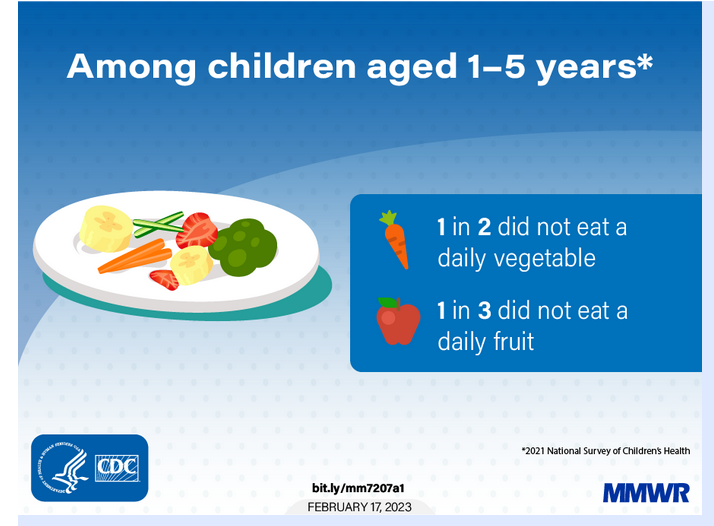
Hamner HC, Dooyema CA, Blanck HM, et al. Fruit, Vegetable, and Sugar-Sweetened Beverage Intake Among Young Children, by State — United States, 2021. MMWR Morb Mortal Wkly Rep 2023;72:165–170. DOI: http://dx.doi.org/10.15585/mmwr.mm7207a1.
Yikes!
Food Addiction

Addiction to Highly Processed Food Among Older Adults — https://www.healthyagingpoll.org/reports-more/report/addiction-highly-processed-food-among-older-adults
Read the press release here – https://ihpi.umich.edu/news/1-8-americans-over-50-show-signs-food-addiction-u-m-poll-finds
Read more about the Yale Food Addiction Scale here – https://sites.lsa.umich.edu/fastlab/yale-food-addiction-scale/

Step 1: I admit I am powerless over pizza.
The picture above is a normal size slice at Benny’s. The tall beer can was strictly in the picture to provide perspective. For more about Benny’s see https://garyskitchen.net/worship-the-whale/.
Do people change their eating habits after a diagnosis of cancer? A systematic review. — Journal of Human Nutrition and Dietetics Notes

The JHND Editor’s Pick for February 2022 is a systematic review by Amal Aldossari, Jana Sremanakova, Anne Marie Sowerbutts, Debra Jones, Mark Hann and Sorrel Burden. This is a very timely review of the evidence as the numbers of people who are now living with and beyond cancer is at a historic high. Whilst 1 in 2 adults […]
Do people change their eating habits after a diagnosis of cancer? A systematic review. — Journal of Human Nutrition and Dietetics Notes
Millions Suffer – Junk Food Industry Profits
Increased consumption of ultraprocessed foods (UPFs) was associated with more than 10% of all-cause premature, preventable deaths in Brazil in 2019. That is the finding of a new peer-reviewed study in the American Journal of Preventive Medicine.
Examples of UPFs are prepackaged soups, sauces, frozen pizza, ready-to-eat meals, hot dogs, sausages, sodas, ice cream, and store-bought cookies, cakes, candies and doughnuts.
UPFs have steadily replaced the consumption of traditional whole foods, such as rice and beans, in Brazil.
Millions Suffer as Junk Food Industry Rakes in Profit, by Colin Todhunter — STRAIGHT LINE LOGIC
Here is a link to the original study https://www.ajpmonline.org/article/S0749-3797(22)00429-9/fulltext
What is the Optimal Diet for the Prevention of Atherosclerotic Cardiovascular Disease? — The Skeptical Cardiologist

The skeptical cardiologist was asked to give a lecture in July on diet to the cardiology fellows in our training program at Saint Louis University. Needless to say, I didn’t hew to current recommendations from the American Heart Association or the Dietary Guidelines for Americans. For example, these recommendations are still promoting the narrative that…
What is the Optimal Diet for the Prevention of Atherosclerotic Cardiovascular Disease? — The Skeptical Cardiologist
Great lecture. Thank you Dr. Pearson.
Variation in cardiovascular disease risk factors among older adults in the Hunter Community Study cohort: A comparison of diet quality versus polygenic risk score — Journal of Human Nutrition and Dietetics Notes

The study of Reay and colleagues was an analysis of data from a subset (n=1703) of the Hunter Community Study cohort, comprising 3253 Australian men and women aged 55-85 at recruitment (between 2004 and 2007). Across the cohort there were 138 participants self-reporting that they suffered angina, 176 atrial fibrillation, 689 high cholesterol, 758 hypertension, 129 a heart attack and 164 an arterial bypass surgery. The CVD phenotypes data had a large number of missing data points (only 1678 subjects responding).
…the ARFS (Australian Recommended Food Score) data suggest that dietary quality was poor across the whole cohort. In the absence of a wide distribution of diet quality it is difficult to evaluate the relationship of diet with disease endpoints (i.e. without a lot of participants consuming a healthy diet it is impossible to detect the effects of a healthy diet on lipids and CVD outcomes)
Variation in cardiovascular disease risk factors among older adults in the Hunter Community Study cohort: A comparison of diet quality versus polygenic risk score — Journal of Human Nutrition and Dietetics Notes
Study shortcomings noted. I am still planning on stir fried veggies with brown rice and Thai sauce for dinner tonight despite not knowing my exact CVD genetic risk.

Dinner. (There’s a fried egg hiding on the bottom of the bowl).
Covid-19 and a Plant Based Diet
Okinawa, one of the blue zone regions, is highlighted due to its extreme longevity, plant-based diet, and now, the population’s resistance to COVID-19.
People in Okinawa, for example, consume a predominantly plant-based diet rich in phytochemicals and antioxidants… They also consume abundant green leafy vegetables and soy products, with minimal fat (about 6% of the total energy intake). In addition to their high life expectancy and low mortality from cardiovascular disease and certain types of cancers, Okinawans have enjoyed a remarkable resistance to COVID-19 mortality. As of June 16, 2021, the COVID-19 mortality in Okinawa, Japan, was 0.08% (163 deaths out of 19,782 cases), which is one-sixteenth that of Tokyo (mortality rate 1.3%; 2183 deaths out of 167,416 cases).
Can a Plant-Based Diet Mitigate the Risk of Severe COVID-19? — https://www.bluezones.com/2022/02/can-a-plant-based-diet-mitigate-the-risk-of-severe-covid-19/#
Journal Reference: Kahleova, H., Barnard, N.D. Can a plant-based diet help mitigate Covid-19?. Eur J Clin Nutr 76, 911–912 (2022). https://doi.org/10.1038/s41430-022-01082-w
The State of Obesity 2021

Nationally, 16 states now have adult obesity rates at or above 35 percent. Reaching the 35 percent or higher level this year were Delaware, Iowa, Ohio, and Texas. The twelve states that continue to have adult rates above 35 percent are: Alabama, Arkansas, Indiana, Kansas, Kentucky, Louisiana, Michigan, Mississippi, Oklahoma, South Carolina, Tennessee, and West Virginia. (See rates chart for data on all 50 states and the District of Columbia).
State of Obesity 2021: Better Policies for a Healthier America — https://www.tfah.org/report-details/state-of-obesity-2021/
In 2012, no state had an adult obesity rate above 35 percent.
In 2000, no state had an adult obesity rate above 25 percent.
The full report can be downloaded from the link above. My post on the 2020 report is here: The State of Obesity 2020
As a former 370 pound human my experience and knowledge can help those struggling with their weight.
Meanwhile work continues on my Future Best Seller.
 lifeunderwriter.net
You must be logged in to post a comment.