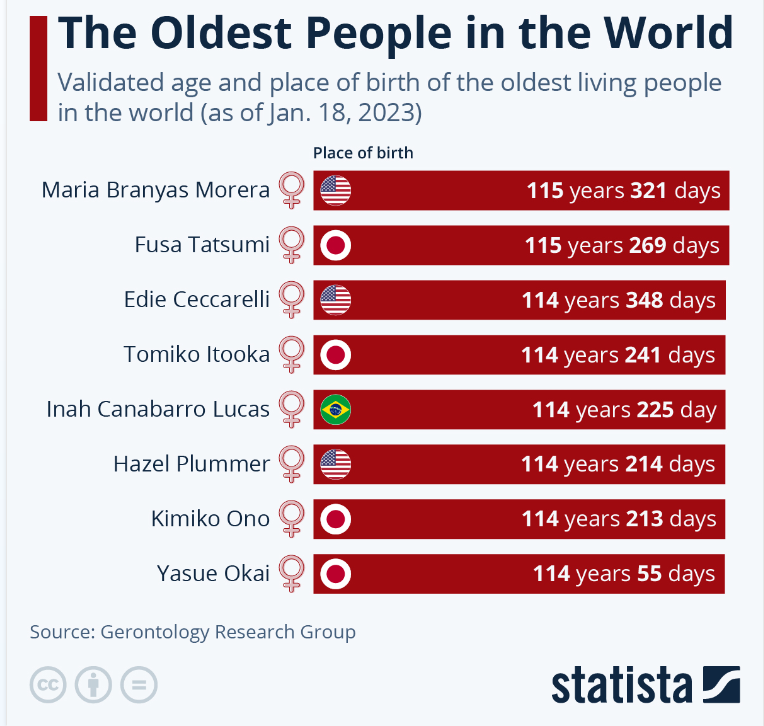
The Oldest People in the World — https://www.statista.com/chart/8978/the-oldest-people-on-earth/
The Oldest People in the World — https://www.statista.com/chart/8978/the-oldest-people-on-earth/
A study by Huang and colleagues is the first nationally representative cohort study examining the association between social isolation and incident dementia for older adults in community dwelling settings. A cohort of 5,022 older adults participating in the National Health and Aging Trends Study was followed from 2011 to 2020. When adjusting for demographic and health factors, including race, level of education, and number of chronic health conditions, socially isolated adults had a greater risk of developing dementia, compared with adults who were not socially isolated (hazard ratio, 1.27; 95% CI, 1.08 – 1.49). Potential mechanisms to explain this association include the increased risk of cardiovascular disease and depression in older adults who are socially isolated, thereby increasing dementia risk.
Mengru Wang. Geriatrician Advises on Use of Vitamin D Supplementation, Lecanemab, and Social Media for Her Patients – Medscape – Jan 20, 2023 — https://www.medscape.com/viewarticle/987285?src=rss#vp_2
One week ago we had our older adult friends over for dinner. Midweek my wife went out with her friends while I gathered with my friends. Last night was date night and we got out of the house. This evening we’re having dinner at a friend’s house.
Dementia risk reduction activities!
There is no mystery to controlling inflation. You just have to stop spending money you don’t have…stop lending out money at interest rates below inflation…and stop ‘printing’ up extra money to cover the holes in your budget. Instead, most governments continue to spend and print. Inflation is on the rise almost everywhere. And for the first time in modern history, much of the entire world’s middle class – the people who make the world work – is facing a grim period of higher inflation and lower real standards of living.
Three Strikes, You’re Out! More on the government’s middle class massacre – Bonner Private Research https://bonnerprivateresearch.substack.com/p/three-strikes-youre-out

But wait…it’s worse in North America.

I’m just thankful I haven’t retired yet.
The Administration for Community Living (ACL) has published its profile of older Americans 2021, an annual summary of critical statistics related to the older population. The updated report shows an older population that’s increasing in size and diversity.
The older population is growing and becoming more diverse — https://healthjournalism.org/blog/2022/12/the-older-population-is-growing-and-becoming-more-diverse/

And in case you’re thinking none of this matters because you are still young…
We found that midlife, generally considered to encompass the ages of 40 to 65, has become a time of crisis…the midlife crisis experienced by most people is subtler, more nuanced and rarely discussed among family and friends. It can be best described as the “big squeeze” – a period during which middle-aged adults are increasingly confronted with the impossible choice of deciding how to split their time and money between themselves, their parents and their kids.
The real midlife crisis confronting many Americans — https://theconversation.com/the-real-midlife-crisis-confronting-many-americans-114347
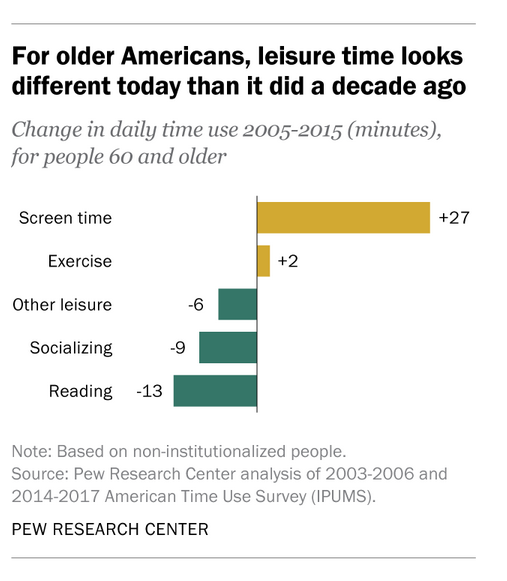
Due to the holiday, travel, and entertaining I’ve been spending less time in front of my screens.
Well, time to get back to my normal screen time habit.
Skin examination reveals a dark pigmented irregular lesion R anterior shin. Noticed for the first time after a morning of yard work. Previous dermatology history includes a large Becker’s nevus L scapula, several small hematomas, multiple mocha colored age spots and solar keratoses. Patient has never consulted Dermatology and has never been followed medically for his Becker’s nevus. No family history of skin cancers.

Previous studies on aging have found that how people thought about themselves at age 50 predicted a wide range of future health outcomes up to 40 years later — cardiovascular events, memory, balance, will to live, hospitalizations; even mortality.”Previous research has shown that people who have positive views of aging at 50 live 7.5 years longer, on average, than people who don’t,” said Karen Hooker, co-author of the study and the Jo Anne Leonard Petersen Endowed Chair in Gerontology and Family Studies at OSU.
Oregon State University. “‘Aging well’ greatly affected by hopes and fears for later life.” ScienceDaily. http://www.sciencedaily.com/releases/2021/01/210121150929.htm (accessed January 23, 2021).
Journal Reference – Shelbie G. Turner, Karen Hooker. Are Thoughts About the Future Associated With Perceptions in the Present?: Optimism, Possible Selves, and Self-Perceptions of Aging. The International Journal of Aging and Human Development, 2020; 009141502098188 DOI: 10.1177/0091415020981883

Our 1-year RCT indicated that a lifestyle intervention program can be highly successful in older adults with diabetes and chronic comorbidities. In this specific population, lifestyle intervention not only improved glycemic control associated with improved insulin action and secretion but also improved age-relevant outcomes such as body composition, physical function, and quality of life.
Alessandra Celli, Yoann Barnouin, Bryan Jiang, Dean Blevins, Georgia Colleluori, Sanjay Mediwala, Reina Armamento-Villareal, Clifford Qualls, Dennis T. Villareal; Lifestyle Intervention Strategy to Treat Diabetes in Older Adults: A Randomized Controlled Trial. Diabetes Care 1 September 2022; 45 (9): 1943–1952. https://doi.org/10.2337/dc22-0338
From the periods 1988–1994 to 2017 to March 2020, there was an increase in the prevalence of diagnosed diabetes (from 4.6% to 11.7%), but no change in prevalence of persistent undiagnosed diabetes (from 2.23% to 2.53%) or confirmed undiagnosed diabetes (from 1.10% to 1.23%). Consequently, the proportion of all undiagnosed diabetes cases declined from 32.8% to 17.8% (persistent undiagnosed diabetes) and from 19.3% to 9.5% (confirmed undiagnosed diabetes). Undiagnosed diabetes was more prevalent in older and obese adults, racial/ethnic minorities, and those without health care access. Among persons with diabetes, Asian Americans and those without health care access had the highest proportion of undiagnosed cases, with rates ranging from 23% to 61%.
Michael Fang, Dan Wang, Josef Coresh, Elizabeth Selvin; Undiagnosed Diabetes in U.S. Adults: Prevalence and Trends. Diabetes Care 1 September 2022; 45 (9): 1994–2002. https://doi.org/10.2337/dc22-0242
Remember, Stay as Thin as You Can as Long as You Can.

The study of Reay and colleagues was an analysis of data from a subset (n=1703) of the Hunter Community Study cohort, comprising 3253 Australian men and women aged 55-85 at recruitment (between 2004 and 2007). Across the cohort there were 138 participants self-reporting that they suffered angina, 176 atrial fibrillation, 689 high cholesterol, 758 hypertension, 129 a heart attack and 164 an arterial bypass surgery. The CVD phenotypes data had a large number of missing data points (only 1678 subjects responding).
…the ARFS (Australian Recommended Food Score) data suggest that dietary quality was poor across the whole cohort. In the absence of a wide distribution of diet quality it is difficult to evaluate the relationship of diet with disease endpoints (i.e. without a lot of participants consuming a healthy diet it is impossible to detect the effects of a healthy diet on lipids and CVD outcomes)
Variation in cardiovascular disease risk factors among older adults in the Hunter Community Study cohort: A comparison of diet quality versus polygenic risk score — Journal of Human Nutrition and Dietetics Notes
Study shortcomings noted. I am still planning on stir fried veggies with brown rice and Thai sauce for dinner tonight despite not knowing my exact CVD genetic risk.

Dinner. (There’s a fried egg hiding on the bottom of the bowl).
Retirement is more than a transition in our relationship with money. It is a major shift in our sense of self. The work that has defined our lives for decades begins to fade from view. Everything about life is different after retirement, down to the minute details of the daily routine. I think it is important to ask yourself, who am I without my job, without my career? And more importantly, how will I spend my time? How will I spend my days, weeks, months, seasons, and years once the routine ends? These are vital questions for anyone contemplating retirement. For many, the allure of endless days on the beach or in the garden loses its luster quite fast. The risk of becoming bored is a real and unexpected risk that many retirees face.
https://blairbellecurve.com/the-biggest-life-event-that-no-one-talks-about/
The endless string of triple digit days has finally ended. I’m so thankful that it’s not Too Hot to Blog and the writing is free and effortless once again. I’m still thinking strategy because having A Plan is Not a Strategy – Update 08.03.22. Yet time and time again the question begs an answer. How will I spend my time in retirement?
As long as I continue working the question doesn’t require an answer.
I guess I’ll keep working.
The discomfort of loneliness eases with time. You come to accept solitude like a cracked tile in a corner of the bathroom floor. Eventually, you just stop noticing the defect. For older people, however, one crack could easily, quietly, lead to more. Living in isolation, for people over 50, can spur a 50 percent increased risk of dementia, according to the CDC, and a 32 percent increased risk of stroke. Loneliness is also associated with higher rates of anxiety, depression, and suicide. Prolonged isolation is the equivalent to smoking 15 cigarettes a day. (And older members of marginalized communities are at an even higher risk for all of the above when they’re socially secluded.) In the years since my mom lost her husband and her friends in Florida, her health declined and her shine dimmed. The woman who owns more makeup than Dolly Parton — including Stila compacts from the early aughts she audaciously calls “my vintage cosmetics” — stopped putting on her face.
My Mom Has No Friends — https://www.thecut.com/2022/08/helping-my-mom-make-friends.html
A beautifully written article. I hope you choose to read the entire piece.
 lifeunderwriter.net
You must be logged in to post a comment.