Social Media
My YouTube Algorithm Advertisements

I am not very handy.

The algorithm thinks I need an electric vehicle. But just in case the target doesn’t want to spend that much…

How about a cheap cruise?

Or a cheap Tiny Home?

New bathtub?

AND my favorite ad…

Seriously???
Scary Charts – 01.19.24

Counsellor Hilarie Cash, the co-founder of reSTART Life, a residential treatment center for tech addiction, told The Epoch Times that screen use is classified as problematic when it starts eating into time necessary for normal human functioning…
Ms. Cash, whose program to treat people struggling with addiction to internet pornography and video games began in the 1990s, has observed a worrying trend. While her earlier clients also experienced major upheaval due to their screen addictions, they had sufficient life skills. In contrast, many of her clients today lack necessary life skills, such as knowing how to cook, maintain personal hygiene, hold down a conversation, make meaningful relationships, keep a job, etc. These people are more challenging to treat.
The Silent Epidemic Eating Away Americans’ Minds — https://www.theepochtimes.com/health/the-silent-epidemic-eating-away-americans-minds-5560857
I see this every day. People cannot drive a car responsibly, process a restaurant meal order correctly, make the correct change when presented with cash not credit, and cannot tell you what time it is unless the clock has a digital readout.
We. Are. Doomed.
Scary Charts 12.26.23 Revised
A very astute reader asked a very simple question: Why is this scary? So I went back and looked at my post. I thought I had completed the post but obviously not. The chart lacked context. So here’s the rest of the post I thought I posted. Welcome to my Senior Moment.

The relatively high labor force participation of Boomers may be beneficial both to them and the wider economy. Some retirement experts emphasize working longer as the key to a secure retirement, in part because the generosity of monthly Social Security benefits increases with each year claiming is postponed. For the economy as a whole, economic growth in part depends on labor force growth, and the Boomers staying in the work force bolsters the latter.
Baby Boomers are staying in the labor force at rates not seen in generations for people their age — https://www.pewresearch.org/short-reads/2019/07/24/baby-boomers-us-labor-force/
What I forgot to include in the post now follows.
After finishing and posting Even More Random Thoughts on Retirement – November 2023 something kept bugging me. So I thought about this for a while and uncovered what was bugging me. The following quote bugged me:
To ease the anxiety of retirement, consider delaying Social Security to get a larger monthly check and perhaps also purchasing immediate fixed annuities. I plan to do both.
What We Lose — https://humbledollar.com/2023/08/what-we-lose
Specifically the part of the quote in bold bugged me. I thought to myself, nice plan. But how many people can afford to buy an immediate fixed annuity? I can’t. How many people actually defer Social Security until age 70 to maximize their monthly payments?
Well, get ready for the ugly. It’s Scary Chart time.

Answer: 4%
Why just 4%?

Answer: 97% of people who retired sooner than planned did so due to health and employment issues.
Source: https://www.transamericacenter.org/retirement-research/23rd-annual-retirement-survey
Some retirees get fabulous bull markets right when they leave the working world while some retire into the teeth of a bear market.
How The Market Shapes Your Portfolio — https://awealthofcommonsense.com/2023/11/how-your-market-shapes-your-portfolio/
And some retirees will leave the working world straight into a world of high inflation.
Just beyond the guests and beyond the hornbeam trees where I’ve strung fairy lights for the party, I think I can see my future. The grind of work is finally over, my retirement dream cued up. April in Paris! Reading by the sea! Spanish lessons in Antigua so I can better speak to my grandson. I’ll be playing with him, too, in the open-ended days my children rarely knew with me. I’m not saying I deserve a life of ease. But I worked hard to earn my retirement, dropping giant chunks of my salary into company and government pension plans throughout those forty years. It’s time for the famous social contract to hold up its end of the bargain and take care of me, the way it did my father before me, to deliver on the idea that retirement is my right after a life of work and the promise that I will have the time and means to enjoy it.
Except none of that happened. The year since my retirement party has not been a dreamy passage to a welcoming future but a nerve-shattering trip into the unknown. My debt is swelling like a broken ankle; my hard-won savings may or may not be sucked into the vortex of an international market collapse. Can I keep my house? Who knows? The macro-economy is messing with my micro-economy. The future keeps shape-shifting. And none of the careful planning I put into my retirement is going to change that.
The End of Retirement — https://thewalrus.ca/the-end-of-retirement/
So beware of statistics. The reason why more Baby Boomers are working is because they have to.
Thank you Ol Red Hair.
The Dark Side of TikTok – Scary Charts 11.19.23

In just three years, the share of U.S. adults who say they regularly get news from TikTok has more than quadrupled, from 3% in 2020 to 14% in 2023.
More Americans are getting news on TikTok, bucking the trend seen on most other social media sites — https://www.pewresearch.org/short-reads/2023/11/15/more-americans-are-getting-news-on-tiktok-bucking-the-trend-seen-on-most-other-social-media-sites/
While TikTok is an engaging entertainment and social connection platform, there are better sources for in-depth personal financial advice. Many finance content creators sell the allure of quick wealth and success, leading neophyte investors to risky decisions that may have lasting consequences.
TikTok Personal Financial Advice Not To Take —https://due.com/tiktok-personal-financial-advice-not-to-take/
This will not end well.
The Dark Side of TikTok – Financial Advice?
The TikToker touting “generational wealth” isn’t alone in promoting the benefits of slapping a child’s name onto credit card debts. TikTok is flooded with influencers who insist that authorizing minors to use their parents or older relatives’ credit cards will set them up for a bright future.
Many of the videos uploaded to the platform are captioned with the hashtag #generationalwealth and suggest that the authorized credit card user trick is a secret hack used by the wealthy.
‘Generational wealth’ influencers are touting the benefits of parents adding their kids to credit card debt—but experts warn it could go badly wrong — https://fortune.com/2023/10/21/building-generational-wealth-parents-children-credit-card-debt/
Parents, don’t do this. TikTok should not be your source for financial advice.
Instead teach your children to save and invest, to live within their means, to understand the difference between needs and wants, to not become an indentured servant to the banking industry.
The Dark Side of Tik Tok – Soak Your Eyeballs in Castor Oil
Some people on TikTok have been telling you to rub castor oil around and potentially into your eyes, even though it’s approved by the Food and Drug Administration (FDA) as a laxative and not as an eye remedy. TikTokers have been claiming that castor oil can help treat all sorts of eye problems ranging from eye dryness to floaters to cataracts to poor vision to glaucoma.
TikTokers Push Castor Oil As An Eye Remedy, Here Are The Problems — https://www.forbes.com/sites/brucelee/2023/08/12/tiktokers-push-castor-oil-as-an-eye-remedy-here-are-the-problems/?sh=1111bfa485ce
Natural selection at its finest. And we thought drinking detergent was bad. The Dark Side of Tik Tok – Updated
The Dark Side of Tik Tok – Updated

In the latest health fad to alarm and exasperate medical experts, people on TikTok have cheerily “hopped on the borax train” and are drinking and soaking in the toxic cleaning product based on false claims that it can reduce inflammation, treat arthritis, and “detoxify” the body.
Borax is the new Tide Pods, and poison control experts are facepalming — https://arstechnica.com/health/2023/07/borax-is-the-new-tide-pods-and-poison-control-experts-are-facepalming/?comments=1&comments-page=1
Natural selection at its finest.
Good article on Vox. Why TikTokers are drinking laundry detergent https://www.vox.com/technology/2023/7/29/23811639/tiktok-borax-challenge-dangerous-laundry-detergent
SARMs (Selective Androgen Receptor Modulators)
SARMs, which are chemical substances that mimic the effects of testosterone and anabolic steroids, are not FDA approved. Online vendors and social media influencers are using social media to make SARMs seem safe and effective.
The reality is SARMs are potentially dangerous. The FDA continues to receive adverse event reports associated with SARMS use. The real number of consumers experiencing adverse events is likely higher due to underreporting. Because these are not approved drugs, consumers may be reluctant to report adverse events or may not be aware that they can report adverse events that they experience. In addition, they might not know that their symptoms are being caused by the product.
Studies and reports show SARMs are associated with serious or life-threatening health problems, such as:
FDA Warns of Use of Selective Androgen Receptor Modulators (SARMs) Among Teens, Young Adults — https://www.fda.gov/consumers/consumer-updates/fda-warns-use-selective-androgen-receptor-modulators-sarms-among-teens-young-adults
- Increased risk of heart attack or stroke
- Psychosis/hallucinations
- Sleep disturbances
- Sexual dysfunction
- Liver injury and acute liver failure
- Infertility
- Pregnancy miscarriage
- Testicular shrinkage
If you’ve read this far, congratulations. Now spread the word.
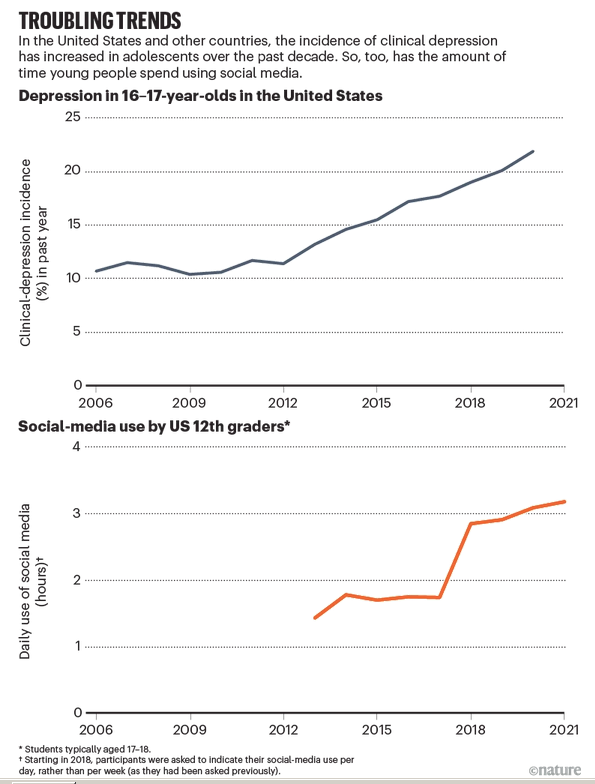
Troubling Trends
Early adolescence is characterized by wide-reaching hormonal changes, as well as physiological changes throughout the body. At the same time, all sorts of neural, cognitive and social shifts are happening. These changes could make social-media environments, such as those provided by Snapchat or TikTok, particularly alluring, but also especially impactful on mental health9–11. Several developmental-psychology studies have shown, for instance, that adolescents — particularly those in early to mid-adolescence — place increased importance on being able to interact with their peers, and on what their peers think of them12. Other studies suggest that although young children tend to view themselves positively, as they become adolescents, their ideas about themselves come to more closely align with what they perceive others to think of them13,14. Still more work has shown that being rejected or not being included has a greater impact on mood for those in early to mid-adolescence than for people older than 2515.
How social media affects teen mental health: a missing link — Nature 614, 410-412 (2023) — https://www.nature.com/articles/d41586-023-00402-9
I Thought I Told You To Put That Phone Down!
If I have to tell you one more time to Put The Phone Away…
Yikes!
 lifeunderwriter.net
You must be logged in to post a comment.