Drawing on a nationally representative survey of 1,591 U.S. adults ages 22–75, this research uncovers a five-year difference between when current retirees, on average, actually left the workforce (age 57) and when future retirees expect to retire (age 62), with half of those planning to retire anticipating they’ll need to delay even further. Future retirees are shifting away from traditional income sources like Social Security and pensions, planning instead to rely more heavily on personal savings and continued employment. Career interruptions remain a significant but underappreciated threat to retirement security, as half of U.S. adults have left the workforce for more than a year.
The entire study Bridging retirement expectation gaps New evidence and insights can be downloaded here:
Colorectal cancer (CRC) is a leading cause of cancer-related mortality worldwide.
In this retrospective, population-based, descriptive cohort study, organized FIT-based screening was associated with a sustained decline in CRC mortality, particularly among individuals aged 50 to 69 years. Colorectal Cancer Mortality Following an Organized Fecal Immunochemical Test–Based Screening Program – https://jamanetwork.com/journals/jamanetworkopen/fullarticle/2852451
Beyond their versatility, tiny homes typically have multifunctional furniture, including fold-down tables, convertible sofas, and Murphy beds. Because of the small space, tiny homes are commonly built vertically, with sleeping areas accessible by built-in ladders or stairs.
The verticality is definitely not senior friendly. Where’s the bathroom? But despite the obvious disadvantages for a person of my vintage, serious downsizing remains highly attractive. All I’m trying to do is make our retirement income last as long as we last. Hon, what do you think?
In this prospective cohort study, resistance training among US adult health care professionals was associated with substantially lower T2D risk, particularly when performed consistently over midlife and combined with adequate aerobic activity and limited sedentary television viewing. These findings support the inclusion of resistance training as a key component of lifestyle recommendations for diabetes prevention. Long-Term Resistance Training and Risk of Type 2 Diabetes – https://jamanetwork.com/journals/jamanetworkopen/fullarticle/2850563
This is another post in the never ending series of random thoughts on retirement. For the curious, here’s a link to my previous posts full of random thoughts (brain droppings): https://lifeunderwriter.net/tag/retirement/.
I am writing this on Father’s Day, the fourth day of a four day weekend and I’m ready to go back to work. It’s tough being an Old Guy who is old enough to be retired but isn’t retired and still working. Some days I wonder why I’m not retired. I guess this is all part of my living a longer healthier life strategy.
Social connection, prosociality, spirituality, optimism, and work—growing evidence suggests these five factors can play an important role in improving the well-being of people and communities…Work is one of the most important—and neglected—social determinants of health, according to Lisa Berkman, Thomas D. Cabot Professor of Public Policy and of Epidemiology at Harvard Chan School and director of the Harvard Center for Population and Development Studies. “Work drives income, social ties, and the opportunity for meaningful participation in society,” she said. “As such, it also shapes both our cognitive and physical health in many different ways.” The importance of connections: Ways to live a longer, healthier life – https://hsph.harvard.edu/news/the-importance-of-connections-ways-to-live-a-longer-healthier-life/
The optimism factor is interesting.
“The findings are remarkably consistent,” she said. “Across different racial and ethnic populations, we have seen that people who are more optimistic are more likely to age in good health and less likely to suffer from chronic diseases, physical illness, or cognitive impairments in old age. Optimists are also more likely to live exceptionally longer lives, beyond age 85 or more.”
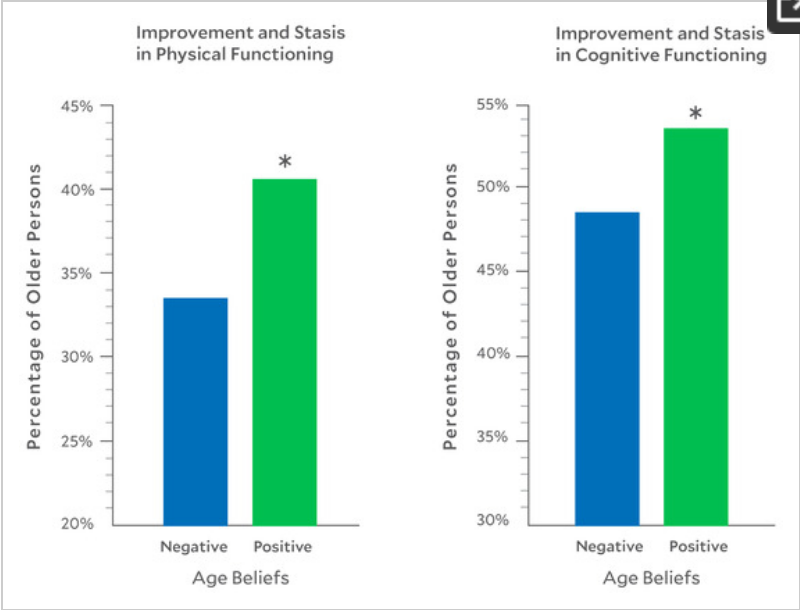
Aging Redefined: Cognitive and Physical Improvement with Positive Age Beliefs
Background/Objectives: A widespread assumption exists among scientists, health care providers, and the public that later life is a time of inevitable and universal cognitive and physical decline. This assumption is likely due to considering older persons who improve to be exceptions, and the reliance on aging-health measures that do not allow for improvement. In contrast, we utilized a measure that allowed for an upward trajectory to occur. Our objective was to examine whether a meaningful number of older persons improve with this measure and, if so, to examine whether a promising modifiable culture-based variable, positive age beliefs, contributes to this improvement. Methods: Individuals 65 years and older, who participated in a nationally representative longitudinal study, had their physical health assessed by walking speed and their cognitive health assessed by a global performance measure. We calculated the percentage of the sample that showed improvement in each domain from baseline to the last measurement up to 12 years later. We also examined whether a positive-age-belief measure predicted this improvement in regression models. Results: It was found that 45.15% of persons improved in cognitive and/or physical function over this period, and positive age beliefs predicted these two types of improvement, both with and without adjusting for relevant covariates. Conclusions: Our findings underscore the need to instill or magnify the positivity of age beliefs and to redefine aging so that it includes the possibility of improvement.
In sociology this phenomenon is known as a self-fulfilling prophecy.
The lesson is pretty straightforward. You’re going to go buy a business, and you’re going to look and say, “Where can I cut costs? How can I start to optimize and streamline this?” You can cut fat, but you definitely don’t want to cut muscle, and you don’t want to cut bone. That’s exactly what these guys did. Why did they do that? They’re private equity guys. They get paid on management fees and the deals when they turn around and put them out in the public. They don’t care about the long term. They care about the next three to five years, and that’s exactly what they optimized for.
Yes dear reader, yet another post in the never ending series of random thoughts on retirement. For the curious, here’s a link to some previous posts https://lifeunderwriter.net/tag/retirement/. I am an Old Guy who is old enough to be retired but isn’t retired and still working. After many mornings spent in deep contemplation and many posts where I think out loud I’ve finally accepted my fate and come to a deeper understanding of why I do what I do.
I’ve spent a lifetime working in risk management. Finally, the light bulb came on.
I am actively managing my longevity risk. It’s what I do. I manage risks.
The majority of our friends are retired. I’m always asked when I’m going to retire. My answer was always “Don’t know”. I subsequently modified my response to “Two to four years”. This has been my answer for the past two years. But now when someone asks when I will retire, my answer will be:
I am managing my longevity risk. I am managing future inflation risk.
Imagine you retire at 65, feeling confident. You’ve budgeted $80,000 a year to live comfortably — travel, dining out, covering healthcare, the works.
Fast-forward 25 years.
At age 85, you’re still spending about $80,000 a year … but that no longer buys what it used to.
That nice dinner out that cost $100 now costs about $210
A $5,000 annual vacation is now closer to $10,500
Groceries that ran $10,000 a year are now over $21,000
In other words, your $80,000 lifestyle now costs roughly $168,000 to maintain.
Ghilarducci is spot on with her assessment. My plan on working longer wasn’t really a plan so much as it was a set of assumptions. Everything had to go as “planned” or forget about working longer. The two major variables were continued good health and finding an employer that values older workers.
I got lucky. My illusion is working (pun intended).
The results, published in Annals of Internal Medicine, were based on 4,746 adults between ages 55 and 75. All had overweight or obesity and metabolic syndrome, but none had diabetes or cardiovascular disease at the start of the study. Researchers followed participants for six years to see whether a more intensive Mediterranean based lifestyle plan could offer stronger protection against type 2 diabetes than the traditional Mediterranean diet alone.
One group followed a calorie reduced Mediterranean diet (about 600 kcal fewer per day), added moderate physical activity (brisk walking, strength and balance training), and received professional guidance. The comparison group followed a traditional Mediterranean diet without calorie restriction or exercise advice.
The difference between the two approaches was striking. Participants in the intervention group were 31% less likely to develop type 2 diabetes than those in the comparison group. Universidad de Navarra. “Scientists found a smarter Mediterranean diet that slashes diabetes risk by 31%.” ScienceDaily. https://www.sciencedaily.com/releases/2026/05/260519003103.htm (accessed May 23, 2026).
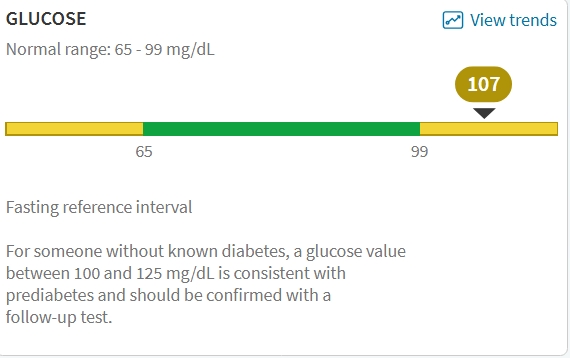
I just had my annual wellness check and got my lab results. All good except my fasting glucose.
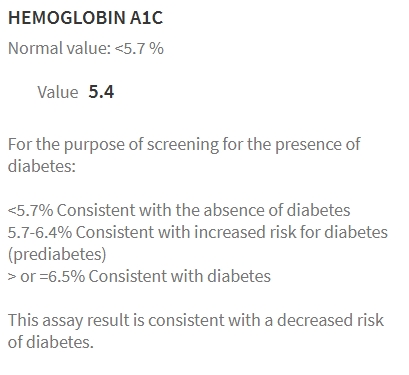
Yikes. Memo to Self, get an A1C. Well, the very next day…
Doc says:
CMP (Comprehensive Metabolic Panel): Your creatinine (a measure related to kidney function) is low, and your blood sugar (glucose) is high; all other values are normal. This test checks how your kidneys and liver are working, your body salts, proteins, and blood sugar. Low creatinine can happen in people with less muscle and may be expected. The slightly high fasting blood sugar could indicate early changes in how your body handles sugar. Options include repeating the blood sugar test next visit.
I know my diet could be better. I know I should eat less, snack less and maybe, just maybe stop drinking beer. But also knowing my IFG is worsening I wondered if there was a diet (besides MedDiet) for IFG?
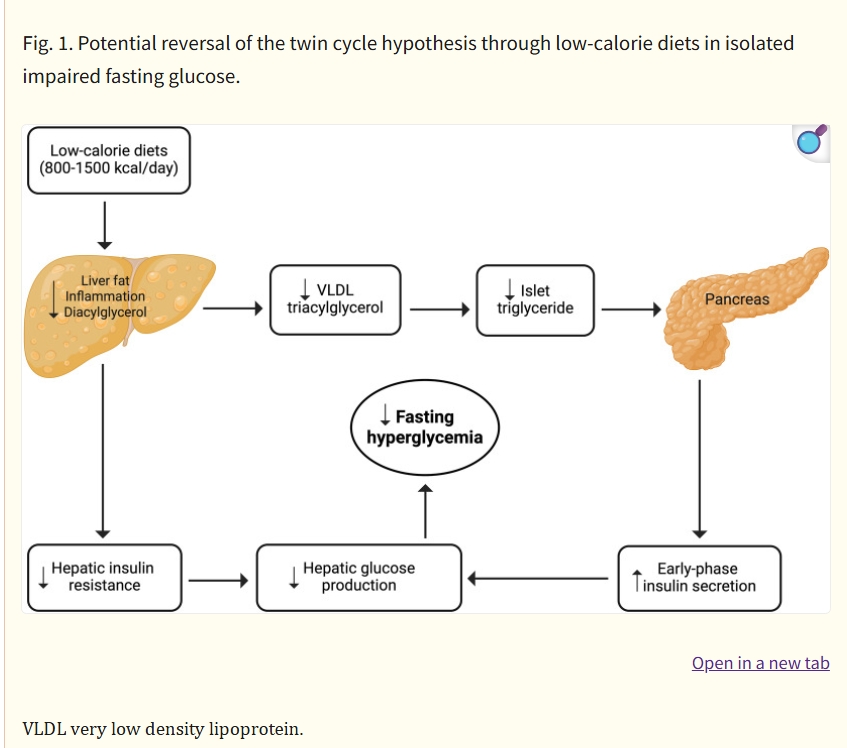
In recent years, low-calorie diets ranging from 800–1500 kcal/day have gained significant attention in managing type 2 diabetes8,16–19. Studies have shown that low-calorie diets can lead to remission and substantial improvements in cardiometabolic risk factors for a significant proportion of individuals with type 2 diabetes8,16–19. These diets are generally well-tolerated and safe, with only mild side effects reported. Table 1 summarizes the key low-calorie diet studies conducted in people with type 2 diabetes8,16–19. Studies implementing low-calorie diets over a 2–5 month period, primarily high in protein and low in fat, have resulted in a mean weight loss of 7–15 kg (8–15% of initial body weight). This level of weight loss was accompanied by a notable reduction in hepatic fat and improved hepatic insulin sensitivity and first-phase insulin secretion. As a result, fasting plasma glucose levels decreased significantly by 27.8 to 43.2 mg/dL. This suggests that low-calorie diets may also be effective for individuals with i-IFG, as they target the pathophysiological defects characterizing this prediabetes phenotype8,16–19. Figure 1 visually depicts the potential reversal of the twin cycle hypothesis through low-calorie diets in individuals with i-IFG. The twin cycle hypothesis20 postulates that chronic excess calorie intake results in increased accumulation of fat in the liver, leading to resistance against insulin’s suppression of hepatic glucose production. Additionally, excess liver fat increases lipid transportation to the pancreas, impairing β-cell function and further promoting hepatic glucose production. These self-reinforcing cycles between the liver and pancreas ultimately result in the onset of hyperglycemia.
Low-calorie diets for people with isolated impaired fasting glucose – Commun Med (Lond) . 2024 Mar 1;4:35. doi: 10.1038/s43856-024-00466-2
You can’t optimize everything. Mistakes will be made and are part of life. Sub-optimal for whatever you are chasing will be the end result because perfection is impossible.




You must be logged in to post a comment.