Reevaluating Retirement Plans due to Covid-19

COVID-19 Has Many Americans Reevaluating Retirement Plans

Roughly two in five Americans (38%) say the COVID-19 pandemic has impacted their retirement plans by having to retire later than planned, now not being able to retire at all or being forced into retirement. Plus, 41% are currently reevaluating their retirement plans to assess the financial impact of COVID-19. These are among the findings revealed by a new COVID-19 Tax Survey conducted online in May 2020 by The Harris Poll on behalf of The Nationwide Retirement Institute® among U.S. adults 18+.  Heightened uncertainty and complexity are driving a need for greater financial protection. Roughly half of Americans agree that the COVID-19 pandemic has made them recognize the need for annuities to protect their investments against market risk (47%) and to protect their retirement income (48%). More than half of all U.S. adults (57%) and investors (60%) also say the pandemic has made them recognize the need for life insurance.

More survey results can be found in the full article at the link above.

The heightened uncertainty and complexity have definitely affected my own retirement plans.

The massive number of people out of work have definitely affected my own thoughts and feelings about work.

Retirement = work.

As long as my health holds up and as long as there’s someone out there willing to pay me to do what I do I plan on working.
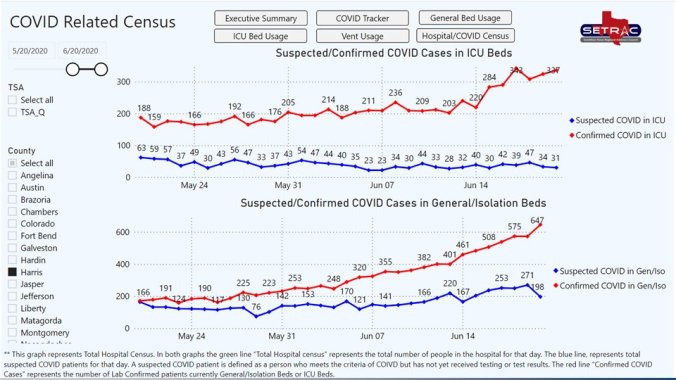
Worried About Houston

Texas is heading down a dangerous path, local leaders warn as coronavirus cases and hospitalizations surge

Dr. Peter Hotez, dean of the National School of Tropical Medicine at Baylor College of Medicine, predicted over the weekend that Houston is on the brink of a disaster, based on the latest trends in increasing numbers.  “My observations if this trajectory persists: 1) Houston would become the worst affected city in the US, maybe rival what we’re seeing now in Brazil 2) The masks = good 1st step but simply won’t be enough 3) We would need to proceed to red alert,” Hotez tweeted.

Houston Yikes 062320

Do not wait for a politician to tell you to:

  • Wear a mask.
  • Avoid crowds (especially younger non-mask wearing crowds where infections are spiking upwards).
  • Pay attention to your local Covid-19 statistics and act accordingly.  Limit your excursions to trips for essentials or shelter in place.
  • Practice physical (social) distancing.
  • Stock your pantry.


NEJM Journal Watch – 06.05.20

Prevalence of asymptomatic disease: An estimated 40–45% of people who test positive for SARS-CoV-2 do not have symptoms at the time of testing, according to a narrative review of 16 cohorts in the Annals of Internal Medicine. In four cohorts with longitudinal data, few of the asymptomatic patients (0–10%) went on to develop symptoms. But in one skilled nursing facility, 89% of initially asymptomatic patients became sick. The researchers say, “It is imperative that testing programs include those without symptoms.” They add, “The early data that we have assembled on the prevalence of asymptomatic SARS-CoV-2 infection suggest that this is a significant factor in the rapid progression of the COVID-19 pandemic.”

COVID-19: Asymptomatic Disease Prevalence / N95 Mask Reuse / Oxygen Management Strategies / Anti-Racism Demonstrations / Studies Retracted

Smoking cigarettes — even one or less per day — is associated with increased mortality risk, a JAMA Network Open study shows.  Researchers combined data from several federal smoking surveys performed between 1992 and 2011. In those surveys, some 500,000 adults reported their smoking histories. National mortality data showed that, compared with never-smokers, daily smokers (averaging 600 cigarettes per month) bore a 2.3-fold higher all-cause mortality risk, with non-daily smokers (averaging 40 per month) sustaining a 1.8-fold higher risk.  Heightened mortality risks became apparent even at levels of 6 to 10 cigarettes per month.  The researchers conclude: “Thus, all smokers should quit, regardless of how infrequently they smoke.”

Infrequent Smoking Carries Heightened Mortality Risk

How the USAF Limited Covid-19 Transmission

USAF Covid

Nonpharmaceutical interventions (NPI) introduced among 10,579 basic trainees at Joint Base San Antonio-Lackland limited COVID-19 incidence to five cases (47 per 100,000 persons), three of which were in persons who were contacts of the first patient.

Citation for this article: Marcus JE, Frankel DN, Pawlak MT, et al. COVID-19 Monitoring and Response Among U.S. Air Force Basic Military Trainees — Texas, March–April 2020. MMWR Morb Mortal Wkly Rep. ePub: 2 June 2020. DOI: http://dx.doi.org/10.15585/mmwr.mm6922e2external icon.

An Interview With Erin Bromage

For every extra body you take out of a room, you are lowering the risk that somebody infected is in there to start off with. Then assuming that someone in that environment is infected, there is a gradient of respiratory droplets from that person that radiates out. So, certainly, having people spread out more in enclosed environments is an important way to reduce infection, but it’s not the solution to controlling all infections. Having a restaurant at half capacity that is still enclosed and has no or very little air exchange is going to be just as risky, but to fewer people.

Memo to Self:

Add the concept of dose-time to your Covid-19 risk reduction strategy.

Add a link to the Medscape interview with Erin Bromage.

An Interview With Erin Bromage

Half of newly diagnosed coronavirus cases in Washington are in people under 40

Half of newly diagnosed coronavirus cases in Washington are in people under 40

cv-age-group-cases-W

Oops.

This shit is real and it is scary. COVID is taking patients down, and we do not know how to stop it. The images of overflowing EDs, overworked providers, patients who cannot breathe—these are real and it is happening. Do not let anyone tell you its not.

Rebecca Karb MD

This shit is real.  Don’t ever forget that.

More Drugs Please


According to Ginger, an organization that provides mental health services to companies, compared to January and February of this year, prescriptions for psychotropics, most of which were antidepressants, were up 86% for the months of March and April.

The stress of unemployment, social isolation and health concerns are all cited by Americans who say the lock down is having a serious impact on their mental health.

Pharmacy group Express Scripts also revealed that prescriptions for anti-anxiety medications were up 34.1% between mid-February and mid-March, while prescriptions for antidepressants increased 18.6%.

Link to the source article.

Wow.

House Hunters International (Pandemic Version) – Mexico

Citation: California Border Hospitals Hit by Surge in COVID-19 Cases From Mexico – Medscape – May 20, 2020.

Here’s the link:

California Border Hospitals Hit by Surge in COVID-19 Cases From Mexico

Here’s an excerpt:

Imperial County has registered fewer than 800 known coronavirus infections and just 15 deaths to date. Baja California, by comparison, has reported 3,458 confirmed COVID-19 cases and 134 deaths.  Two main medical centers in Baja’s state capital – Mexicali Hospital General and IMSS Regional Hospital 30 – are both “saturated” by the outbreak, Mario Cervantes, head of relief services for the Red Cross of Mexicali, told Reuters.  Some arriving ambulances have had to wait hours to deliver new patients, while others were turned away altogether, he said.  Baja health department officials said neither Mexicali hospital had exhausted its bed space, but Dr. Rafael Abril, president of the Mexicali College of Surgeons, told local news in April that half the IMSS hospital’s doctors were infected with COVID-19, which could lead to staffing shortages.

Coronavirus: Hamster Research shows Effectiveness of Masks

Coronavirus: hamster research shows effectiveness of masks ‘huge’

Hamsters placed in adjoining cages with infected subjects were infected at a 66.7 per cent rate; the introduction of a barrier saw the percentage drop to 16.7%.

The study, which the team called the first of its kind, found the rate of non-contact transmission – in which the virus was transmitted via respiratory droplets or airborne particles – dropped by as much as 75 per cent when masks were present.

“I know wearing masks will be difficult during the summer time. My advice is especially when you are in an indoor or closed environment where there’s no free air exchange, in crowded places or on public transport, you must wear a mask.”

img_1976