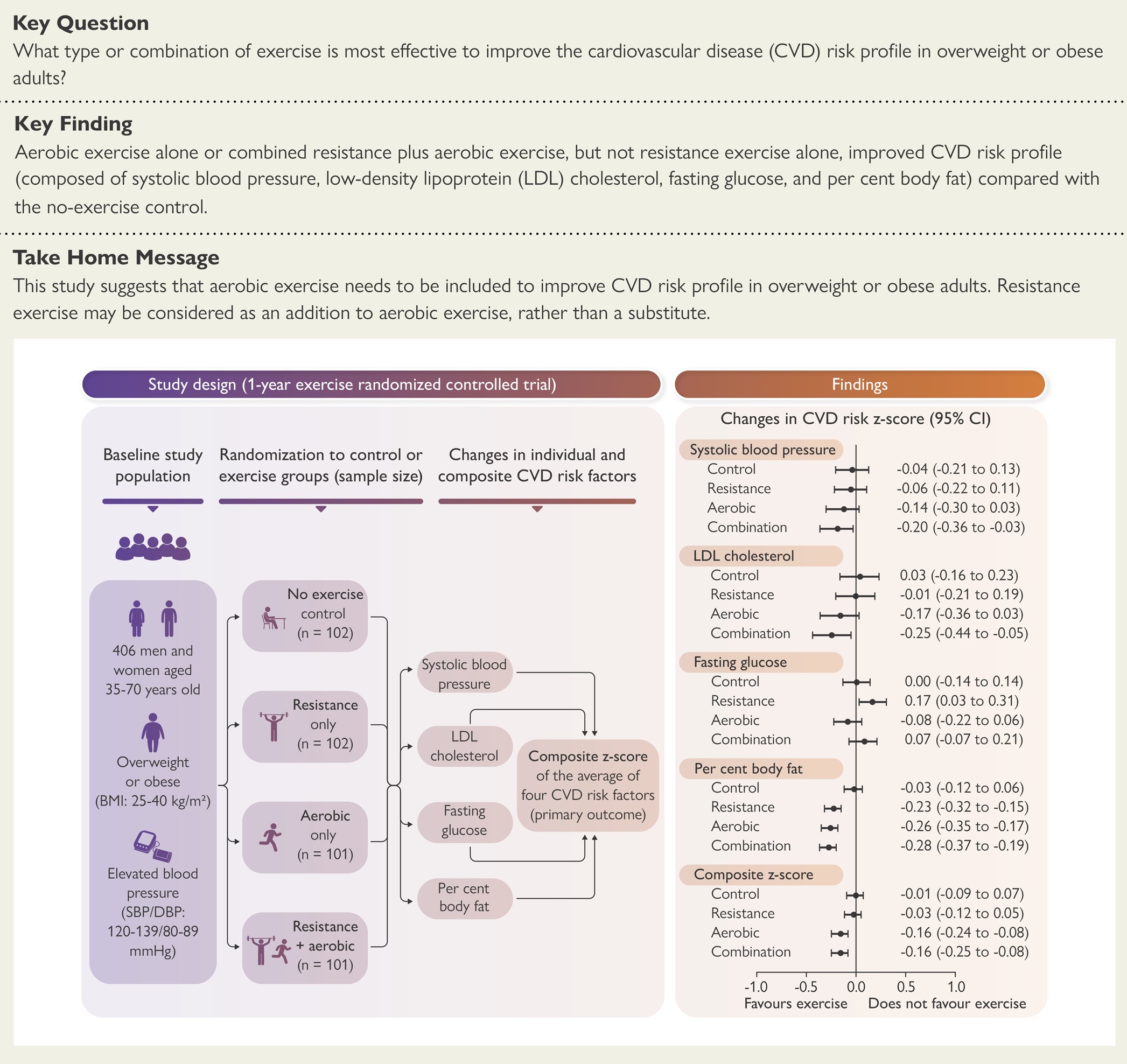
Conclusions: In adults with overweight or obesity, aerobic exercise alone or combined resistance plus aerobic exercise, but not resistance exercise alone, improved composite CVD risk profile compared with the control.
Aerobic, resistance, or combined exercise training and cardiovascular risk profile in overweight or obese adults: the CardioRACE trial – European Heart Journalhttps://doi.org/10.1093/eurheartj/ehad827
Effects of 1-year resistance, aerobic, or combined exercise training on cardiovascular disease (CVD) risk profile: the CardioRACE trial. Aerobic exercise alone or combined aerobic plus resistance exercise, but not resistance exercise alone, improved CVD risk profile (composite Z-score) compared with no-exercise control (Z-score values below 0 indicate favourable changes in CVD risk factors). BMI, body mass index; CI, confidence interval; CVD, cardiovascular disease; DBP, diastolic blood pressure; SBP, systolic blood pressure.
Of the total participants, 47 percent reported having had COVID-19 infection. The omnivorous group had a significantly higher incidence of infection (52 percent vs. 40 percent) and were more likely to experience moderate to severe symptoms (18 percent vs. 11 percent).
After adjusting for influential factors such as weight, pre-existing medical conditions, and physical activity levels, there was no overall difference in symptom severity between the groups. However, those following predominantly plant-based or vegetarian diets were 39-percent less likely to become infected than their omnivorous counterparts.
The researchers suggest that plant-based diets may contribute to a boosted immune system and better defense against viral infections due to their richness in antioxidants, phytosterols, and polyphenols.
A very astute reader asked a very simple question: Why is this scary? So I went back and looked at my post. I thought I had completed the post but obviously not. The chart lacked context. So here’s the rest of the post I thought I posted. Welcome to my Senior Moment.
The relatively high labor force participation of Boomers may be beneficial both to them and the wider economy. Some retirement experts emphasize working longer as the key to a secure retirement, in part because the generosity of monthly Social Security benefits increases with each year claiming is postponed. For the economy as a whole, economic growth in part depends on labor force growth, and the Boomers staying in the work force bolsters the latter.
To ease the anxiety of retirement, consider delaying Social Security to get a larger monthly check and perhaps also purchasing immediate fixed annuities. I plan to do both.
Specifically the part of the quote in bold bugged me. I thought to myself, nice plan. But how many people can afford to buy an immediate fixed annuity? I can’t. How many people actually defer Social Security until age 70 to maximize their monthly payments?
Well, get ready for the ugly. It’s Scary Chart time.
Answer: 4%
Why just 4%?
Answer: 97% of people who retired sooner than planned did so due to health and employment issues.
And some retirees will leave the working world straight into a world of high inflation.
Just beyond the guests and beyond the hornbeam trees where I’ve strung fairy lights for the party, I think I can see my future. The grind of work is finally over, my retirement dream cued up. April in Paris! Reading by the sea! Spanish lessons in Antigua so I can better speak to my grandson. I’ll be playing with him, too, in the open-ended days my children rarely knew with me. I’m not saying I deserve a life of ease. But I worked hard to earn my retirement, dropping giant chunks of my salary into company and government pension plans throughout those forty years. It’s time for the famous social contract to hold up its end of the bargain and take care of me, the way it did my father before me, to deliver on the idea that retirement is my right after a life of work and the promise that I will have the time and means to enjoy it.
Except none of that happened. The year since my retirement party has not been a dreamy passage to a welcoming future but a nerve-shattering trip into the unknown. My debt is swelling like a broken ankle; my hard-won savings may or may not be sucked into the vortex of an international market collapse. Can I keep my house? Who knows? The macro-economy is messing with my micro-economy. The future keeps shape-shifting. And none of the careful planning I put into my retirement is going to change that.
Let’s be honest, some people in academia are horrible, arrogant, selfish and narcissistic. And no matter how much the people at the top say they deal with bad behaviour, the nasty folk do have an annoying habit of getting promoted. The way in which academia selects and rewards particular skill sets produces an over-concentration of people who are low on empathy. I’ve met a lot of those ‘special’ colleagues over the years (no names mentioned obviously). I will not miss them one jot. They create a toxic working environment , dominate the discourse, ride roughshod over the rules, and cause a great deal of harm to others and get away scot-free. They’ve done me significant mental damage, but I can now happily forget them and move on with life.
My recommendation to anyone starting out in academia is stand your ground, challenge these energy vampires and politely make it clear that you don’t want to play their stupid toxic games. They really don’t have the power that they want you to believe they have, even though the system tends to promote them to roles that are beyond their emotional competence to fulfill. Pity them for the lack of other things to do with their lives. And, remember that 98% of what we do as academics is of no importance at all out there in the real world, so when a self-entitled colleague insists that their work on their favourite gene is earth-shattering; more important than anything you could ever do; and a good reason for their career to be advanced faster than yours; just smile and ignore them. Do your own thing, at your own pace. Have a life outside the university and remember that it’s just a job.
Retirement blues are “a dirty secret,” says Robert Delamontagne, PhD, author of The Retiring Mind. He had to go through his own adjustment when he retired in 2007. He says people are reluctant to talk openly about those struggles because it’s embarrassing. “People would ask me, ‘How’s retirement?’ I used to say, ‘It’s great! I’m having a great time!’ What was I supposed to say?” Once the newness wears off, you may start to question your new situation. “Will my money last?” “Will my health hold up?” “Am I being useful, or am I going to just play bridge and golf for the rest of my life?”
The strategy has achieved clarity. The Plan is a 3-5 year time-frame. The objective is to continue full time paid work then pursue part time paid work til death do us part. As a younger man I never envisioned this to be my desired life in retirement. But here we are.
Time is the most valuable asset I’m sacrificing for this strategy. Time to do whatever I please, whenever I like. Personal projects like my future best seller The Man Who Had No Hobbies will have a completion date further into the future. But the tradeoffs for me are worth it. Many times I’ve asked retired people how’s retirement? Too many times the answer is “I’m bored”. When you are younger, working your ass off, building a career, raising a family, the thought of retirement is seductive. The reality of retirement is different and nothing you could have imagined in your younger life.
No one talks about what we lose when we retire. Well, no one except Jonathan Clements the founder and editor of https://humbledollar.com/ Here’s his list:
Income
Identity
Purpose
Structure
Community
Relevance
Power
Income. This is the most obvious loss, we all know it’s coming—and yet many folks are left anxious by the disappearance of their paycheck, even if they have ample savings. Moreover, with that paycheck gone, not only do we lose the ability to save, but also our financial life goes into reverse, with savings coming out of our nest egg instead of going in.
Given that, it’s hardly surprising that studies suggest retirees tend to be happier when they have ample predictable income, such as from a pension. Don’t have a pension? To ease the anxiety of retirement, consider delaying Social Security to get a larger monthly check and perhaps also purchasing immediate fixed annuities. I plan to do both.
Read the full article at the link above. Especially if you are nearing retirement.
Well, that’s enough thinking about retirement for a Saturday morning. I have to mow the shade grass The Boss over seeded in the backyard. There’s college football today. I also need to get ready for dinner company tonight.
One of the most important parts of exercise programming, no matter who I am working with, is proper resistance training to build muscle strength. Some amount of age-related loss of muscle function is normal and inevitable. But by incorporating resistance training that is appropriate and safe at any ability level, you can slow down the rate of decline and even prevent some loss of muscle function.
In one of our team’s previous studies, we saw that otherwise healthy individuals with sarcopenia had issues delivering vital nutrients to muscle. This could lead to greater likelihood of various diseases, such as Type 2 diabetes, and slow down recovery from exercise.
Recent estimates suggest that sarcopenia affects 10% to 16% of the elderly population worldwide. But even if a person doesn’t have clinically diagnosed sarcopenia, they may still have some of the underlying symptoms that, if not dealt with, could lead to sarcopenia.
Reducing overall calorie intake may rejuvenate your muscles and activate biological pathways important for good health, according to researchers. Decreasing calories without depriving the body of essential vitamins and minerals, known as calorie restriction, has long been known to delay the progression of age-related diseases in animal models. This new study suggests the same biological mechanisms may also apply to humans.
Again, you can’t connect the dots looking forward; you can only connect them looking backward. So you have to trust that the dots will somehow connect in your future. You have to trust in something — your gut, destiny, life, karma, whatever. This approach has never let me down, and it has made all the difference in my life.
Steve Jobs
The older I get the more I think about retirement. But some things in this life should take a while to make decisions about and retirement is definitely one of those things. I made my decision on retirement 4 years ago when I decided not to retire. Recently, I made my second decision about retirement when I again decided not to retire. But it’s never too early to start thinking about various aspects of retirement as in what you want to retire to. I want to retire to a quiet life of blogging and writing my Future Best Seller tentatively titled The Man Who Had No Hobbies.
The time had come to upgrade my workstation.
Here’s the workstation for my Day Job.
And here’s my new personal workstation setup (yeah, looks the same).
My old Windows 7 machine was nearing the end. At the bottom left of the picture you can see it still sitting on the floor. I’ve upgraded to a Windows 11 laptop, docking station, and two extra monitors. I should be good until Windows 20 now.
For other random retirement thoughts go to https://garyskitchen.net/. At one point I may combine the two into a single blog.
You must be logged in to post a comment.