iMedicalApps: Aspirin Guide – Medpage Today

Makes sense of USPSTF recommendations

Source: iMedicalApps: Aspirin Guide | Medpage Today

Loyal readers know I’ve been looking at this daily aspirin thing for quite some time.  Read this, or this, and this.  So when I learned about a new iPhone app I had to download it and enter my personal data.

The app says I should take low dose aspirin daily.  I stopped taking aspirin a few years ago after a minor bleeding episode.  I had bumped my shin, broke the skin and began bleeding.  The bleeding took forever to stop so I stopped the aspirin.  I’ve cut myself since and not had any difficulties coagulating.

Annual wellness visit is in a few months.  I’ll show the app to my doctor and see what he recommends.

Great little app by the way.

Jobs With the Highest Suicide Rates

From 2000 to 2012, the overall rates of suicide for people aged 16 and older rose 21 percent, the study found. That works out to an approximate increase from 13 to 16 suicides per every 100,000 people in the United States. But among farmers, fishers and foresters, the suicide rate was dramatically higher — at 85 suicides per 100,000 people. For males in those jobs, the rate was even greater. Their suicide rate was 90.5 suicides per 100,000, according to the report.

Source: Jobs With the Highest Suicide Rates

Overview of Alcoholic Liver Disease and Addiction with Dr. McClain — Louisville Lectures

In this lecture, Dr. Craig McClain discusses the pathogenesis of alcoholic liver disease, treatment, and patient cases. Dr. McClain uses his expertise in nutrition to discuss risk factors and advanced pathophysiology that predispose patients to excess harm from alcohol. He closes with a focus on where the research on treatment is and what the most recent evidence tells us about how we might improve clinical management.

Source: Overview of Alcoholic Liver Disease and Addiction with Dr. McClain — Louisville Lectures

Type 2 Diabetes Remission Rates After Laparoscopic Gastric Bypass and Gastric Banding: Results of the Longitudinal Assessment of Bariatric Surgery Study | Diabetes Care

CONCLUSIONS – Diabetes remission up to 3 years after RYGBP and LAGB was proportionally higher with increasing postsurgical weight loss. However, the nearly twofold greater weight loss–adjusted likelihood of diabetes remission in subjects undergoing RYGBP than LAGB suggests unique mechanisms contributing to improved glucose metabolism beyond weight loss after RYGBP.

Source: Type 2 Diabetes Remission Rates After Laparoscopic Gastric Bypass and Gastric Banding: Results of the Longitudinal Assessment of Bariatric Surgery Study | Diabetes Care

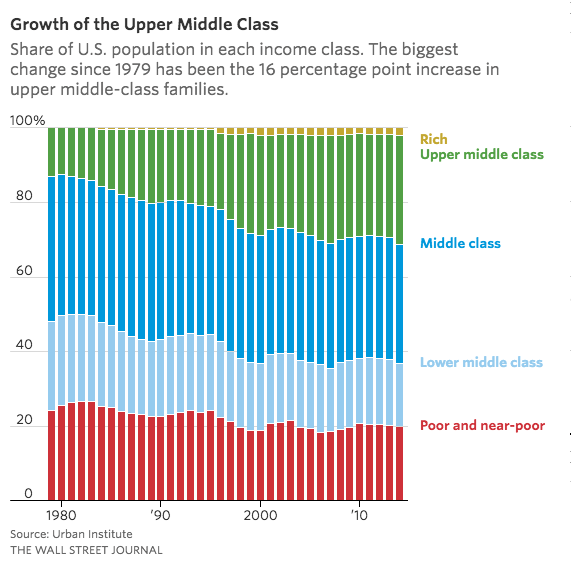
Not Just the 1%: Upper Middle Class Is Larger & Richer – The Big Picture

Interesting data point — its not just the top 1% who are thriving, nor just the top 0.1%, who are really killing it — but the Upper Middle Class is doing well also. According to an Urban Institute paper, The Growing Size and Incomes of the Upper Middle Class using absolute income thresholds [adjusted for inflation and family…Read More

Source: Not Just the 1%: Upper Middle Class Is Larger & Richer – The Big Picture

Lily Tomlin — “The trouble with being in the rat race is that even if you win, you’re still a rat.”

I suspect you’ll start seeing more press about this study in the coming weeks.  I followed the link to the Urban Institute and downloaded the paper.  I pretty much stopped reading the paper when the author wrote,

The study did not adjust for regional differences in the cost of living…Not using area price differences certainly means that some families were incorrectly categorized in this five-level class structure. However, inaccurately placing people from Washington, DC, as upper middle class because they have incomes just above $100,000, even though they have high local costs and would not generally be considered as being upper middle class in that location, is offset by categorizing Des Moines, IA, families with incomes just below $100,000 as being middle class, even though those families could be considered upper middle class because costs in their area are low. Because the point of this exercise was to determine large changes in social classes, any bias one way or the other should not be large.

Talk about a fatal flaw in methodology.  Add in the faulty assumption that “…any bias one way or the other should not be large” and you have IMHO a study that is worthless.

Tell me, how can you be “upper middle class” solely by income level if you have the cost of living in Manhattan, Miami, Boston, Chicago, San Francisco, Los Angeles, or Seattle?

Here’s another critic of the study:

Source: oftwominds-Charles Hugh Smith: What Does It take to Be Upper Middle Class?


Clinical Toxicology Interviews – Taylor & Francis Online

Source: Clinical Toxicology Interviews | Taylor & Francis Online

Audio interview with Dr. Doyon (bystander naloxone)
listen to audio file | mp3 | 18’20”
Read the transcript | pdf

Audio interview with Ms. Priyanka (e-cigarettes)
listen to audio file | mp3 | 10’45”
Read the transcript | pdf

Audio interview with Dr. Doyon (acetaminophen fatalities)
listen to audio file | mp3 | 10’51”
Read the transcript | pdf

Audio interview with Dr. Lipshultz (energy drinks)
listen to audio file | mp3 | 7’35”
Read the transcript | pdf

Audio interview with Dr. Benson (gastric lavage)
listen to audio file | mp3 | 14’32”
Read the transcript | pdf

Have fun and enjoy the interviews.