
Many people don’t realize that both men and women develop an increased sensitivity and a decreased tolerance to alcohol as they get older. It’s important to pay attention to this issue because research has shown that alcohol use has been increasing among people ages 65 and older in recent years—and the size of the older adult population is expanding rapidly now that people are living longer, notes George Koob, a neuroscientist and director of the National Institute on Alcohol Abuse and Alcoholism. “People are largely unaware of the physiological changes [related to aging] that lead to higher blood alcohol levels and bigger impairments in behavior and cognition.” Why your alcohol tolerance diminishes as you age — https://www.nationalgeographic.com/science/article/alcohol-age-tolerance?rid=BA5F7BEC25AE320E1B6791799E955700&cmpid=org=ngp::mc=crm-email::src=ngp::cmp=editorial::add=Health_20240702
Yes I am sipping some bourbon as I write this post.
Why do you ask?
On a serious note, good article with plenty of links for more information. READ IT.

Source: The World’s Deadliest Behavioral Risk Factors – https://www.statista.com/chart/32039/behavioral-risks-leading-to-highest-estimated-number-of-deaths-from-related-diseases/
“Meaning is not something you stumble across, like the answer to a riddle or the prize in a treasure hunt. Meaning is something you build into your life. You build it out of your own past, out of your affections and loyalties, out of the experience of humankind as it is passed on to you, out of your own talent and understanding, out of the things you believe in, out of the things and people you love, out of the values for which you are willing to sacrifice something. The ingredients are there. You are the only one who can put them together into that unique pattern that will be your life. Let it be a life that has dignity and meaning for you. If it does, then the particular balance of success or failure is of less account.”
John Gardner
Read Gardner’s entire speech here – http://www.pbs.org/johngardner/sections/writings_speech_1.html
Resiliency
The researchers found that people in the high resiliency group were less anxious and depressed, less prone to judge, and had activity in regions of the brain associated with emotional regulation and better cognition compared to the group with low resiliency. “When a stressor happens, often we go to this aroused fight or flight response, and this impairs the breaks in your brain,” Gupta said. “But the highly resilient individuals in the study were found to be better at regulating their emotions, less likely to catastrophize, and keep a level head,” added Desiree Delgadillo, postdoctoral researcher and one of the first authors.
The high resiliency group also had different microbiome activity than the low resiliency group. Namely, the high resiliency group’s microbiomes excreted metabolites and exhibited gene activity associated with low inflammation and a strong and healthy gut barrier. A weak gut barrier, otherwise known as a leaky gut, is caused by inflammation and impairs the gut barrier’s ability to absorb essential nutrients needed by the body while blocking toxins from entering the gut.
University of California – Los Angeles Health Sciences. “Resiliency shaped by activity in the gut microbiome and brain.” ScienceDaily. http://www.sciencedaily.com/releases/2024/06/240621122904.htm (accessed June 22, 2024) https://www.sciencedaily.com/releases/2024/06/240621122904.htm
Resilience is the capacity to remain flexible and adaptable while facing life’s challenges. It is a complex concept involving traits, environmental factors, and a learned capacity that comes from experience. https://positivepsychology.com/what-is-resilience/
I have some simple rules when it comes to staying out of trouble when investing:
Know what you own and why you own it.
If you don’t understand something, don’t invest in it.
If it sounds too good to be true, it probably is.
This is not exciting or sexy advice but successful investing is generally boring. Not Getting Rich Fast Enough – A Wealth of Common Sense — https://awealthofcommonsense.com/2024/06/not-getting-rich-fast-enough/
Ben Carlson is a smart man. His short list of unexciting, non-sexy and generally boring bits of investment advice inspired me to add my own generally boring bits of non solicited quasi-investment advice. And in no particular order of importance here they are.
Happy Father’s Day to all the fathers out there.

Again, you can’t connect the dots looking forward; you can only connect them looking backward. So you have to trust that the dots will somehow connect in your future. You have to trust in something — your gut, destiny, life, karma, whatever. This approach has never let me down, and it has made all the difference in my life.
Steve Jobs
Save as Much as You Can Because Whatever You Manage to Save Will Never Be Enough – Random Thoughts on Retirement was the post that started the entire series of periodic Random Thoughts on Retirement. In More Random Thoughts on Retirement – Memorial Day 2024 I wrote about staying healthy as my primary goal in retirement.
Sometimes things in life work out as planned. Sometimes they don’t. This time the plan is going as planned. At my annual wellness check up everything turned out fine except for my blood pressure. The two readings taken showed an elevated systolic and per Doctor’s orders I had to buy a BP machine which set me back $36 plus tax. I was instructed to keep a log for two weeks. For grins, I checked my online account to see what Dr. Lewis wrote for the office visit notes. No mention whatsoever regarding my BP readings. Probably because both of us felt this wasn’t a huge problem. The Boss started showing some concern and I had to report my pressures to her every day. Again I felt this wasn’t a worrisome medical issue. Besides if the diagnosis was hypertension I was looking at daily Lisinopril 10 mg, no big deal.
After two weeks I sent Dr. Lewis my log. She replied later that day.
Thank you for diligently keeping track of your blood pressure readings. I see that your readings have been fairly consistent. Yes you can stop watching it. If you feel fatigued or headaches please recheck it.
Sincerely,
KL
I survived another annual wellness check. The Road to 70 is still pretty smooth. But the ride is not as smooth for others.
A CivicScience survey of nearly 3,000 respondents conducted between March and May 2024 reported 61% of those aged 55 and over say they won’t be able to retire by 65, and 53% will need to keep working even when they do retire. Boomers and Beyond: 5 Ways To Make Extra Money if You Retire in Your 70s – https://www.gobankingrates.com/retirement/planning/boomers-ways-make-extra-money-retire-70s/.
I admit to falling for the clickbait. Of course I wanted to know about 5 ways to make extra money if I retire in my 70’s. And I’m a Boomer. So I read the article. Here are the 5 ways to make extra money:
- Add Money to a High-Yield Savings Account
- Buy Dividend Stocks
- Rent Out Unused Space in Your Home
- Become a Dog Walker
- Become a Ride-Share Driver
What is the average monthly benefit for a retired worker? The estimated average monthly Social Security retirement benefit for January 2024 is $1,907. https://faq.ssa.gov/en-us/Topic/article/KA-01903
Hmm…

I wrote back in May that my focus was simple. All I had to do was stay healthy and stay connected with an employer willing to keep an Old Guy with a particular set of skills on the payroll. More Random Thoughts on Retirement – The Dot Project May 2024. At this point I hope to become a dog walker only if I want to, not if I have to. Prioritize your health. Save as much as you can. Plan on living AND working longer. Defer collecting Social Security retirement until you turn 70 (if you can). Read my other blog https://garyskitchen.net/. Tell your friends and family you found this blog written by an Old Guy on what it takes to become an Old Guy. They’ll love you for this.
The researchers found signs that a high-fat, low-fiber diet may increase inflammation in the gut that prevents it from naturally suppressing tumors. The cells of young people with colorectal cancer also appeared to have aged more quickly — by 15 years on average — than a person’s actual age. That’s unusual, because older people with colorectal cancer don’t have the same boost in cellular aging.
The rate of colorectal cancer among young people has been rising at an alarming rate, according to a 2023 report from the American Cancer Society. In 2019, 1 in 5 colorectal cancer cases were among people younger than 55. That’s up from 1 in 10 in 1995, which means the rate has doubled in less than 30 years. Young People’s Gut Bacteria May Drive Colorectal Cancer Risk – Medscape – June 06, 2024 — https://www.medscape.com/s/viewarticle/young-peoples-gut-bacteria-may-drive-colorectal-cancer-risk-2024a1000amd?src=rss
Yikes.
JP Morgan data showing expectations vs. reality on the timing of retirement:
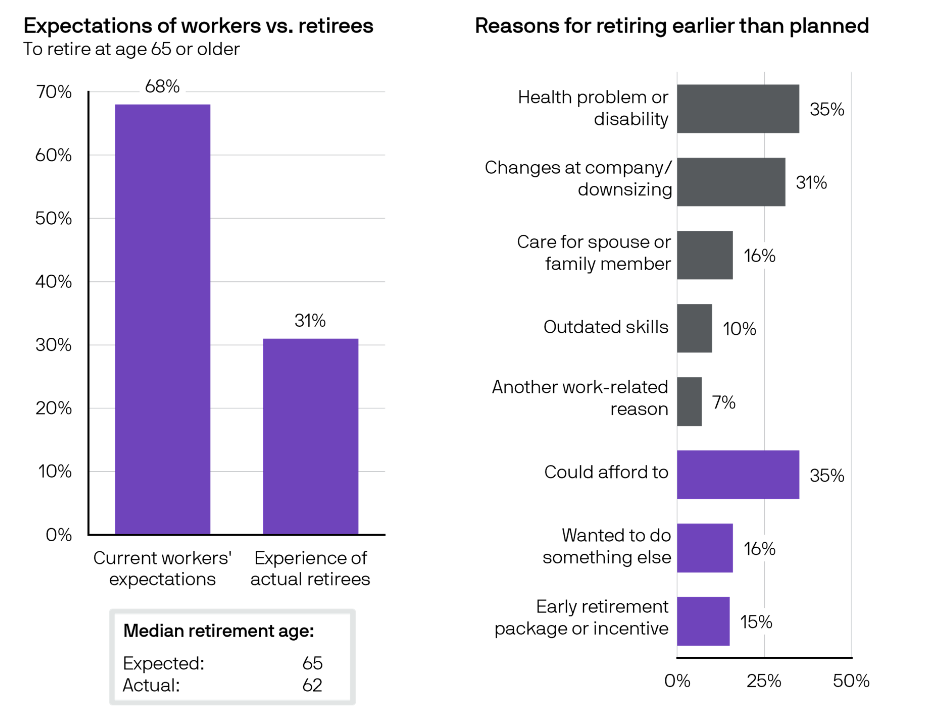
Source: When Life Forces Your Hand – https://awealthofcommonsense.com/2024/05/when-life-forces-your-hand/
Memorial Day 2024
The Boss once again is outside in the yard doing her thing. I’m inside doing my thing, drinking coffee, reading, writing. One of my addictions is staying current with the news and this post popped up in my RSS feed. At my age it doesn’t take much prompting for me to reflect on retirement. The Road to 70 is nearly complete. Soon I’ll be writing the next chapter of life The Road to 75. Dear Reader, if this sounds “old”, it is.
Critical thinking and understanding risk are the cornerstones of what I do. So when I have an opportunity to validate or repudiate the key assumptions in my plans I am in my Happy Place. When I decided not to retire several years ago my personal mantra focused on the following two critical variables in my retirement planning:
Stay healthy.
Find a willing employer.
Number One. I just had my annual wellness checkup. Bloodwork normal. Tendency towards obesity curtailed. Blood pressure elevated on two readings. Per Doctor’s orders I bought a BP machine and started keeping a log. All of my readings at home have been normal. A little white coat effect and the excitement of seeing my physician (Redhead Effect)…all good.
Number Two. Don’t underestimate how essential having or finding an employer who will pay you to work as you get older. Too many of us know the feeling of being cast out to the street for becoming too “old”.
As I prepare to write the next chapter it’s time to revisit and revise the two most important goals that got me to where I am. After some considerable time and effort here are my revised goals for the next five years.
Stay healthy.
Keep working for my current willing employer.
Happy Memorial Day.
 lifeunderwriter.net
You must be logged in to post a comment.