For some, it can be dangerous. In the past few years, reports have swelled of people, especially teens, experiencing short- and long-term “marijuana-induced psychosis,” with consequences including hospitalizations for chronic vomiting and auditory hallucinations of talking birds. Multiple studies have drawn a link between heavy use of high-potency marijuana, in particular, and the development of psychological disorders, including schizophrenia, although a causal connection hasn’t been proved. “It’s entirely possible that this new kind of cannabis—very strong, used in these very intensive patterns—could do permanent brain damage to teenagers because that’s when the brain is developing a lot,” Keith Humphreys, a Stanford psychiatry professor and a former drug-policy adviser to the Obama administration, told me. Humphreys stressed that the share of people who have isolated psychotic episodes on weed will be “much larger” than the number of people who end up permanently altered. But even a temporary bout of psychosis is pretty bad. Marijuana Is Too Strong Now – https://www.theatlantic.com/ideas/archive/2024/08/high-potency-marijuana-regulation/679639/
Reported cannabis use declined to a nadir in 1992, with partial recovery through 2008, and substantial increases since then, particularly for measures of more intensive use. Between 2008 and 2022, the per capita rate of reporting past-year use increased by 120%, and days of use reported per capita increased by 218% (in absolute terms from the annual equivalent of 2.3 to 8.1 billion days per year). From 1992 to 2022, there was a 15-fold increase in the per capita rate of reporting daily or near daily use. Whereas the 1992 survey recorded 10 times as many daily or near daily alcohol as cannabis users (8.9 vs. 0.9 M), the 2022 survey, for the first time, recorded more daily and near daily users of cannabis than alcohol (17.7 vs. 14.7 M). Far more people drink, but high-frequency drinking is less common. In 2022, the median drinker reported drinking on 4–5 days in the past month, versus 15–16 days in the past month for cannabis. In 2022, past-month cannabis consumers were almost four times as likely to report daily or near daily use (42.3% vs. 10.9%) and 7.4 times more likely to report daily use (28.2% vs. 3.8%).
Long-term trends in cannabis use in the United States parallel corresponding changes in cannabis policy, with declines during periods of greater restriction and growth during periods of policy liberalization. A growing share of cannabis consumers report daily or near daily use, and their numbers now exceed the number of daily and near daily drinkers. Changes in self-reported cannabis use in the United States from 1979 to 2022 — https://doi.org/10.1111/add.16519
In 2022, according to provisional data from the Centers for Disease Control and Prevention (CDC), close to 83,000 people died from opioid overdoses in the United States, the majority from fentanyl and other highly potent synthetic substances. A Yale Medicine addiction medicine specialist discusses how the synthetic opioid became a problem – https://www.yalemedicine.org/news/fentanyl-driving-overdoses
APC indicates annual percentage change. This study of alcohol-related mortality in the US suggests there has been a significantly higher rate of increase in deaths among female individuals in recent years.
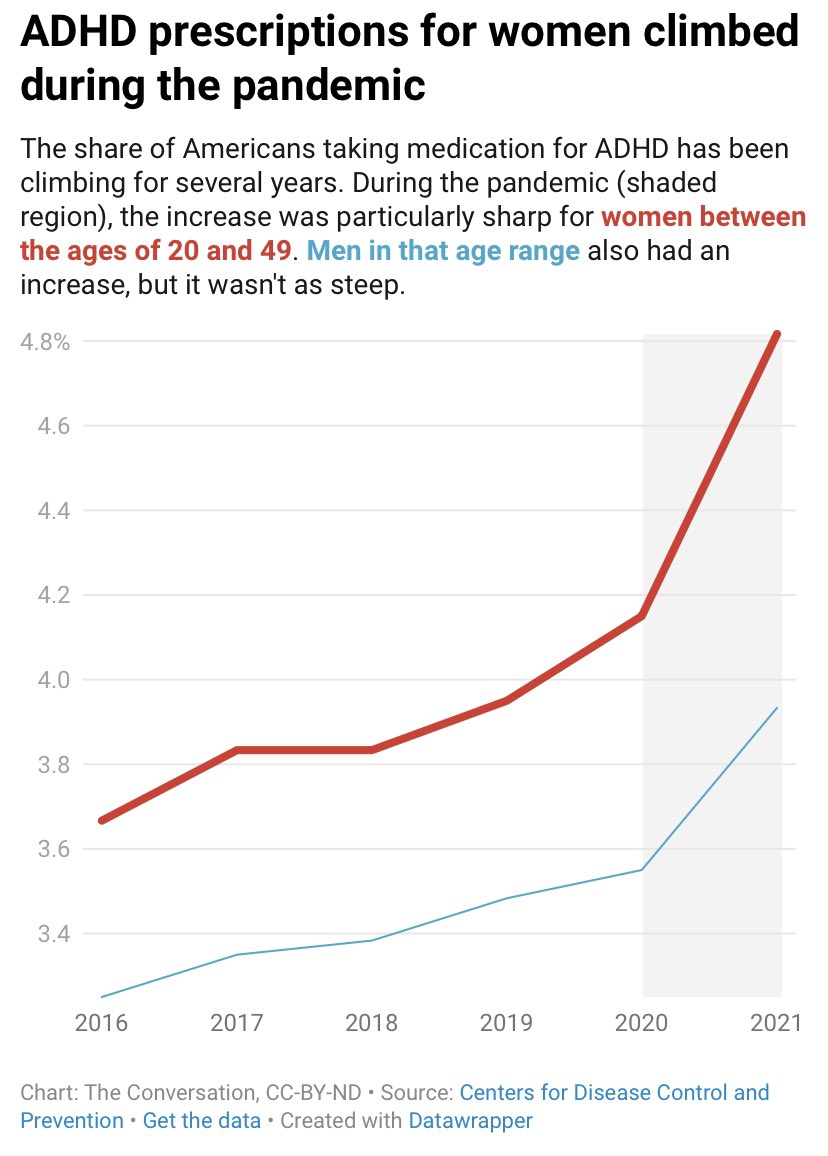
In March 2023, the U.S. Centers for Disease Control and Prevention reported an unprecedented spike in stimulant prescriptionsbetween 2020 and 2021. Perhaps most surprising was that the demographic showing the greatest increases in stimulant use – an increase of almost 20% in one year – were in women in their 20s and 30s…
But while the internet exploded with ADHD content, researchers in Canada began sorting #ADHD TikTok videos into categories based on their accuracy and helpfulness. They reported something important: A majority of #ADHD content was misleading. Only 21% of the posts provided useful and accurate information.
I’m actually not WFH (working from home) today but reading about WFH. And I learned some new things about the world today. One of my favorite tidbits of unsolicited advice comes in the form of this question:
Do you live to work or work to live?
As Gartner research shows, workers want a more “human value proposition,” with 65% of survey respondents agreeing that the pandemic made them rethink the role that work should have in their lives. For all of our talk for decades about work-life balance, people finally feel in their bones what that means. The big question has shifted from “How does life fit into work?” to “How does work fit into life?”
Nice to see others coming around to my way of thinking. The strongest motivation I had to establishing a WFH life was to not have work dominate my entire life. Not once have I felt lonely working in my home office. But apparently some WFH people get lonely.
When I first made the switch to working remotely, I was elated. I had been commuting for years, which regularly constituted 12 or more hours stuck in traffic each week and resulted in incalculable levels of stress and frustration. When I began working from home, in addition to regaining my lost commuting hours, I loved my new ability to focus on my work without the distraction of an open-plan office environment.
However, as time progressed, I started to feel lonely. I was able to laser-focus on my work, but my interactions with others were driven solely by virtual meeting agendas or email. I noticed I was becoming less enthused and more withdrawn. I spent too much time scrolling social media because I was silently craving connection with others. I was slowly but steadily becoming isolated.
Maybe you should turn your camera on during meetings.
A recent survey of 4,200 work-from-home employees found that 49% report a positive impact from engagement when their cameras are on during online meetings, and only 10% felt disengagement from turning on cameras. As leaders are figuring out hybrid and remote work, they are facing the challenge of deciding whether to encourage employees to keep their cameras on during meetings. This decision has a significant impact on communication, engagement and trust-building within the team. I can attest to that from my experience helping 21 organizations transition to long-term hybrid work arrangements.
Then again, there may be a good reason why people have their cameras off.
A May 2022 study by the Federal Reserve Bank of Atlanta estimates that the number of working age Americans (25 to 54 years old) with substance use disorders has risen by 23% since pre-pandemic, to 27 million. A figure that’s about one in six of people who were employed around the time of the study. It’s caused a 9% to 26% drop in labor force participation that Karen Kopecky, one of the authors of the report, says continues today.Drug recovery firm Sierra Tucson concluded from a November 2021 survey that about 20% of US workers admitted to using recreational drugs while working remotely, and also to being under the influence during virtual meetings. Digital recovery clinic Quit Genius found in August 2022 that one in five believe that substance use has affected their work performance, also according to a survey.
Drug overdose persists as a major public health issue in the United States, with more than 101,750 reported fatal overdoses occurring in the 12-month period ending in October 2022, primarily driven by synthetic opioids like illicit fentanyl.
This shortage is complicated, and has several causes. Teva Pharmaceuticals, for instance, which is the largest producer, had problems with its factory. And yet, Teva today has Adderall to sell, as do many other producers, but the shortage persists. What is going on? I suspect that we aren’t hearing about one part of the problem. Monopolization. Indeed, monopolies often leads to shortages, which we’ve seen with baby formula, hospital medicine, ammunition, and military equipment. And they are a part of the problem here.
Violence associated with psychosis has also been well-documented. Marijuana use may be associated with increased impulsivity on the same day and the following day relative to days when marijuana was not used. It is also associated with increased hostile behaviors and perceptions of hostility in others on the same day compared to days when marijuana was not used. Cannabis use disorder appears to increase the risk of aggression towards others, particularly among youths. There is also evidence of a moderate association between cannabis use and physical violence.
Psychosis can be caused by various conditions, including licit and illicit substances, particularly cannabis. Cannabis has a higher conversion rate to psychosis than other substances. 32 percent of patients with substance-induced psychosis convert to either bipolar or schizophrenia-spectrum disorders, with the highest conversion rate found with cannabis-induced psychosis (47 percent). There is debate about the causal relationship between cannabis and psychosis. However, this can be demonstrated using Bradford-Hill criteria. Despite this, psychosis is often multifactorial in many instances. Cannabis exposure increases the risk of psychosis, from transient psychotic states to chronic recurrent psychosis. In individuals with established psychosis, cannabis has a negative impact on the course and expression of the illness.
Today, the U.S. Food and Drug Administration, in coordination with the Centers for Disease Control and Prevention (CDC), released federal data from the 2022 National Youth Tobacco Survey (NYTS) on e-cigarette use among U.S. youth. The findings, published in Morbidity & Mortality Weekly Report, show that youth use of e-cigarettes remains high, with 2.5 million (9.4%) of the nation’s middle and high school students reporting current e-cigarette use.



 lifeunderwriter.net
You must be logged in to post a comment.