Scary Chart of the Day – 10/29/10

Calculated Risk: Housing Bust impacting Manager Mobility

One of the strengths of the U.S. labor market has been the flexibility associated with labor mobility at all levels of employment – households could easily move from one region to another for better employment. The sharp decline in house prices, leaving homeowners with significant negative equity, appears to be limiting this flexibility.
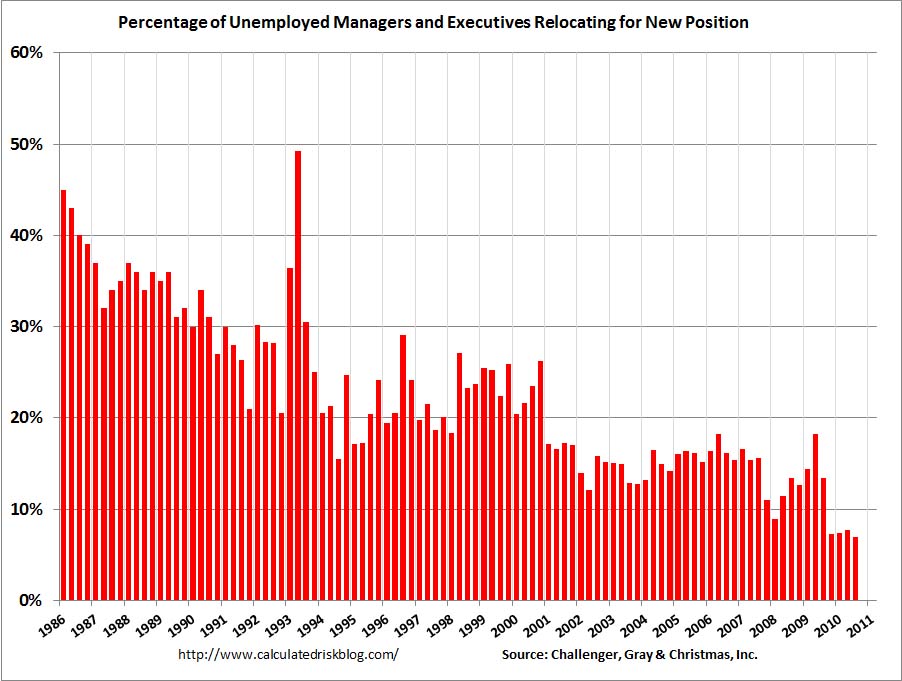
Bad times for moving companies

It’s Saturday morning and I’m not sufficiently caffeinated, sitting in my office catching up on the news when I come across this chart.  So I get up and get another cup of Joe, sip and think a little more about just what this chart is telling me.

A lot.
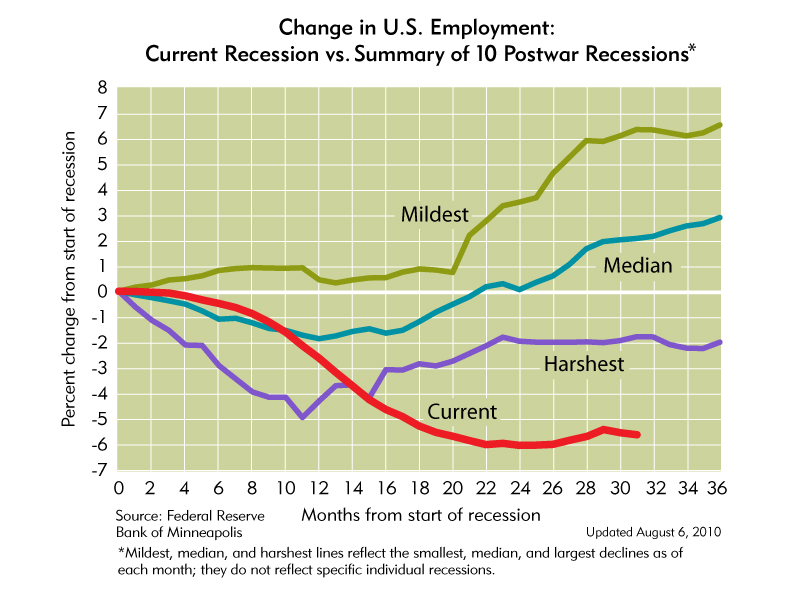
Changing Attitudes Toward Work

Recession May Be Changing Americans’ Attitudes Toward Work

Ignore this attitudinal shift at your own risk.  My consulting buddies and I have been advising companies on this issue for several years.  What’s your company strategy to help the staff achieve balance between work and personal needs?

Welcome to My World – Contingent Staffing Update 10.26.10

Special Report on Contingent Staffing: Contingency Plan | workforce.com

Staffing company officials say the pace of contingent job growth suggests a shift toward more use of temporary labor at the expense of permanent jobs. Companies had to fire thousands of workers during this downturn and are leery of ramping up permanent employment too quickly. They can more easily downsize again if they hire mainly temporary employees. 

Train Your Brain

Underwriters love stuff like this!

How Your Brain Connects the Future to the Past – Jeff Brown and Mark Fenske – Your Health at Work – Harvard Business Review

In the business world, it’s a distinct advantage to have a brain that anticipates future demands and negotiates them well. Accurate predictions typically translate to success. Being able to envision future scenarios helps foster strategic planning and resist immediate rewards in favor of longer-term gains. The proactive brain flexibly recombines details from past experiences that, by analogy with your current surroundings, help you make sense of where you are, anticipate what will come next, and successfully navigate the transition.

Mind Shift

The hidden trend in the monthly jobs report — and what it means for you | paulacaligiuri.com

There is a big change on the horizon in the way we should conceive of the concept of jobs – and it is dramatically changing how job security will be created in the future. For many, jobs of the future may be more like multiple income generating activities (or gigs) where we leverage our talents and skills. Job security will no longer be derived from being employed 40 hours/week. Rather, it will be something we create for ourselves when our talents and skills are in demand.

This is a mind shift.

The emphasis of the future will be on the skills you bring, rather than the job you occupy. There will be a far greater focus on self-management of both our skills and our network, two critical components of career success. Possessing more sought-out skills and having a strong network will be related to more income opportunities, whether working for a single organization or as an independent contractor.

Perhaps we need to take a collective deep breath and realize that, while change is afoot, this free agent mentality may also come with some upsides:

  • You will now have tremendous flexibility to plan and grow your own career, no longer relinquishing career management to an employer.
  • You will now have the ability to craft your sources of income across multiple opportunities if this is what you chose to do.
  • You will now have the opportunity to engage in a career that fits with your life – and not vice versa.

Thanks Paula.  I could not have said this better myself.

(Sobering) Thought for Today – 5/28/10

The New Republic: Reality For The Unemployed : NPR

Of the 908-person sample, 67 percent remained unemployed but were still looking for work, and an additional 12 percent had given up and dropped out of the labor force. Only 21 percent had found jobs (only 13 percent full-time) and were currently employed. A stunning 28 percent of the newly reemployed had been looking for work for more than one year, and 6 percent for more than two years. Fifty-five percent accepted a pay cut in their new jobs; 13 percent took a cut larger than one-third of their previous salary.

Women (26 percent newly employed) did somewhat better than men (18 percent). Surprisingly, young adults (29 percent newly employed) did better than 30 to 49-year olds (21 percent). Not surprisingly, this is a terrible time to be over 50 and out of work: Only 12 percent of these older workers had managed to find jobs.