Underlying Causes and Causal Pathways are Largely Unknown (guess the disease)

Using high-quality population-based cancer registry data until 2017, this study presents contemporary trends in early-onset colorectal cancer incidence across 50 countries and territories, including 12 additional countries (Argentina, Bahrain, Belarus, Chile, Columbia, Ecuador, France [Martinique], Iceland, Kuwait, the USA [Puerto Rico], Qatar, and Uganda) since the last published report on colorectal cancer incidence trends. The findings show that the rising incidence of early-onset colorectal cancer is no longer limited to high-income countries; it now extends to countries and territories in Latin America and the Caribbean (Argentina, Chile, Costa Rica, Ecuador, Martinique, and Puerto Rico), Asia (Israel, Japan, Thailand, and Türkiye), and eastern Europe (Belarus). Colorectal cancer incidence trends in younger versus older adults: an analysis of population-based cancer registry datahttps://www.thelancet.com/journals/lanonc/article/PIIS1470-2045(24)00600-4/fulltext

Yikes.

Gut Bacteria May Drive Colorectal Cancer Risk

The researchers found signs that a high-fat, low-fiber diet may increase inflammation in the gut that prevents it from naturally suppressing tumors. The cells of young people with colorectal cancer also appeared to have aged more quickly — by 15 years on average — than a person’s actual age. That’s unusual, because older people with colorectal cancer don’t have the same boost in cellular aging.

The rate of colorectal cancer among young people has been rising at an alarming rate, according to a 2023 report from the American Cancer Society. In 2019, 1 in 5 colorectal cancer cases were among people younger than 55. That’s up from 1 in 10 in 1995, which means the rate has doubled in less than 30 years. Young People’s Gut Bacteria May Drive Colorectal Cancer Risk – Medscape – June 06, 2024 — https://www.medscape.com/s/viewarticle/young-peoples-gut-bacteria-may-drive-colorectal-cancer-risk-2024a1000amd?src=rss

Yikes.

Diet Until Proven Otherwise

According to a study published in BMC Medicine, men who ate the most plant-based foods had a 22 percent reduced risk of colon cancer, compared with those who ate the least. Eating a plant-based diet increases consumption of fiber and antioxidants associated with cancer prevention, while simultaneously avoiding the compounds in animal products linked to cancer risk. It has long been known that people who avoid meat are at reduced risk.

The power of nutrition in cancer prevention — https://www.kevinmd.com/2024/02/the-power-of-nutrition-in-cancer-prevention.html

Also schedule that colonoscopy you’ve been putting off.

Diet Until Proven Otherwise

Plant foods, high in fiber, can reduce the contact of potential carcinogens with cells lining the digestive tract. The fiber causes food to travel faster through a person’s digestive system. This also reduces intestinal cells’ contact with bile acids, which can promote cancer growth. Fruits, vegetables, whole grains, and legumes also provide phytonutrients and antioxidants, which can help repair damaged cells and reduce cancer risk.

Why poor diets are contributing to a surge in colorectal cancer cases among young people — https://www.kevinmd.com/2023/04/why-poor-diets-are-contributing-to-a-surge-in-colorectal-cancer-cases-among-young-people.html

Life is short and science takes too long.

Change your diet. If you have any changes in your bowel habits, talk to your physician.

Microbial Link Between Western-style Diet and Colon Cancer Risk

Investigators from Brigham and Women’s Hospital with collaborators looked at data from more than 134,000 participants from two U.S.-wide prospective cohort studies. The team analyzed dietary patterns as well as DNA from Escherichia coli strains found in more than 1,000 colorectal tumors. The team looked for bacterial strains carrying a distinct genetic island known as polyketide synthase (pks). Pks encodes an enzyme that has been shown to cause mutations in human cells. Overall, the team found that Western diet was associated with colorectal tumors containing high amounts of pks+ E. coli but not with tumors containing little to no amount of pks+ E. coli.

Brigham and Women’s Hospital. “Microbial link between Western-style diet and incidence of colorectal cancer uncovered.” ScienceDaily. ScienceDaily, 27 June 2022. www.sciencedaily.com/releases/2022/06/220627124937.htm.

Diet-induced Alteration of Intestinal Stem Cell Function (in mice)

“The first thing we noticed was that the small intestine increases greatly in size on the high-calorie diet,” says study leader Anika Böttcher. “Together with Fabian Theis’ team of computational biologists at Helmholtz Munich, we then profiled 27,000 intestinal cells from control diet and high fat/high sugar diet-fed mice. Using new machine learning techniques, we thus found that intestinal stem cells divide and differentiate significantly faster in the mice on an unhealthy diet.” The researchers hypothesize that this is due to an upregulation of the relevant signaling pathways, which is associated with an acceleration of tumor growth in many cancers. “This could be an important link: Diet influences metabolic signaling, which leads to excessive growth of intestinal stem cells and ultimately to an increased risk of gastrointestinal cancer,” says Böttcher.

Helmholtz Zentrum München – German Research Center for Environmental Health. “New link between diet, intestinal stem cells and disease discovered.” ScienceDaily. http://www.sciencedaily.com/releases/2021/11/211119155604.htm (accessed November 27, 2021).

I wonder what Dr. Lustig would say about this study?

Dr. Robert Lustig – The Sugar Pandemic – 2012 Presentation at Yale University and Dr. Robert Lustig on Sugar.

Dead at Just 49 Years Old

Get tested.

Because the birth-cohort effect in cancer suggests that exposures early in life, during childhood or young adulthood, may be crucial, some have begun looking closely at changes to the microbiome. “We know that diet and lifestyle significantly shape our microbiome. They also significantly shape our immune system, which we need to fight off the development of cancer. And so we are hypothesizing that it’s a complex interplay among the microbiome, diet, lifestyle and your immune system,” Ng says.

The Colon Cancer Conundrum — https://www.nature.com/articles/d41586-021-03405-6

My cousin died from metastatic colon cancer at age 49.

Get tested.

Colonoscopy – Just Do It (an almost forgotten post)

I came across this post in my collection of unpublished drafts. I thought I posted this but obviously I didn’t. This article link was intended to be posted before Colorectal Cancer Rates Rising in Ages 50-54. Better late than never, I guess.

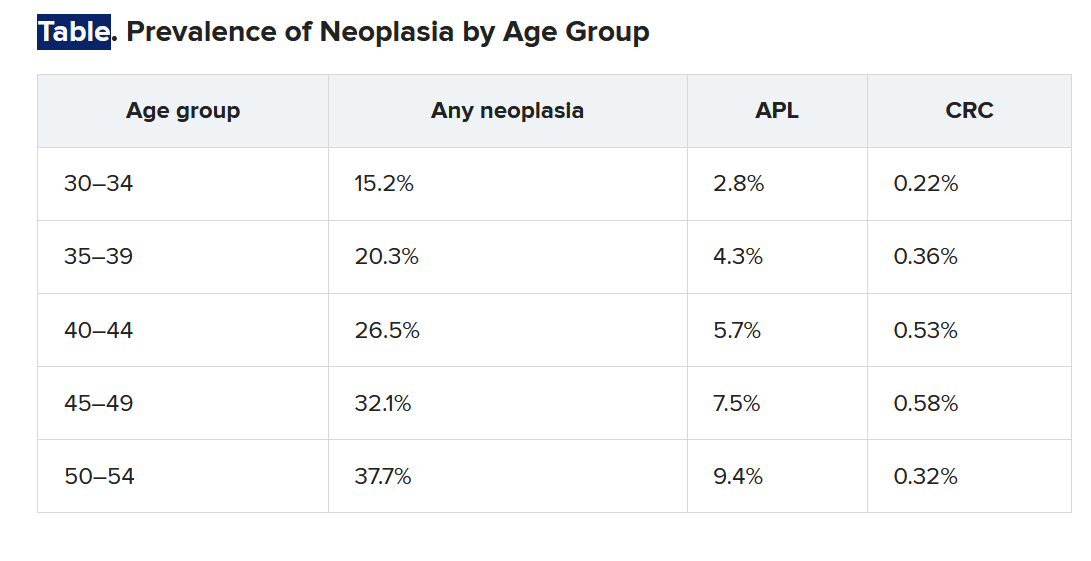
More than one quarter of colonoscopies carried out in Americans aged 30 to 49 years reveal some type of neoplasm, and slightly over 6% of these patients have advanced cancer, results of a nationally representative endoscopic registry show.

One Quarter of 30–49-Year-Olds Have Abnormal Colonoscopy Results – Medscape – Jun 07, 2021. — https://www.medscape.com/viewarticle/952536?src=rss#vp_1
APL = Advanced Premalignant Lesions. CRC = Colorectal cancer.

Also see Study Finds Sharp Rise in Colon Cancer and Rectal Cancer Rates Among Young Adults and Diet and Colon Cancer Risk – CBS News.

Colorectal Cancer Rates Rising in Ages 50-54

During the period 1992–2018, there were a total of 101,609 cases of CRC among adults aged 45–59 years. Further analysis showed that the CRC incidence rates rose from 23.4 to 34.0 per 100,000 among people aged 45–49 years and from 46.4 to 63.8 per 100,000 among those aged 50–54 years. Conversely, incidence rates decreased among individuals aged 55–59 years, from 81.7 to 63.7 per 100,000 persons.

Colorectal Cancer Rates Rising in People Aged 50 to 54 Years – Medscape – Nov 11, 2021 – https://www.medscape.com/viewarticle/962769?src=rss#vp_2

I am posting a link to this article as I enjoy the effects of 238 grams of Miralax mixed with a gallon of sports beverage and/or water. It certainly takes your mind off of not eating all day.

Dumb and Dumber – Noncompliance with Colonoscopy Post Positive FIT

Results Some 88 013 patients who were FIT positive complied with colonoscopy (males: 56.1%; aged 50–59 years: 49.1%) while 23 410 did not (males: 54.6%; aged 50–59 years: 44.9%).

The 10-year cumulative incidence of CRC was 44.7 per 1000 (95% CI, 43.1 to 46.3) among colonoscopy compliers and 54.3 per 1000 (95% CI, 49.9 to 58.7) in non-compliers, while the cumulative mortality for CRC was 6.8 per 1000 (95% CI, 5.9 to 7.6) and 16.0 per 1000 (95% CI, 13.1 to 18.9), respectively. The risk of dying of CRC among non-compliers was 103% higher than among compliers (adjusted HR, 2.03; 95% CI, 1.68 to 2.44).

Conclusion The excess risk of CRC death among those not completing colonoscopy after a positive faecal occult blood test should prompt screening programmes to adopt effective interventions to increase compliance in this high-risk population.

Non-compliance with colonoscopy after a positive faecal immunochemical test doubles the risk of dying from colorectal cancer — https://gut.bmj.com/content/early/2021/03/30/gutjnl-2020-322192?rss=1

Help me understand human behavior. You get a positive FOBT or Cologuard test and your doctor says you need a colonoscopy but you decide not to follow up and follow through with the scope.

SMH.