Think Some More About Outsourcing Your Thinking (if you can)

Artificial Intelligence Breeds Mindless Inhumanity

By Bruce Abramson

July 15, 2025

I began studying AI in the mid-1980s. Unusually for a computer scientist of that era, my interest was entirely in information, not in machines. I became obsessed with understanding what it meant to live during the transition from the late Industrial Age to the early Information Age.  

What I learned is that computers fundamentally alter the economics of information. We now have inexpensive access to more information, and to higher quality information, than ever before. In theory, that should help individuals reach better decisions, organizations devise improved strategies, and governments craft superior policies. But that’s just a theory. Does it? 

The answer is “sometimes.” Unfortunately, the “sometimes not” part of the equation is now poised to unleash devastating consequences. 

Consider the altered economics of information: Scarcity creates value. That’s been true in all times, in all cultures, and for all resources. If there’s not enough of a resource to meet demand, its value increases. If demand is met and a surplus remains, value plummets.  

Historically, information was scarce. Spies, lawyers, doctors, priests, scientists, scholars, accountants, teachers, and others spent years acquiring knowledge, then commanded a premium for their services.  

Today, information is overabundant. No one need know anything because the trusty phones that never leave our sides can answer any question that might come our way. Why waste your time learning, studying, or internalizing information when you can just look it up on demand? 

Having spent the past couple of years working in higher education reform and in conversation with college students, I’ve come to appreciate the power—and the danger—of this question. Today’s students have weaker general backgrounds than we’ve seen for many generations because when information ceased being scarce, it lost all value.  

It’s important to recall how recently this phenomenon began. In 2011, an estimated one-third of Americans, and one-quarter of American teenagers, had smartphones. From there, adoption among the young grew faster than among the general population. Current estimates are that over 90% of Americans, and over 95% of teenagers, have smartphone access. 

Even rules limiting classroom use cannot overcome the cultural shift. Few of today’s college students or recent grads have ever operated without the ability to scout ahead or query a device for information on an as-needed basis. There’s thus no reason for them to have ever developed the discipline or the practices that form the basis for learning.

The deeper problem, however, is that while instant lookup may work well for facts, it’s deadly for comprehension and worse for moral thinking.

A quick lookup can list every battle of WWII, along with casualty statistics and outcome. It cannot reveal the strategic or ethical deliberations driving the belligerents as they entered that battle. Nor can it explain why Churchill fought for the side of good while Hitler fought for the side of evil—a question that our most popular interviewers and podcasters have recently brought to prominence. 

At least, lookup couldn’t provide such answers until recently. New AI systems—still less than three years old—are rushing to fill that gap. They already offer explanations and projections, at times including the motives underlying given decisions. They are beginning to push into moral judgments. 

Of course, like all search and pattern-matching tools, these systems can only extrapolate from what they find. They thus tend to magnify whatever is popular. They’re also easy prey for some of the most basic cognitive biases. They tend to overweight the recent, the easily available, the widely repeated, and anything that confirms pre-conceived models. 

The recent reports of Grok regurgitating crude antisemitic stereotypes and slogans illustrate the technological half of the problem. The shocking wave of terror-supporting actions wracking college campuses and drawing recent grads in many of our cities illustrate the human half. 

The abundance of information has destroyed its value. Because information—facts and data—are the building blocks upon which all understanding must rest, we’ve raised a generation incapable of deep understanding. Because complex moral judgments build upon comprehension, young Americans are also shorn of basic morality 

We are rapidly entering a world in which widespread access to voluminous information is producing worse—not better—decisions and actions at all levels. We have outsourced knowledge, comprehension, and judgment to sterile devices easily biased to magnify popular opinion. We have bred a generation of exquisitely credentialed, deeply immoral, anti-intellectuals on the brink of entering leadership. 

When the ubiquity of instant lookup evolves beyond basic facts and into moral judgments, banal slogans and mindless cruelty will come to rule our lives.  

Is there a way out of this morass?  Perhaps the only one that the ancients discovered back when information, understanding, and morality all retained immense value: faith in a higher power. Because the path we’ve set on our own is heading into some very dark places. 

This article was originally published by RealClearScience and made available via RealClearWire.

I Bet This Is a Big Problem

Is sports wagering a public health crisis?

“Folks might be familiar with this group at Northeastern, the Public Health Advocacy Institute. It is treating gambling as a public health issue and has deemed it a crisis…

“First of all, lots of people, predominantly young men, are losing more money than they can afford gambling on sports, or are developing either full-blown or sort of borderline gambling addictions. To me, that makes it a public health issue.”

Jonathan D. Cohen on how sports gambling became a public health crisis – https://awfulannouncing.com/gambling/author-jonathan-d-cohen-perils-sports-betting.html

The next major health epidemic in the U.S. will not come from a pathogen. This plague has a potential patient population in the tens of millions, limited effective treatments, and is not widely studied in the medical community. I’m referring to sports gambling, an activity that deeply alarms me as a physician who specializes in addiction. Problem gambling can increase the incidence of depression and anxiety and can lead to bankruptcy, homelessness, or suicide. Why gambling addiction is America’s next health crisis – https://kevinmd.com/2025/06/why-gambling-addiction-is-americas-next-health-crisis.html

Yikes.

I’m Taking Your Phone Away (and you didn’t do anything wrong)

The study found that those who had high and increasing addiction to mobile phones and social media platforms were at a higher risk of suicidal behaviors and thoughts. At year four, almost 18% of kids reported having suicidal thoughts, and 5% said they had suicidal behaviors. Teens with ‘addictive’ phone use more likely to be suicidal: Study – https://thehill.com/policy/healthcare/5360042-teens-addiction-social-media-phones-suicidal-thoughts/

Here’s the link to the JAMA article https://jamanetwork.com/journals/jama/article-abstract/2835481/

Yikes!

Humans are Difficult

That day at the Costco checkout, I paid for my groceries at a human-powered cash register and received the tiny oxytocin boost that comes from a random interaction with strangers, the kind that Mehret Biruk is always raving about, those small insignificant moments of connection that add to the richness of life…

This interaction made me realize that much of what I explore in this newsletter is about embracing inefficiencies—making phone calls instead of texting, planning your route ahead of time instead of relying on a GPS, waiting to check your email from a desktop instead of on-the-go, letting people know that you can’t always be instantly available across various communication platforms.

We live in a world obsessed with optimization. An era of contactless everything. This holiday season, lean into the inefficiencies. Make eye contact with strangers. Take your AirPods out of your ears and make small talk with the cashier instead of scanning your own groceries. Chat with the kind humans handing out samples at Costco. Choose human connection, however uncomfortable that may be. You might be pleasantly surprised. Humans are difficult – https://substack.com/@carmellaguiol

Choose human connection.

We are deeply sorry for the inconvenience and disruption (try rebooting 15 times)

CrowdStrike fixes start at “reboot up to 15 times” and get more complex from there — https://arstechnica.com/information-technology/2024/07/crowdstrike-fixes-start-at-reboot-up-to-15-times-and-get-more-complex-from-there/

Deeply sorry for the inconvenience and disruption…

Scary Charts – 01.19.24

Counsellor Hilarie Cash, the co-founder of reSTART Life, a residential treatment center for tech addiction, told The Epoch Times that screen use is classified as problematic when it starts eating into time necessary for normal human functioning…

Ms. Cash, whose program to treat people struggling with addiction to internet pornography and video games began in the 1990s, has observed a worrying trend. While her earlier clients also experienced major upheaval due to their screen addictions, they had sufficient life skills. In contrast, many of her clients today lack necessary life skills, such as knowing how to cook, maintain personal hygiene, hold down a conversation, make meaningful relationships, keep a job, etc. These people are more challenging to treat.

The Silent Epidemic Eating Away Americans’ Minds — https://www.theepochtimes.com/health/the-silent-epidemic-eating-away-americans-minds-5560857

I see this every day. People cannot drive a car responsibly, process a restaurant meal order correctly, make the correct change when presented with cash not credit, and cannot tell you what time it is unless the clock has a digital readout.

We. Are. Doomed.

Got Kids? READ THIS

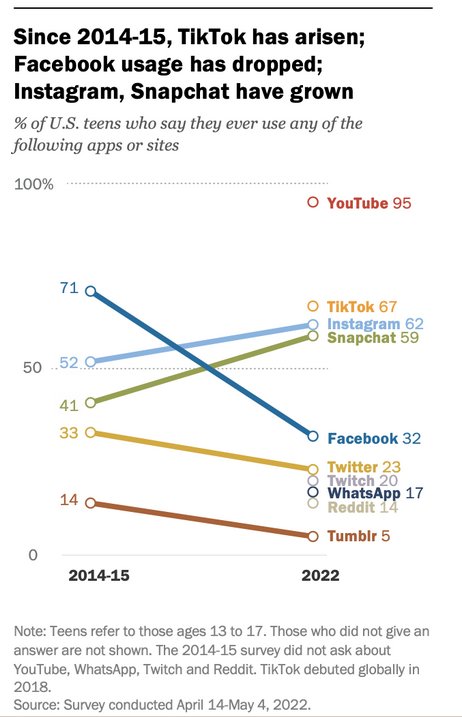
Beyond just online platforms, the new survey finds that the vast majority of teens have access to digital devices, such as smartphones (95%), desktop or laptop computers (90%) and gaming consoles (80%). And the study shows there has been an uptick in daily teen internet users, from 92% in 2014-15 to 97% today. In addition, the share of teens who say they are online almost constantly has roughly doubled since 2014-15 (46% now and 24% then).These are some of the findings from an online survey of 1,316 teens conducted by the Pew Research Center from April 14 to May 4, 2022

Teens, Social Media and Technology 2022 — https://www.pewresearch.org/internet/2022/08/10/teens-social-media-and-technology-2022/

Remember my earlier post I Thought I Told You To Put That Phone Down! This earlier post has additional links to other posts on the topic of social media addiction.

Technology addictions, also commonly known as digital addictions or internet addictions, are often overlooked due to the acceptance that society has placed on using digital devices. Technology addictions often go unnoticed by loved ones because the addicted individual may appear as though they are tending to something important such as work-related tasks on their digital device, when in reality hiding behind the screen is something extraneous. When a technological problem does develop and is noticed it is often not viewed as being an imminent risk akin to an addiction to alcohol or drugs because not only is it more acceptable, but it is also not viewed as being acute or deadly. Despite these beliefs, pathological technology use can indeed be pervasive and detrimental to one’s health and well being. In a growing digital age there is a rapid expansion of digital use and subsequent potential for problematic pathological technology use to ensue.

https://www.familyaddictionspecialist.com/blog/the-6-most-common-types-of-technology-addiction

The link provided above is neither an endorsement or evidence of a previous or existing patient-therapist relationship.

Although I will admit to a quasi-addiction to You Tube for new music.