POP !!!
Death by technology
The Data Centers Next Door You Didn’t Know Were There
Until your city loses 3,000,000 gallons of water.
Massive El Reno water leak traced to Bitcoin mining data center facility – https://kfor.com/news/local/massive-el-reno-water-leak-traced-to-bitcoin-mining-data-center-facility/
The culprit – https://athlonbt.com/about-us/
The website went down while I was reading about the company.

Scheduled maintenance? I call bullshit.
Data Centers Can (are) Ruining People’s Lives
As construction began, Newsom says he spoke with Amazon and Clark Construction representatives, who knocked on his door and, as they put up the fencing around the construction site, told him that if he ever had issues to come to them as they’d “make it right.”
“Then I started having problems, lots of problems,” he says. Innumerable dump trucks came down the road and sent dust through the air day after day. Flashing blue lights from security cameras poured into his bedroom all night. The roads became covered in mud. And eventually, that mud made its way into Newsom’s well, he claims.
“A lot of people in this county have what’s called a bored well, which is a shallow surface water well. So when they’re moving this amount of dirt and earth, digging and vibrations—all those microvibrations over time will work that sediment into the water stream, into that well, and flow straight into my water,” he explains.
He adds that a hydrologist he brought in agreed that the work was disturbing the water table. But when he tried to get in touch with the Amazon superintendent who promised to help address issues, he was met with silence.
A Virginia Homeowner Is Suing Amazon Over a Data Center Being Built by His Home—That He Says Is Already Making Life Unbearable https://www.realtor.com/news/trends/virginia-homeowner-suing-amazon-over-data-center-unbearable/

YIKES. And now a word or two from the great 20th century philosopher Willie:
Amen.
Data Centers are Stealing my Stuff
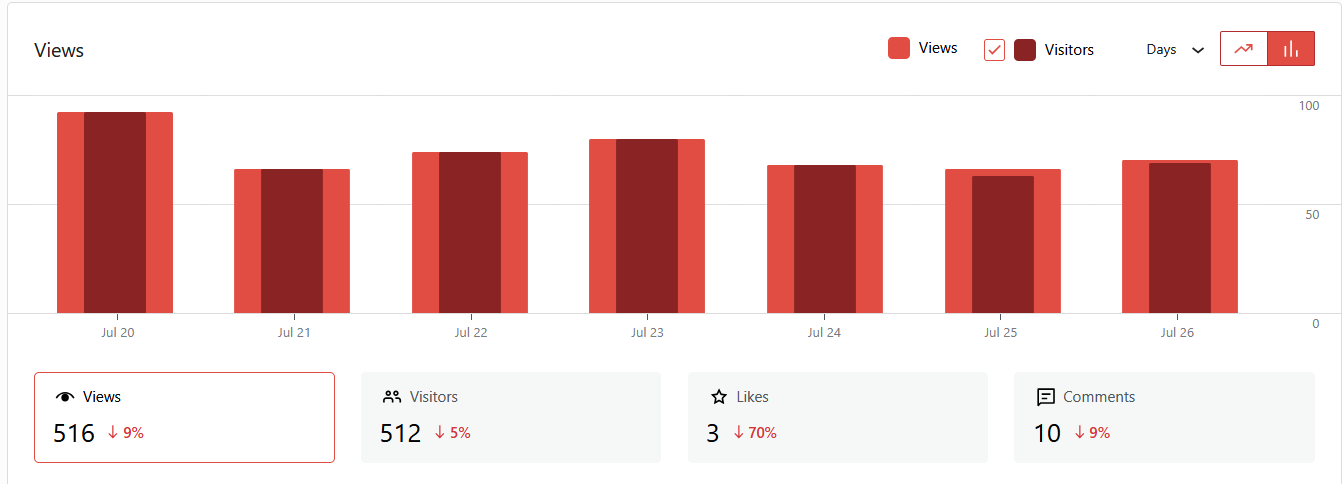
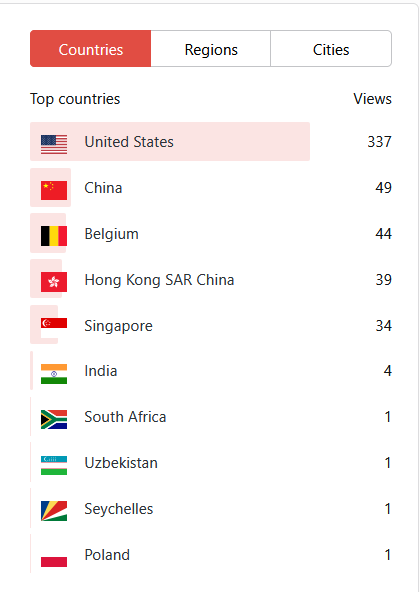
See The Articles in This Blog are Being Stolen by AI and The Recipes in This Blog Are Being Stolen by AI.
The United States has >4500 data centers. China, maybe as many as 450 data centers. Belgium? 47 data centers. Hong Kong 60-120 data centers, estimated. Singapore > 70 data centers. India has 150-270 data centers.
If I was trying to make money from this blog I would be pissed!
Scary Charts 05.17.26
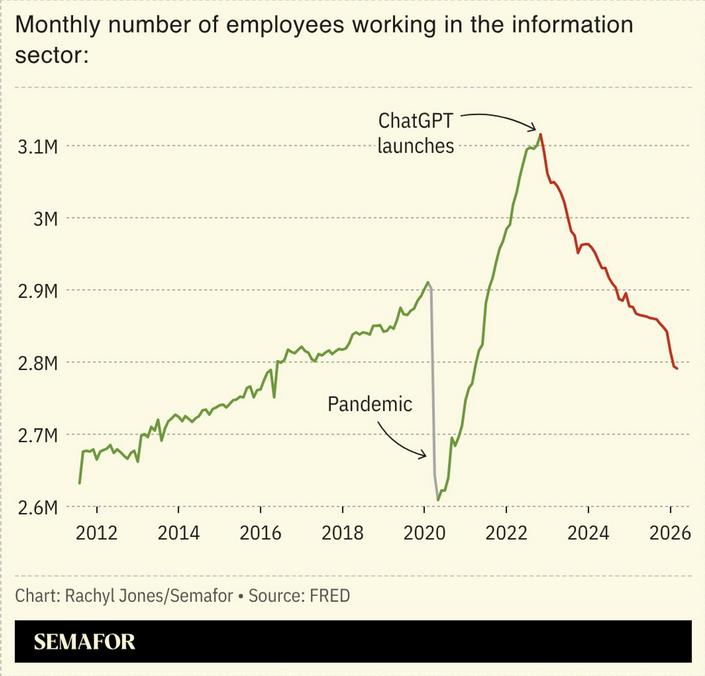
Source – The Class of 2026 is cooked https://www.semafor.com/article/05/15/2026/ai-has-contorted-the-job-market-for-twentysomethings-leaving-college-this-may
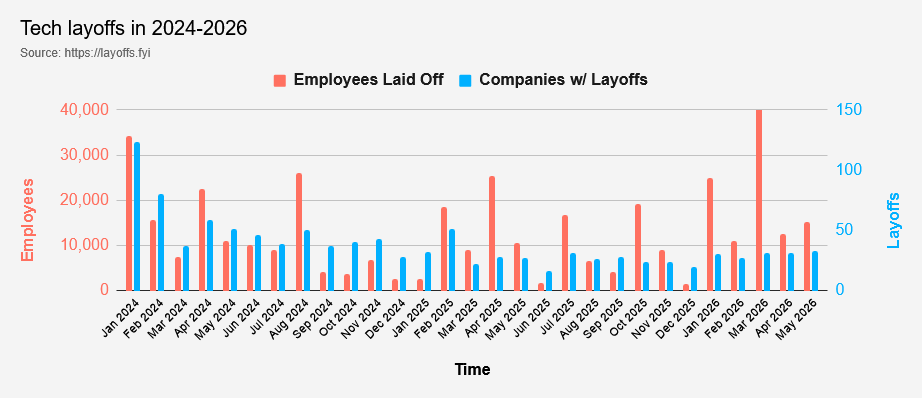
Source – https://layoffs.fyi/
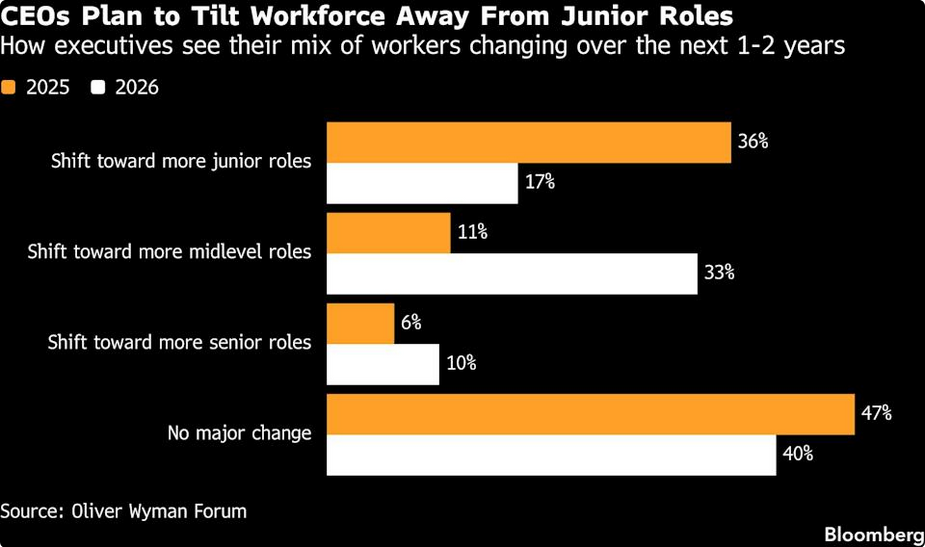
“I think the junior level is definitely finding it harder now to enter the workforce,” said John Romeo, who leads the consulting firm’s research arm, the Oliver Wyman Forum. “It’s those mid- and senior-level employees that CEOs are now looking at to drive productivity.” That’s because of the types of tasks that AI agents are able to perform, from writing code at the level of a junior developer to evaluating sales leads. What the agents can’t do in many fields is make judgment calls using the insight that comes from on-the-job experience, according to labor experts. AI Poised to Tilt Job Market Leverage Toward Older Workers – https://finance.yahoo.com/economy/policy/articles/ai-poised-tilt-job-market-150000094.html
Yikes!
If you managed to scroll down this far here’s a bonus video.
The Articles in This Blog are Being Stolen by AI
Now READ THIS (if you can)
Just a few days ago I posted READ THIS! (if you can). Then I came across this:
A conservative colleague said the use of AI to create addiction and device dependency was evil. That is an understatement. These kids rely on ChatGPT not just for information but also to make choices, and for many, that seems to extend to every aspect of their lives. Sam Altman makes clear in video clips below that this extreme loss of independence, of personal autonomy, is deliberate.
That means unless these kids can find a way to break free, they are cognitive serfs that can be told to do anything. How to vote. Whether to sign up to die in a hopeless war. Whether to take a job in a unsafe meatpacking plant and risk loss of limbs.
This widespread abuse is far worse than what the Sacklers and other opioid peddlers did to mainly working class pain victims, or what the British did to China in the Opium Wars. At least with opioid addiction, it is possible for the victims to recover even if the withdrawal process is painful. The evidence is mounting that even for adults, regular use of AI diminishes reasoning skills and attention spans.
These children are being turned into automatons, incapable of independent thought and action. It’s widely known in developmental psychology that if certain patterning does not happen at critical ages, the deficit is permanent. Kittens needing visual input in their first few days or they are blind. Kids who don’t crawl having coordination issues as adults due to missing important movement patterning. Less dramatic versions are not being able to make sounds in foreign languages if you have not heard and practiced them when young.
These young AI addicts are set to be permanently damaged. This is tech bros creating something as permanent and harmful as fetal alcohol syndrome on a mass basis. And they clearly know what they are doing, witness how they raise their children on completely different lines. “We Are Watching Critical Thinking Disappear in Real Time” Due to AI Addiction: 40% of Kids Can’t Read, Teachers Quitting in Droves – https://www.nakedcapitalism.com/2026/01/we-are-watching-critical-thinking-disappear-in-real-time-due-to-ai-addiction-40-of-kids-cant-read-teachers-quitting-in-droves.html
Thanks for sharing Yves. But as one of your readers noted,
If we teach kids to think they won’t do what they’re told!
Not Your Grandma’s Teddy Bear
Safety features or not, it seems like the chatbots in these toys can be manipulated into engaging in conversation inappropriate for children. The consumer advocacy group U.S. PIRG tested a selection of AI toys and found that they are capable of doing things like having sexually explicit conversations and offering advice on where a child can find matches or knives. They also found they could be emotionally manipulative, expressing dismay when a child doesn’t interact with them for an extended period. Earlier this week, FoloToy, a Singapore-based company, pulled its AI-powered teddy bear from shelves after it engaged in inappropriate behavior. Do Not, Under Any Circumstance, Buy Your Kid an AI Toy for Christmas – https://gizmodo.com/do-not-under-any-circumstance-buy-your-kid-an-ai-toy-for-christmas-2000689652
AI-Powered Teddy Bear Caught Talking About Sexual Fetishes and Instructing Kids How to Find Knives – https://gizmodo.com/ai-powered-teddy-bear-caught-talking-about-sexual-fetishes-and-instructing-kids-how-to-find-knives-2000687140
The alleged perpetrator

Would You Trust an AI Chatbot with Your Children?
All this offloading of parental responsibility to AI is alarming because one of ChatGPT’s biggest flaws, its manipulative and sycophantic nature, is known to intensify delusions and cause breaks from reality — a grim phenomenon that’s been linked to numerous suicides, including several teenagers. Parents Using ChatGPT to Rear Their Children – https://futurism.com/artificial-intelligence/parents-chatgpt-rear-children
Here’s the disclaimer from the ChatGPT homepage:
ChatGPT can make mistakes. Check important info.
Yikes.
Bromism and AI
A Case of Bromism Influenced by Use of Artificial Intelligence
This case… highlights how the use of artificial intelligence (AI) can potentially contribute to the development of preventable adverse health outcomes – https://www.acpjournals.org/doi/10.7326/aimcc.2024.1260
Read more AI horror stories here – https://www.thehumanlineproject.org/media
Yikes.


You must be logged in to post a comment.