“But the real question is what is the quality of the weight regain and what is the shift in people’s metabolism, and it seems to be very bad,” she said. “Ongoing studies that haven’t been published yet suggest that hypertension comes back. All the inflammatory markers come back, and lipids go up. And if you have diabetes, it gets worse. Overall, it’s kind of a mess…As these studies and others showed, most people regain the weight. Whether or not they regain all the weight depends in part on diabetes and insulin and many other factors, but people will likely regain most of their weight.”
“But the message isn’t that you regain the weight. The message is that you may be less healthy when you regain the weight. That’s why we need to couple the drugs with lifestyle interventions. And it’s why people who just want to lose 5 or 10 pounds really need to consider that lifestyle change, hard as it is, is the better way to do it.”
Anne Peters, MD, professor Keck School of Medicine of the University of Southern California
I never envisioned developing an obsession with pharmaceuticals. And after many years of endless blogging into the void I learned I could link to previous posts like this: https://lifeunderwriter.net/tag/glp-1-receptor-agonist/
The study focused exclusively on adults 80 and older, a group with very different dietary requirements than younger adults. As people age, the body goes through significant physiological changes. Energy expenditure decreases, and losses in muscle mass, bone density, and appetite are common. Together, these changes increase the risk of malnutrition and frailty.
Most evidence for the health benefits of diets that exclude meat comes from studies of younger adults rather than frail older populations. Some research suggests older non-meat eaters face a higher risk of fractures due to lower calcium and protein intake.
In later life, nutritional priorities shift. Rather than focusing on preventing long-term diseases, the goal becomes maintaining muscle mass, preventing weight loss and ensuring every mouthful delivers plenty of nutrients. Study finds vegetarians over 80 less likely to reach 100-The Conversation. https://www.sciencedaily.com/releases/2026/02/260225081214.htm “Study finds vegetarians over 80 less likely to reach 100.” ScienceDaily. (accessed February 27, 2026).
Story Source:
Materials provided by The Conversation. Original written by Chloe Casey, Lecturer in Nutrition and Behaviour, Bournemouth University. Note: Content may be edited for style and length.
The first takeaway is about the mindset. Winning requires staying in the present. When you lose nearly half the points you play, the past offers no help. Dwelling on past mistakes only distracts from the real goal, which is to win the match. We cannot change what has happened, and we cannot control what comes next. Stay present, follow the process, and let the result take care of itself…The idea of edge applies directly to our lives. Life is made up of thousands of decisions taken over decades. A small edge in how we make those decisions quietly stacks the odds in our favor.
Take health. Lifting weights a few times a week, walking a few miles a day, eating reasonably well, and sleeping enough each give us a small edge. We are not competing with anyone else here. We are competing against chronic diseases. These habits do not guarantee outcomes, but they help us avoid most of the problems that are within our control, and leave the rest to chance. None of these decisions matter much on their own. Taken together over years they matter a lot.
Nice article, wonderful insights. Now go read the entire article.
“We have to understand that anything in the past takes you out of the present moment. Anything in the future takes you out of the present moment.”
Zen Master Daigneault
To readers who are visiting this blog for the first time my posts on Random Thoughts About Retirement and Unretirement are written by an Old Guy who is old enough to be retired but isn’t retired and is still working. I had another birthday and the older I get the more I think about retirement. Back in 2023 I was thinking about what retirement for me would look like (see More Random Thoughts on Retirement – June 2023). But decisions such as this take serious thought and consideration. At first I thought I wanted to retire to a quiet life of blogging and writing my Future Best Seller titled The Man Who Had No Hobbies. After much thought I decided to add a short term goal to my retirement plan. My new short term goal is to avoid unretirement.
My RSS feed feeds me headlines on unretirement.
According to a new report from T. Rowe Price around 7% of retirees are looking for work in retirement, while 20% say they’re already working part time or full time…The two main reasons for coming back into the workforce are a tale of opposites. While 45% chose to work for social and emotional benefits… a slightly larger percentage — 48% — felt they needed to work for financial reasons.
Once an eagerly awaited milestone, retirement is currently undergoing a transformative reevaluation. Traditionally seen as a well-deserved period of rest and relaxation, the dream of early retirement is now being challenged by a new perspective – that of embracing lifelong work. This paradigm shift reflects the changing nature of work, increased life expectancy, and the desire for personal fulfillment.
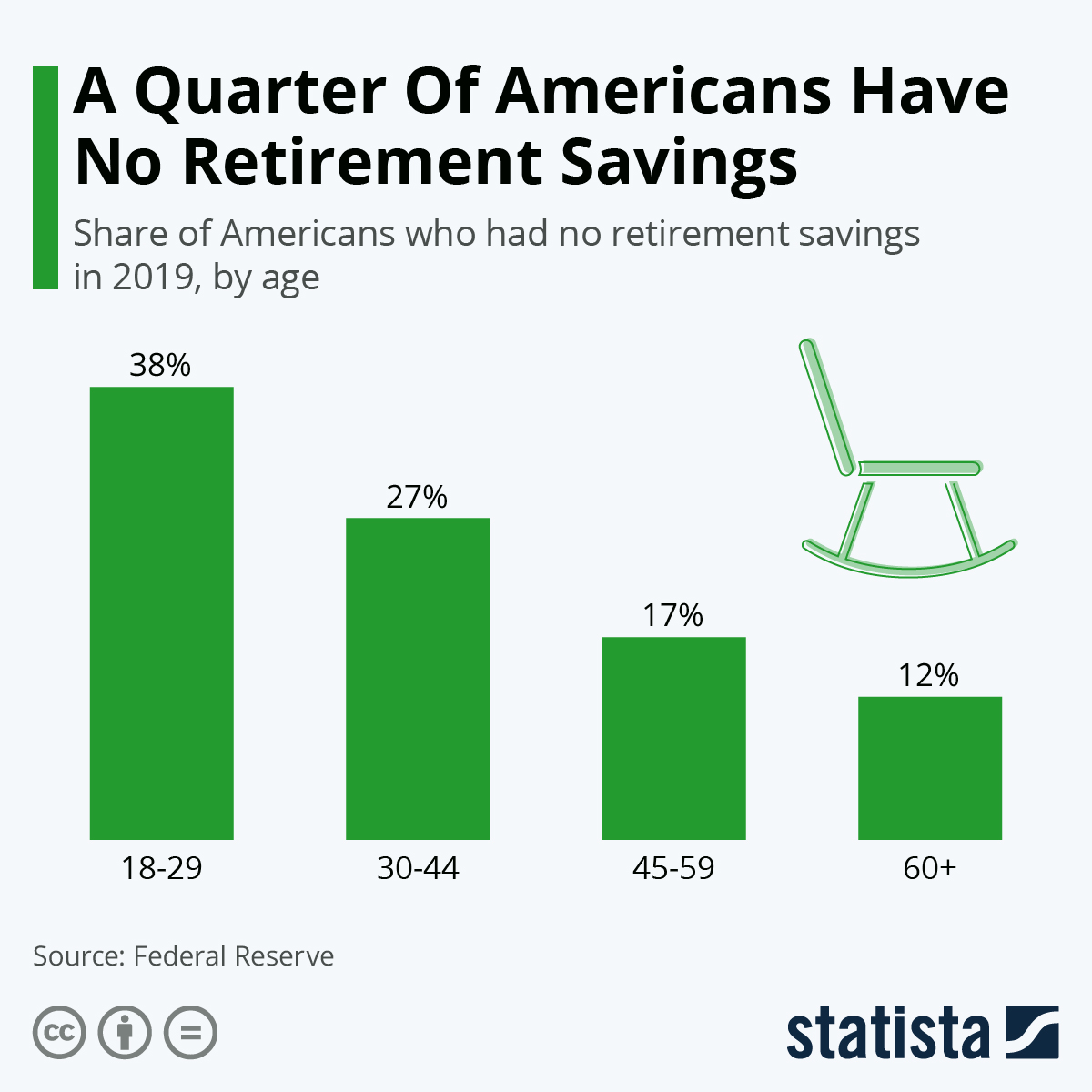
The reality is many won’t have a choice. The following chart illustrates retirement savings as of 2019.
Americans are having trouble financially preparing themselves for life after work. A recent Federal Reserve report found that nearly a quarter of U.S. adults have absolutely no retirement savings or pension. Even though the level of preparation increases as people get older, concern about inadequate savings is still readily apparent across all age groups, even older people in their 60s.
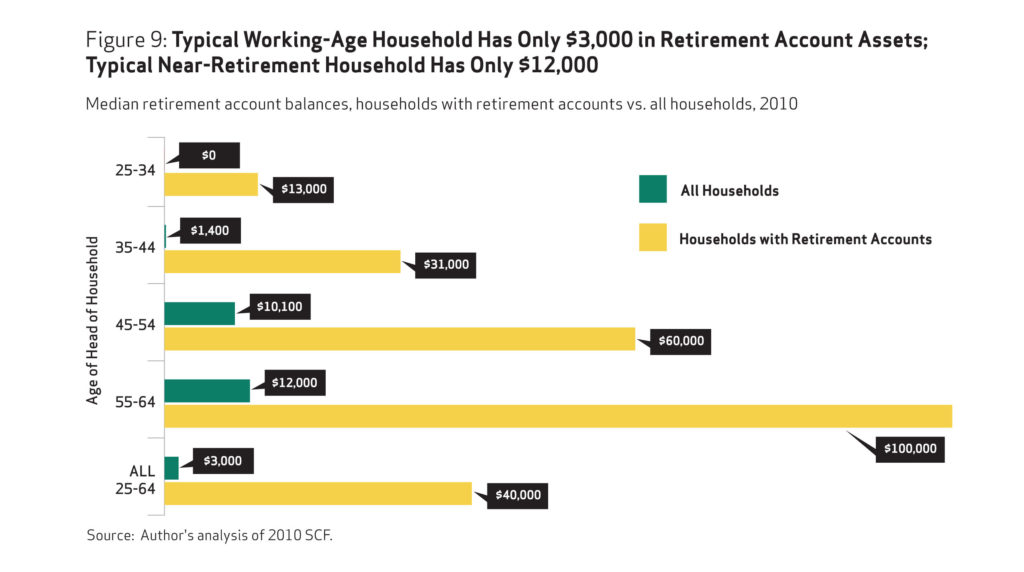
OOPS. I’m glad I didn’t click the Publish button. The savings situation appears to be worse than I thought. The study below was an analysis of data from 2010!
The study broadly examines how American households are faring in relation to retirement savings targets recommended by some financial services firms. It uses the Federal Reserve’s Survey of Consumer Finances to analyze retirement plan participation, savings, and overall assets of all U.S. households age 25 to 64, not just those with retirement account assets. This is important because some 45 percent, or 38 million working-age households, do not have any retirement account assets.
The average working household has virtually no retirement savings. When all households are included— not just households with retirement accounts—the median retirement account balance is $3,000 for all working-age households and $12,000 for near-retirement households. Two-thirds of working households age 55-64 with at least one earner have retirement savings less than one times their annual income, which is far below what they will need to maintain their standard of living in retirement.
The findings confirm that the American Dream of retiring comfortably after a lifetime of work will be impossible for many. Based on 401(k)–type account and IRA balances alone, some 92 percent of working households do not meet conservative retirement savings targets for their age and income. Even when counting their entire net worth, 65 percent still fall short.
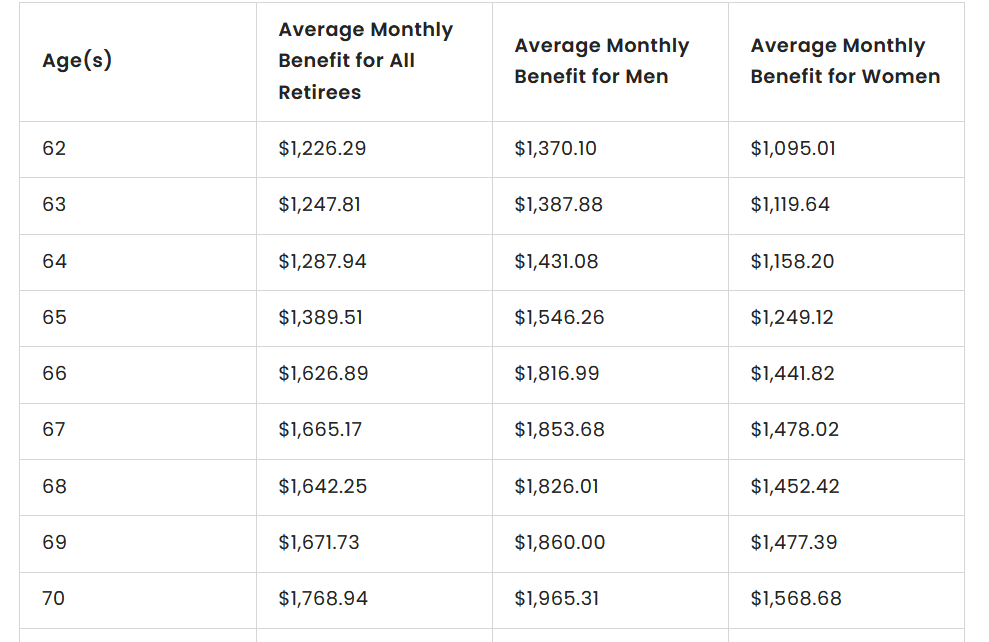
So how will you afford retirement without any savings? Don’t look to Social Security. Here’s some numbers on average Social Security payments. The full chart at the source website goes up to age 100.
As of December 31, 2021, the average Social Security payment for all retirees was $1,658.03 a month, according to the Social Security Administration’s Annual Statistical Supplement for 2022. For men, the overall average was $1,838.08. For women, the average was $1,483.75 — a difference of $354.33 per month.
Whether people unretire or simply stay in the workforce longer, some of the largest financial benefits of additional years of work are delaying retirement account withdrawals and delaying claiming Social Security benefits. These actions essentially shorten the amount of time your assets will need to support you in retirement. Even a few additional years of income have a positive effect on the probability that you won’t outlive your funds.
Michael Gerlich, head of the Centre for Strategic Corporate Foresight and Sustainability at SBS Swiss Business School, began studying the impact of generative AI on critical thinking because he noticed the quality of classroom discussions decline. Sometimes he’d set his students a group exercise, and rather than talk to one another they continued to sit in silence, consulting their laptops. He spoke to other lecturers, who had noticed something similar. Gerlich recently conducted a study, involving 666 people of various ages, and found those who used AI more frequently scored lower on critical thinking. (As he notes, to date his work only provides evidence for a correlation between the two: it’s possible that people with lower critical thinking abilities are more likely to trust AI, for example.) Like many researchers, Gerlich believes that, used in the right way, AI can make us cleverer and more creative – but the way most people use it produces bland, unimaginative, factually questionable work. Are we living in a golden age of stupidity? – https://www.theguardian.com/technology/2025/oct/18/are-we-living-in-a-golden-age-of-stupidity-technology
In 2001, only about 1 out of every 7 U.S. workers was 55 or older. By 2021, the number jumped to almost 1 out of every 4 workers (a 93% increase). That’s almost twice the proportion of older workers as before.3 Older workers are staying on the job longer for various reasons, ranging from financial needs to the joy of work. More people are working past the age when they might have retired. They might be responding to the increase in the Social Security full retirement age, needing money or health insurance, or simply enjoying their jobs and being around their friends at work.⁴ Clearing Up Myths About Older Workers While Understanding and Supporting an Aging Workforce — https://blogs.cdc.gov/niosh-science-blog/2023/09/25/older-workers/
Our research identifies six core attributes of cool people. Specifically, cool people tend to be powerful, hedonistic, adventurous, autonomous, open, and extroverted. Surprisingly, the attributes of cool people vary little across cultures. Cool People https://www.apa.org/pubs/journals/releases/xge-xge0001799.pdf
I used to be a runner. Quite a few years ago my knees told me not to run anymore.
I joined the Y and did the elliptical and treadmills until my knees complained some more. I moved my exercise routine to the resistance machines. Then Covid hit, I cancelled my membership and the months turned into years away from the gym.
I found some resistance bands in the house and started some simple exercises at home. I rejoined the Y and started back with the resistance machines.
Earlier this year my employer offered access to online virtual physical therapy. I took advantage of this benefit from https://www.hingehealth.com/ and have been in physical therapy now for over three months. Less pain (especially my cervical spine, the result of a near fatal encounter with a car), less stiffness, better flexibility, and gradually improving strength. The beauty of the program is availability on demand and it is 100% HEP (home exercise program). Sessions are 10-12 minutes long and you don’t have to leave the house.

 lifeunderwriter.net
You must be logged in to post a comment.