Just 2-4 Cups of Fruits and Veggies Does What?

Lowers blood pressure, improves kidney health, improves CVD risk factors.

In a randomized control trial over a five-year period, investigators divided the cohort of 153 patients with hypertension into three groups:

  1. Study participants adding 2-4 cups of base-producing fruits and vegetables in addition to their usual daily food intake
  2. Study participants prescribed NaHCO3 (acid-reducing sodium bicarbonate, which is common baking soda) tablets in two daily doses of 4-5 650 mg tablets
  3. Study participants receiving standard medical care from primary care clinicians

The results of the study show that both fruits and vegetables and NaHCO3 improved kidney health, but only fruits and vegetables, and not NaHCO3, reduced blood pressure and improved indices of cardiovascular disease risk.

The trial supports fruits and vegetables as foundational hypertension treatment to reduce chronic kidney disease progression and cardiovascular disease risk.

Elsevier. “Eating more fruits and vegetables to reduce dietary acid lowers blood pressure and improves kidney and heart health in patients with hypertension.” ScienceDaily. http://www.sciencedaily.com/releases/2024/08/240806131316.htm (accessed August 11, 2024).

Journal Reference:

  1. Nimrit Goraya, Nicolaos E. Madias, Jan Simoni, Maninder Kahlon, Nazan Aksan, Donald E. Wesson. Kidney and Cardiovascular Protection Using Dietary Acid Reduction in Primary Hypertension: A Five-Year, Interventional, Randomized, Control Trial. The American Journal of Medicine, 2024; DOI: 10.1016/j.amjmed.2024.06.006

I had two cups of fruit in my breakfast bowl this morning.

What did you eat for breakfast?

Simple Investment Advice

I have some simple rules when it comes to staying out of trouble when investing:

Know what you own and why you own it.

If you don’t understand something, don’t invest in it.

If it sounds too good to be true, it probably is.

This is not exciting or sexy advice but successful investing is generally boring. Not Getting Rich Fast Enough – A Wealth of Common Sense — https://awealthofcommonsense.com/2024/06/not-getting-rich-fast-enough/

Ben Carlson is a smart man. His short list of unexciting, non-sexy and generally boring bits of investment advice inspired me to add my own generally boring bits of non solicited quasi-investment advice. And in no particular order of importance here they are.

  • Live beneath your means.
  • Pay yourself first (save, save, save some more).
  • Invest in your health (diet, exercise, etc).
  • Invest in your brain, be a lifelong learner.
  • Connect with family and friends (social media doesn’t count).
  • Find your purpose.
  • Work hard. Hard work is no guarantee of success but the lack of hard work guarantees failure.
  • A happy fulfilling life is more than just the money or your net worth.

Happy Father’s Day to all the fathers out there.

More Random Thoughts on Retirement – Memorial Day 2024

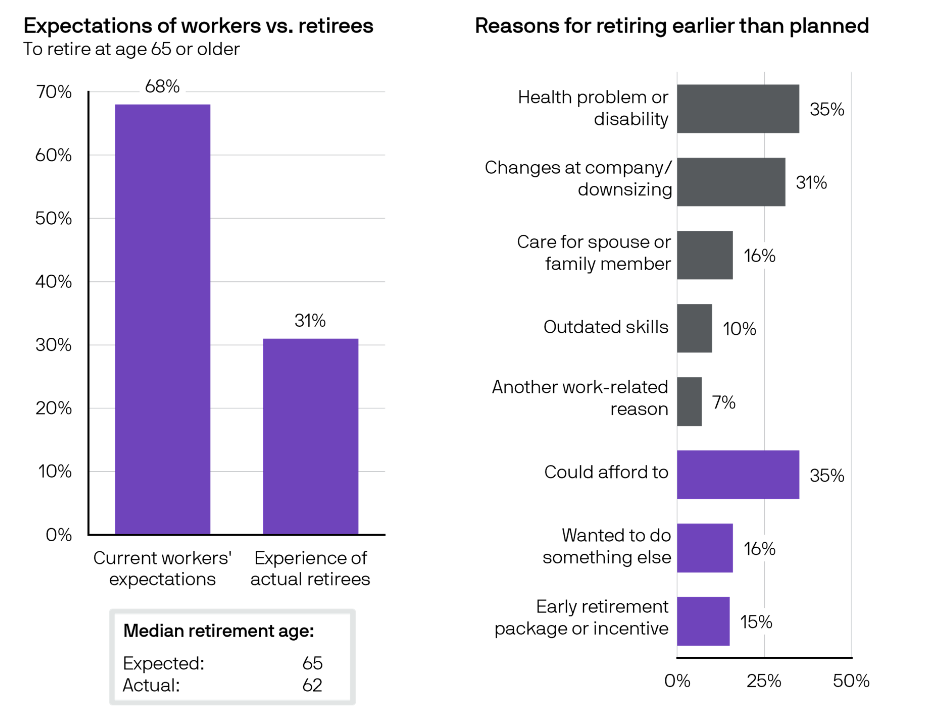
JP Morgan data showing expectations vs. reality on the timing of retirement:

Source: When Life Forces Your Hand – https://awealthofcommonsense.com/2024/05/when-life-forces-your-hand/

Memorial Day 2024

The Boss once again is outside in the yard doing her thing. I’m inside doing my thing, drinking coffee, reading, writing. One of my addictions is staying current with the news and this post popped up in my RSS feed. At my age it doesn’t take much prompting for me to reflect on retirement. The Road to 70 is nearly complete. Soon I’ll be writing the next chapter of life The Road to 75. Dear Reader, if this sounds “old”, it is.

Critical thinking and understanding risk are the cornerstones of what I do. So when I have an opportunity to validate or repudiate the key assumptions in my plans I am in my Happy Place. When I decided not to retire several years ago my personal mantra focused on the following two critical variables in my retirement planning:

Stay healthy.

Find a willing employer.

Number One. I just had my annual wellness checkup. Bloodwork normal. Tendency towards obesity curtailed. Blood pressure elevated on two readings. Per Doctor’s orders I bought a BP machine and started keeping a log. All of my readings at home have been normal. A little white coat effect and the excitement of seeing my physician (Redhead Effect)…all good.

Number Two. Don’t underestimate how essential having or finding an employer who will pay you to work as you get older. Too many of us know the feeling of being cast out to the street for becoming too “old”.

As I prepare to write the next chapter it’s time to revisit and revise the two most important goals that got me to where I am. After some considerable time and effort here are my revised goals for the next five years.

Stay healthy.

Keep working for my current willing employer.

Happy Memorial Day.

Another Reason to Exercise (your brain)

Group-based trajectory modeling identified four groups of distinct occupational cognitive demands according to the degree of routine tasks in the participants occupations during their 30s, 40s, 50s and 60s. The researchers analyzed the link between these trajectory groups and clinically diagnosed MCI and dementia in participants in the HUNT4 70+ Study (2017-19). Additionally, the researchers accounted for important dementia risk factors such as age, gender, educational level, income, overall health, and lifestyle habits from assessments made in 1984-86 and 1995-97.  Within age groupings the researchers looked at such occupations as primary school teacher, salesperson, nurse and caregiver, office cleaner, civil engineer, and mechanic, among others.

After adjusting for age, sex, and education, the group with low occupational cognitive demands (the high RTI group) had a 37 percent higher risk of dementia compared to the group with high occupational cognitive demands. Occupations That Are Cognitively Stimulating May Be Protective Against Later-life Dementia https://www.publichealth.columbia.edu/news/occupations-are-cognitively-stimulating-may-be-protective-against-later-life-dementia

Link to the study abstract – https://www.neurology.org/doi/10.1212/WNL.0000000000209353

I hope my spouse doesn’t read this or she’ll never let me retire.

Sensational yet Obvious! Time Restricted Eating Works!

Photo by Tim Mossholder on Pexels.com

In a randomized-controlled trial, people who followed a time-restricted diet lost about the same amount of weight as people who ate the same diet without the time restriction, according to a study published Friday in Annals of Internal Medicine…nutrition experts Krista Varady and Vanessa Oddo of the University of Illinois wrote in an editorial accompanying the study. “Using a controlled feeding design, Maruthur and colleagues show that TRE is effective for weight loss, simply because it helps people eat less.” It’s cutting calories—not intermittent fasting—that drops weight — https://arstechnica.com/science/2024/04/its-cutting-calories-not-intermittent-fasting-that-drops-weight-study-suggests/

You learn something old every day.

Enough

In the pursuit of “fine” to “great,” we chase products. Through no fault of our own, we fall prey to messaging from social media users, algorithms, and expert marketers, urging us that this shampoo or this rug will shift the scales toward enoughness. “This is how the marketplace continues to work,” says Brooke Erin Duffy, an associate professor of communication at Cornell University, “which is by amplifying our inadequacies and insecurities.”

Baked into these social platforms is a natural ecosystem for comparison. In the past, people weighed themselves against celebrities in the media and those within their immediate social circles, Duffy says. Now, we can compare ourselves to the idealized version of millions of strangers online — who may be perpetuating an aesthetic trend inspiring us to buy in order to participate.

How to be enough
Our obsession with self-improvement is making us miserable. https://www.vox.com/the-highlight/24091379/how-to-be-enough-habituation-hedonic-treadmill-comparison

How to be enough.

How to have enough.

Know when enough is enough.

You’re welcome.

The Best Retirement Letter Ever

My favorite excerpt from the letter:

Let’s be honest, some people in academia are horrible, arrogant, selfish and narcissistic. And no matter how much the people at the top say they deal with bad behaviour, the nasty folk do have an annoying habit of getting promoted. The way in which academia selects and rewards particular skill sets produces an over-concentration of people who are low on empathy. I’ve met a lot of those ‘special’ colleagues over the years (no names mentioned obviously). I will not miss them one jot. They create a toxic working environment , dominate the discourse, ride roughshod over the rules, and cause a great deal of harm to others and get away scot-free. They’ve done me significant mental damage, but I can now happily forget them and move on with life.

My recommendation to anyone starting out in academia is stand your ground, challenge these energy vampires and politely make it clear that you don’t want to play their stupid toxic games. They really don’t have the power that they want you to believe they have, even though the system tends to promote them to roles that are beyond their emotional competence to fulfill. Pity them for the lack of other things to do with their lives. And, remember that 98% of what we do as academics is of no importance at all out there in the real world, so when a self-entitled colleague insists that their work on their favourite gene is earth-shattering; more important than anything you could ever do; and a good reason for their career to be advanced faster than yours; just smile and ignore them. Do your own thing, at your own pace. Have a life outside the university and remember that it’s just a job.

https://journalofhumannutritionanddieteticseditor.wordpress.com/2023/11/27/thats-it/

The Dark Side of TikTok – Financial Advice?

The TikToker touting “generational wealth” isn’t alone in promoting the benefits of slapping a child’s name onto credit card debts. TikTok is flooded with influencers who insist that authorizing minors to use their parents or older relatives’ credit cards will set them up for a bright future.

Many of the videos uploaded to the platform are captioned with the hashtag #generationalwealth and suggest that the authorized credit card user trick is a secret hack used by the wealthy.

‘Generational wealth’ influencers are touting the benefits of parents adding their kids to credit card debt—but experts warn it could go badly wrong — https://fortune.com/2023/10/21/building-generational-wealth-parents-children-credit-card-debt/

Parents, don’t do this. TikTok should not be your source for financial advice.

Instead teach your children to save and invest, to live within their means, to understand the difference between needs and wants, to not become an indentured servant to the banking industry.

What to Expect as You Age

Rosanne M. Leipzig is a geriatrician and author of the book, Honest Aging: An Insider’s Guide to the Second Half of Life. An earlier post Unlocking the Secrets to Aging Well pointed to a podcast. The following is an excerpt from an article by Judith Graham at KFF Health News titled Let’s Have an Honest Conversation About What to Expect as You Age https://kffhealthnews.org/news/article/navigating-aging-expectation-adjustment-change/. Graham interviewed Dr. Leipzig for the story.

Can the stages of aging be broken down, roughly, by decade? No, said Leipzig, noting that people in their 60s and 70s vary significantly in health and functioning. Typically, predictable changes associated with aging “start to happen much more between the ages of 75 and 85,” she told me. Here are a few of the age-related issues she highlights in her book:

  • Older adults often present with different symptoms when they become ill. For instance, a senior having a heart attack may be short of breath or confused, rather than report chest pain. Similarly, an older person with pneumonia may fall or have little appetite instead of having a fever and cough.
  • Older adults react differently to medications. Because of changes in body composition and liver, kidney, and gut function, older adults are more sensitive to medications than younger people and often need lower doses. This includes medications that someone may have taken for years. It also applies to alcohol.
  • Older adults have reduced energy reserves. With advancing age, hearts become less efficient, lungs transfer less oxygen to the blood, more protein is needed for muscle synthesis, and muscle mass and strength decrease. The result: Older people generate less energy even as they need more energy to perform everyday tasks.
  • Hunger and thirst decline. People’s senses of taste and smell diminish, lessening food’s appeal. Loss of appetite becomes more common, and seniors tend to feel full after eating less food. The risk of dehydration increases.
  • Cognition slows. Older adults process information more slowly and work harder to learn new information. Multitasking becomes more difficult, and reaction times grow slower. Problems finding words, especially nouns, are typical. Cognitive changes related to medications and illness are more frequent.
  • The musculoskeletal system is less flexible. Spines shorten as the discs that separate the vertebrae become harder and more compressed; older adults typically lose 1 to 3 inches in height as this happens. Balance is compromised because of changes in the inner ear, the brain, and the vestibular system (a complex system that regulates balance and a person’s sense of orientation in space). Muscles weaken in the legs, hips, and buttocks, and range of motion in joints contracts. Tendons and ligaments aren’t as strong, and falls and fractures are more frequent as bones become more brittle.
  • Eyesight and hearing change. Older adults need much more light to read than younger people. It’s harder for them to see the outlines of objects or distinguish between similar colors as color and contrast perception diminishes. With changes to the cornea, lens, and fluid within the eye, it takes longer to adjust to sunlight as well as darkness.
  • Because of accumulated damage to hair cells in the inner ear, it’s harder to hear, especially at high frequencies. It’s also harder to understand speech that’s rapid and loaded with information or that occurs in noisy environments.
  • Sleep becomes fragmented. It takes longer for older adults to fall asleep, and they sleep more lightly, awakening more in the night.

This is by no means a complete list of physiological changes that occur as we grow older.

Ouch.