The App That Helps Me Be a More Patient Centered Physician — A Country Doctor Writes:

One of the most rewarding things I do in my clinic happens on my iPhone. When I sit down with a middle aged patient to talk about their cardiovascular risk, I open the risk calculator created by the American Heart Association and the American College of Cardiology. I talk my way through as I enter […]

The App That Helps Me Be a More Patient Centered Physician — A Country Doctor Writes:

The risk calculator is quite useful but I re-blogged this post for its link to the Hale study, which was news to me. This study published in 2004 showed older people between the ages of 70 and 90 who followed a Mediterranean diet have 50% lower rate of all-cause and cause-specific mortality than people who dine on the SAD Western diet. The four primary risk factors were diet, moderate alcohol intake, physical activity, and non-smoking.

Lifestyle matters.

Internet Use in Retirement and Cognitive Function

Focusing on a sample of 2,105 older people from Austria, Belgium, Denmark, France, Germany, Italy, Israel, Spain, Sweden and Switzerland who have been retired since 2004, researchers examined retirees’ cognitive function in both 2013 and 2015. They specifically focused on a word recall test, where individuals were asked to recall a list of 10 words immediately, and then again five minutes later.

Results found that, on average, people who used the internet after they retired were able to recall 1.22 extra words in the recall test compared to non-internet users. However, retirees who used the internet were also more likely to be male, younger, better educated, and have been retired for a shorter period. They also appear to be in better health — even though they drink and smoke more.

Lancaster University. “Using internet in retirement boosts cognitive function.” ScienceDaily. http://www.sciencedaily.com/releases/2021/09/210920100910.htm (accessed September 20, 2021).

The Myth of Retirement

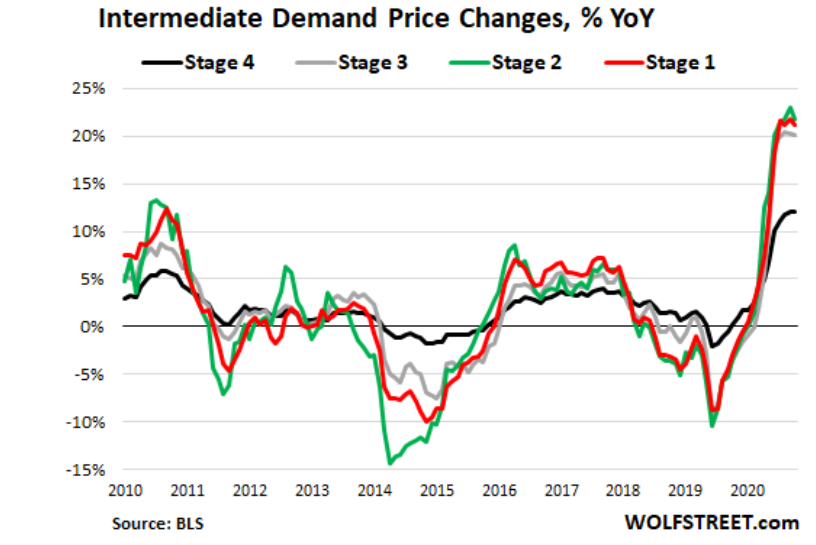
Prices in the three production stages that are the furthest up the pipeline (Stages 1-3, red, green, gray) have all jumped by over 20% year-over-year. Prices at production stage 4 (black), up 12.1% year-over-year, are inputs for final demand prices, which are inputs for consumer prices.

Final demand prices are what consumer prices will encounter pretty soon in their consumer prices. Stage 4 intermediate demand prices will follow. And prices in productions stages 1-3 are further behind, but they’re true whoppers, and they will provide massive pressures on consumer prices for months to come:

Up the Price Pipeline, Inflation Rages at 20% — https://wolfstreet.com/2021/09/10/up-the-price-pipeline-inflation-rages-at-20/#comments

Prior to the 1950’s, there was no such thing as retirement, as the term is used today. A 1950 poll showed that most workers aspired to work for as long as possible. Quitting was for the disabled. Also, remember that in 1935 when the government was determining the appropriate retirement age for social security (65) the average adult male died at age 63.

The Baby Boom generation is also living longer than the generation before it. Chances are a married couple age 65 will have one spouse live into his or her early nineties. That is nearly 30 years of living off of one’s savings and Social Security if one retires at age 65. The math does not work for this many people. For so many to have golden years, there needs to be gold (money) to support them.

Trust Company Oklahoma May 2016 The Retirement Myth — https://www.trustok.com/our-latest-quarterly-newsletter/

Thinking about retirement? I’ve been thinking about retirement for quite some time and the thought of not working doesn’t appeal to me. There will come a time when the 40+ hour workweek will be no longer doable. But for now that time is far off in the future. The math in retirement will not work for the majority. I see inflation all around and my planned retirement income streams and savings will not last as long as hoped if everything costs more. Retirement math now is simple. If you can, work longer and save more.

Thursday 08.12.21 – More Diabetes Research for Your Reading Pleasure

Prevalence and incidence of microvascular and macrovascular complications over 15 years among patients with incident type 2 diabetes

Our findings show that a substantial proportion of patients had existing complications including CKD, stable angina, and peripheral neuropathy at the time of T2D diagnosis. Results also show that among those newly diagnosed with T2D, the highest incidence rates of complications included peripheral neuropathy, CKD, and CVD (myocardial infarction, unstable angina, and stroke).

Time to incidence of microvascular and macrovascular complications was only a few years; peripheral vascular disease, stable angina, CKD, and peripheral neuropathy developed earlier in the disease course.

BMJ Open Diabetes Research and Care – http://dx.doi.org/10.1136/bmjdrc-2020-001847

Diabetic Ketoacidosis and Mortality in People With Type 1 Diabetes and Eating Disorders

CONCLUSIONS Adolescents and young adults with type 1 diabetes and eating disorders have more than triple the risk of DKA and nearly sixfold increased risk of death compared with their peers without eating disorders.

Diabetes Care 2021 Aug; 44(8): 1783-1787. https://doi.org/10.2337/dc21-0517

Fenofibrate Use Is Associated With Lower Mortality and Fewer Cardiovascular Events in Patients With Diabetes: Results of 10,114 Patients From the Korean National Health Insurance Service Cohort

Diabetes Care 2021 Aug; 44(8): 1868-1876. https://doi.org/10.2337/dc20-1533

I’ve been out of town the past three weekends in a row. Prior to taking these trips I was feeling a bit burned out. I had little desire to continue my research activities. I had even less desire to write or post to my blogs. But as suddenly as my energy levels dipped, the mojo came back.

Hiatus is over. The SupremeCmdr is back.

Ten Commandments of Emergency Medicine Revisited

#2 Remember naloxone, glucose, and thiamine (NGT)
Original: Consider or give naloxone, glucose and thiamine
The number of patients presenting with opioid intoxication is growing, and the gentle reversal of patients without severe respiratory depression with naloxone is in the art of medicine – consider starting with 0.4mg and titrate to effect.

In contrast to empiric administration of glucose in the altered or ill patient, rapid assessment of glucose level with point-of-care testing is recommended.

Thiamine deficiency may be less prevalent than previously thought in intoxicated patients, but we now know that giving 100mg of IV thiamine can benefit other malnourished patients, including those with calorie-malnourishment from cancer, gastric bypass, hyperemesis gravidarum, and eating disorders. Personally, I use the ‘T’ of ‘NGT’ to remind myself not to miss alcohol withdrawal.

Ten Commandments of Emergency Medicine Revisitedhttps://journalfeed.org/article-a-day/2021/ten-commandments-of-em-revisited

Why does this matter? I hear you thinking we underwrite life insurance, we’re not doctors. So true. But if we think like doctors we will get better at what we do by recognizing the subtleties buried within the medical charts we read. Here’s what my eyes/brain picked up.

The bold in the excerpt above are mine to illustrate how the mind of a mortality risk expert works. In Emergency Department records pay attention to the initial treatments provided which in some cases hints to a serious condition impacting mortality. Naloxone and opioids are obvious. But would you have associated the administration of IV thiamine to malnutrition or alcohol withdrawal? I thought so.

So read and research widely. You’ll always find little jewels to improve your skills and to impress your friends with. Or in my case to make Dr. Lee think his old man knows more than he actually does.