The study found that those who had high and increasing addiction to mobile phones and social media platforms were at a higher risk of suicidal behaviors and thoughts. At year four, almost 18% of kids reported having suicidal thoughts, and 5% said they had suicidal behaviors. Teens with ‘addictive’ phone use more likely to be suicidal: Study – https://thehill.com/policy/healthcare/5360042-teens-addiction-social-media-phones-suicidal-thoughts/
At the minimum I have a plan. Sell the house, buy a van and do an upscale conversion so I can sleep in it. Travel. Spend time in Oklahoma and Colorado.
Anorexia has one of the highest mortality rates of any psychiatric illness. People with anorexia are 18 times as likely to die from suicide as their peers. Fewer than half of those with anorexia make a full recovery.
Attention-deficit/hyperactivity disorder (ADHD) exerts lifelong impairment, including difficulty sustaining employment, poor credit, and suicide risk. To date, however, studies have assessed selected samples, often via self-report. Using mental health data from the entire Swedish population (N = 11.55 million) and a random sample of credit data (N = 189,267), we provide the first study of objective financial outcomes among adults with ADHD, including associations with suicide. Controlling for psychiatric comorbidities, substance use, education, and income, those with ADHD start adulthood with normal credit demand and default rates. However, in middle age, their default rates grow exponentially, yielding poor credit scores and diminished credit access despite high demand. Sympathomimetic prescriptions are unassociated with improved financial behaviors. Last, financial distress is associated with fourfold higher risk of suicide among those with ADHD. For men but not women with ADHD who suicide, outstanding debt increases in the 3 years prior. No such pattern exists for others who suicide.
Then my mind wanders to drugs (to drugs, not due to drugs).
To summarize, the psychiatric side effects of methylphenidate are quite similar to those of cocaine and amphetamines, giving more support to the idea that almost all CNS stimulants will produce a similar clinical picture. A person using cocaine can experience nervousness,57,58 restlessness,58 agitation,57 suspiciousness,60 paranoia,61–63 hallucinations and delusions,61,63 impaired cognitive functions,64 delirium,65 violence,57,58,62,65,66 suicide,67 and homicide.67–70
Since the start of the COVID-19 pandemic, there has been a dramatic increase in depression, anxiety, psychosis, and suicidality, new research shows.
The most profound health problems were found among adults younger than 25 years. Roughly 90% screened positive for moderate to severe depression, and 80% screened positive for moderate to severe anxiety.
One of the most alarming findings was that in June, 25,498 participants who screened positive for depression reported thinking of suicide or self-harm on “more than half of days to nearly every day.” A total of 14,607 participants said they had these thoughts every day.
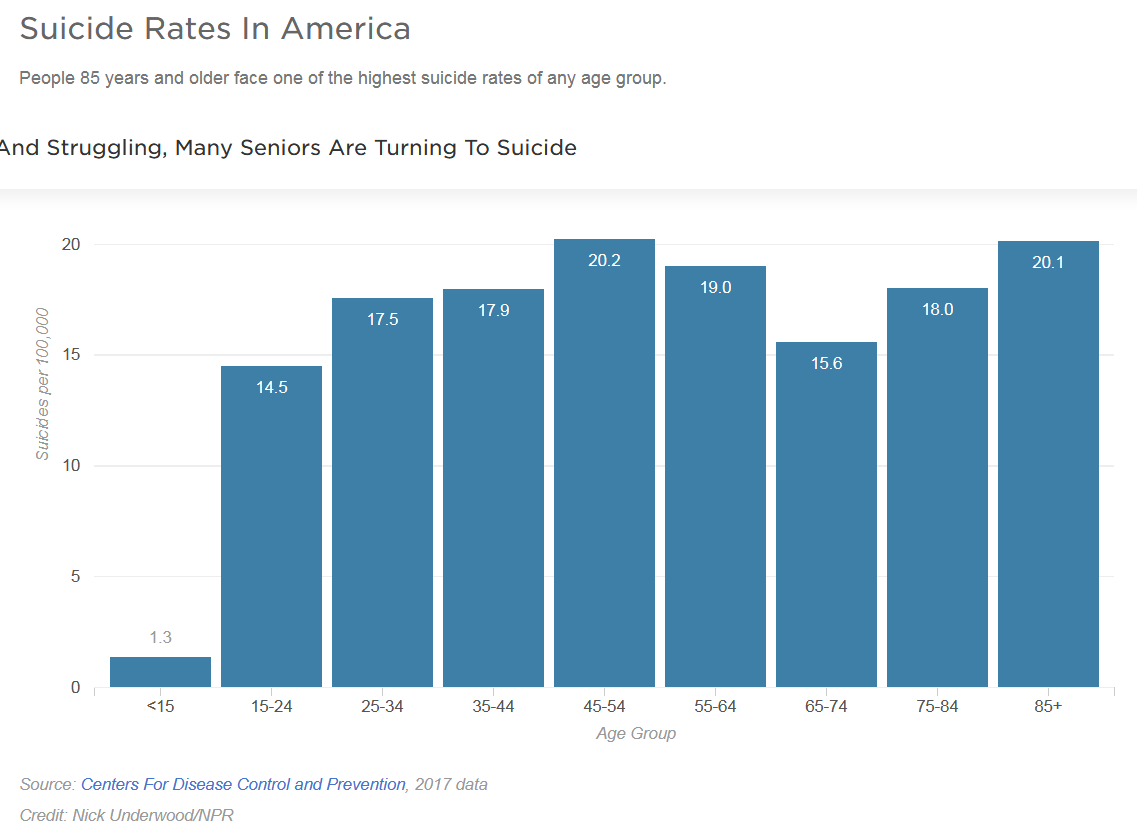
Across the country, suicide rates have been on the rise, and that rise has struck the nation’s seniors particularly hard. Of the more than 47,000 suicides that took place in 2017, those 65 and up accounted for more than 8,500 of them, according to the Centers for Disease Control and Prevention. Men who are 65 and older face the highest risk of suicide, while adults 85 and older, regardless of gender, are the second most likely age group to die from suicide.
Eight of the top ten states with the highest suicide rates in the nation are in the rural mountain West, including Colorado. The region has been labeled “the suicide belt.” Even scenic mountain resort towns like Aspen and Durango, Colo., have reported upticks in suicide. Suicide is a problem everywhere in rural America though. More than half of those surveyed in a poll conducted by NPR, the Robert Wood Johnson Foundation and the Harvard T.H. Chan School of Public Health said they knew someone personally affected by suicide.
Of 123 181 suicide decedents included in the study, 10 789 (8.8%) had evidence of chronic pain, and the percentage increased from 7.4% in 2003 to 10.2% in 2014. More than half (53.6%) of suicide decedents with chronic pain died of firearm-related injuries and 16.2% by opioid overdose.




 lifeunderwriter.net
You must be logged in to post a comment.