In reality, though, most workers don’t get to retire on their own terms. Retirement often arrives suddenly and unexpectedly, triggered by health setbacks or corporate downsizing. And once you’re retired, returning to the workforce is seldom easy. Planning to work in retirement? Don’t count on it – https://www.usatoday.com/story/money/personalfinance/2026/06/20/most-americans-plan-to-work-in-retirement-few-actually-do/90603686007/
This is another post in the never ending series of random thoughts on retirement. For the curious, here’s a link to my previous posts full of random thoughts (brain droppings): https://lifeunderwriter.net/tag/retirement/.
I am writing this on Father’s Day, the fourth day of a four day weekend and I’m ready to go back to work. It’s tough being an Old Guy who is old enough to be retired but isn’t retired and still working. Some days I wonder why I’m not retired. I guess this is all part of my living a longer healthier life strategy.
Social connection, prosociality, spirituality, optimism, and work—growing evidence suggests these five factors can play an important role in improving the well-being of people and communities…Work is one of the most important—and neglected—social determinants of health, according to Lisa Berkman, Thomas D. Cabot Professor of Public Policy and of Epidemiology at Harvard Chan School and director of the Harvard Center for Population and Development Studies. “Work drives income, social ties, and the opportunity for meaningful participation in society,” she said. “As such, it also shapes both our cognitive and physical health in many different ways.” The importance of connections: Ways to live a longer, healthier life – https://hsph.harvard.edu/news/the-importance-of-connections-ways-to-live-a-longer-healthier-life/
The optimism factor is interesting.
“The findings are remarkably consistent,” she said. “Across different racial and ethnic populations, we have seen that people who are more optimistic are more likely to age in good health and less likely to suffer from chronic diseases, physical illness, or cognitive impairments in old age. Optimists are also more likely to live exceptionally longer lives, beyond age 85 or more.”
Aging Redefined: Cognitive and Physical Improvement with Positive Age Beliefs
Geriatrics–2026, 11(2), 28; https://doi.org/10.3390/geriatrics11020028
Abstract
Background/Objectives: A widespread assumption exists among scientists, health care providers, and the public that later life is a time of inevitable and universal cognitive and physical decline. This assumption is likely due to considering older persons who improve to be exceptions, and the reliance on aging-health measures that do not allow for improvement. In contrast, we utilized a measure that allowed for an upward trajectory to occur. Our objective was to examine whether a meaningful number of older persons improve with this measure and, if so, to examine whether a promising modifiable culture-based variable, positive age beliefs, contributes to this improvement. Methods: Individuals 65 years and older, who participated in a nationally representative longitudinal study, had their physical health assessed by walking speed and their cognitive health assessed by a global performance measure. We calculated the percentage of the sample that showed improvement in each domain from baseline to the last measurement up to 12 years later. We also examined whether a positive-age-belief measure predicted this improvement in regression models. Results: It was found that 45.15% of persons improved in cognitive and/or physical function over this period, and positive age beliefs predicted these two types of improvement, both with and without adjusting for relevant covariates. Conclusions: Our findings underscore the need to instill or magnify the positivity of age beliefs and to redefine aging so that it includes the possibility of improvement.
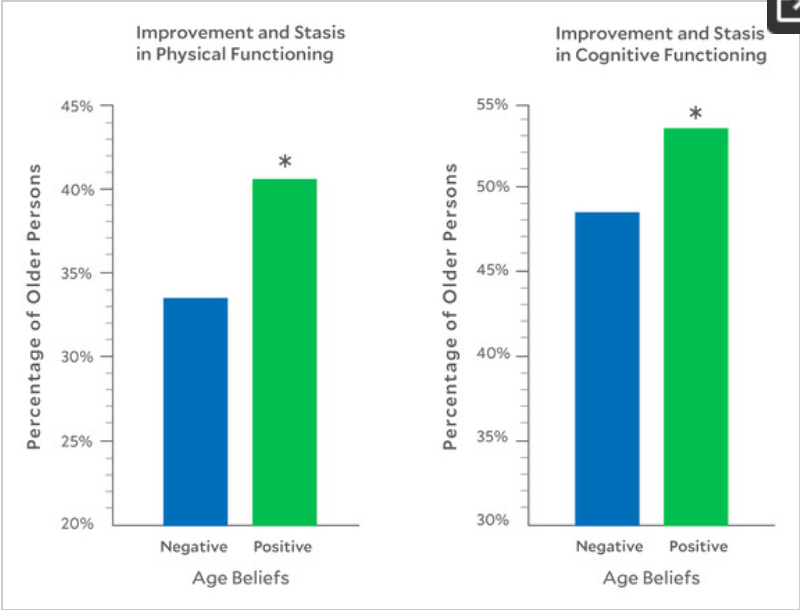
In sociology this phenomenon is known as a self-fulfilling prophecy.
Keep thinking positive thoughts!


You must be logged in to post a comment.