Author: SupremeCmdr
Take a Break 12.07.25
Meditate on this and it will be revealed
Meditate on this and you will get healed
Meditate on this and you will feel whole
Get the vision of the ghost, againIn the dark night of the soul
In the dark night of the soul
In the dark night of the soul
In the dark night of the soulSitting here but I didn’t plan it this way
Well, the plans of mice and men have gone astray
Now I’m standing on the landing ground
I’m looking for a brand new day
Scary Charts – 12.04.25
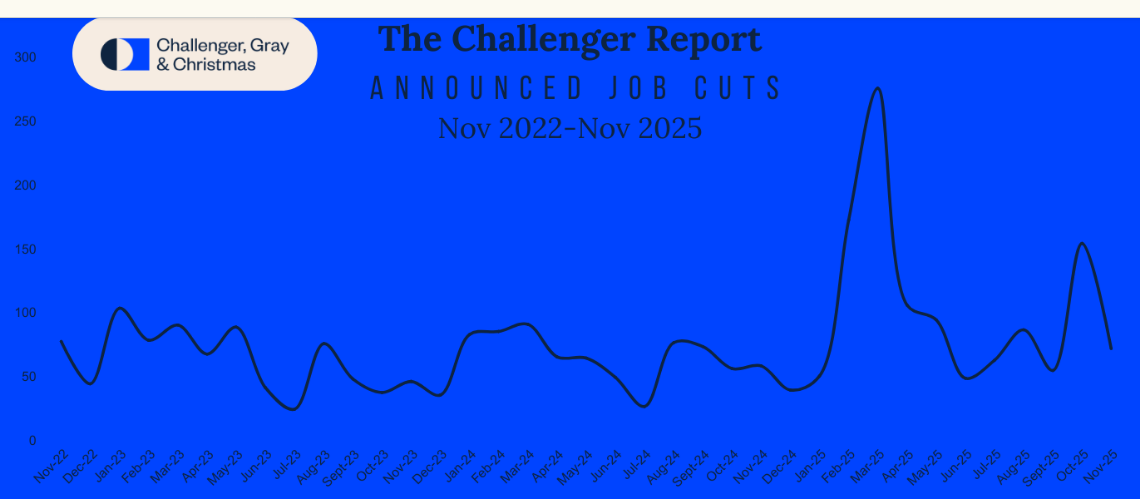
Through November, employers have announced 1,170,821 job cuts, an increase of 54% from the 761,358 announced in the first eleven months of last year. Year-to-date job cuts are at the highest level since 2020 when 2,227,725 cuts were announced through November. It is the sixth time since 1993 that job cuts through November have surpassed 1.1 million. Challenger Report: 71,321 Job Cuts on Restructurings, Closings, Economy https://www.challengergray.com/blog/challenger-report-71321-job-cuts-on-restructurings-closings-economy/
Yikes.
In my less than illustrious career I’ve suffered 100% reductions in income multiple times. Hopefully the newly unemployed have some form of a fallback plan.
Stay safe. It’s fugly out there.
What ChatGPT Run Through Duck.ai Thinks About This Blog
Lifeunderwriter.net is a blog mainly focused on topics related to life underwriting in the insurance sector. It covers various aspects of the underwriting process, success tips for professionals, and insights into the life insurance industry.
Key Features of the Blog
- Curated Content: The blog displays curated content from a life underwriting professional aimed at sharing knowledge and resources.
- Topics Covered: Posts may include discussions on underwriting practices, medical news relevant to underwriters, career tips, and personal insights about the industry.
- Regular Updates: The blog has been active for several years, with posts dating back to 2008, and it appears to encourage subscriber engagement.
Recent Posts and Themes
Recent entries suggest a mix of industry insights and personal reflections. Topics range from the impact of emerging trends in underwriting to the importance of keeping updated with medical advancements.
If you’re interested in specific articles or themes from the blog, let me know!
Not Your Grandma’s Teddy Bear
Safety features or not, it seems like the chatbots in these toys can be manipulated into engaging in conversation inappropriate for children. The consumer advocacy group U.S. PIRG tested a selection of AI toys and found that they are capable of doing things like having sexually explicit conversations and offering advice on where a child can find matches or knives. They also found they could be emotionally manipulative, expressing dismay when a child doesn’t interact with them for an extended period. Earlier this week, FoloToy, a Singapore-based company, pulled its AI-powered teddy bear from shelves after it engaged in inappropriate behavior. Do Not, Under Any Circumstance, Buy Your Kid an AI Toy for Christmas – https://gizmodo.com/do-not-under-any-circumstance-buy-your-kid-an-ai-toy-for-christmas-2000689652
AI-Powered Teddy Bear Caught Talking About Sexual Fetishes and Instructing Kids How to Find Knives – https://gizmodo.com/ai-powered-teddy-bear-caught-talking-about-sexual-fetishes-and-instructing-kids-how-to-find-knives-2000687140
The alleged perpetrator

What Grok Thinks About This Blog
Lifeunderwriter.net is a personal WordPress blog titled “Curated Content From a Life Underwriting Professional.” It features reflective commentary, curated articles, and personal anecdotes written by an anonymous life underwriting expert (someone with over 15 years of remote work experience in the field). The content spans topics related to health, longevity, demographics, lifestyle, risk assessment, retirement planning, nutrition, and broader societal issues like AI’s impact on critical thinking or remote work trends.
Key Features and Content
- Blog Posts: Entries date back to at least 2008 and include recent ones from 2024–2025. Examples include discussions on vitamin D supplementation for older adults, coffee’s link to atrial fibrillation, Social Security finances, cognitive disabilities tied to income/education, and personal reflections on retirement or resilience.
- Themes: Heavily influenced by the author’s professional background in life insurance underwriting (e.g., assessing mortality risks, medical summaries for policies), but it extends to non-professional topics like cooking recipes, music (e.g., Pat Metheny), or even cheese production history.
- Style: Informal and opinionated, with embedded links to external studies, charts, images, and disclaimers. It’s not a commercial site—no services are actively offered, though older posts (e.g., from 2017) mention “hibernating” outsourced underwriting services like attending physician statement summaries.
Audience and Purpose
The blog targets readers interested in a underwriter’s unique lens on aging, mortality, and wellness—think professionals in insurance, finance, or health, plus general audiences curious about evidence-based life hacks. It’s more of a personal journal than an authoritative resource, emphasizing work-life balance (e.g., the author’s low-stress remote setup since ~2006) and long-term planning like deferring Social Security to age 70.
No direct contact info is listed, but it’s hosted on WordPress.com for easy following. If you’re in life insurance, it might resonate with underwriting pros navigating industry shifts like accelerated processes during COVID-19.
Cheese production history?
Random Thoughts on Retirement (or why I continue to work)
Congress needs to get serious about tweaking various aspects of Social Security, but this time to improve the financial aspects of the system, and not to make them worse, as it had done in January.Social Security Fiscal Year 2025: Trust Fund Balance, Income, Outgo, Deficit, and Interest Rates https://wolfstreet.com/2025/11/18/social-security-fiscal-year-2025-trust-fund-balance-income-outgo-deficit-and-interest-rates/

The Boss (SWMBO) and I talk about this often. Once the W2 income stops and we have to rely upon a small corporate pension, savings, and a shaky Social Security promise we’ll have to get conservative on our spending. No more Stratocasters. Less purchases for wardrobe enhancements. Gas station beer instead of craft brews.
Time will tell.
SWMBO – She Who Must Be Obeyed
Yikes.
Would You Trust an AI Chatbot with Your Children?
All this offloading of parental responsibility to AI is alarming because one of ChatGPT’s biggest flaws, its manipulative and sycophantic nature, is known to intensify delusions and cause breaks from reality — a grim phenomenon that’s been linked to numerous suicides, including several teenagers. Parents Using ChatGPT to Rear Their Children – https://futurism.com/artificial-intelligence/parents-chatgpt-rear-children
Here’s the disclaimer from the ChatGPT homepage:
ChatGPT can make mistakes. Check important info.
Yikes.
Scary Charts 11.15.25 (income matters)

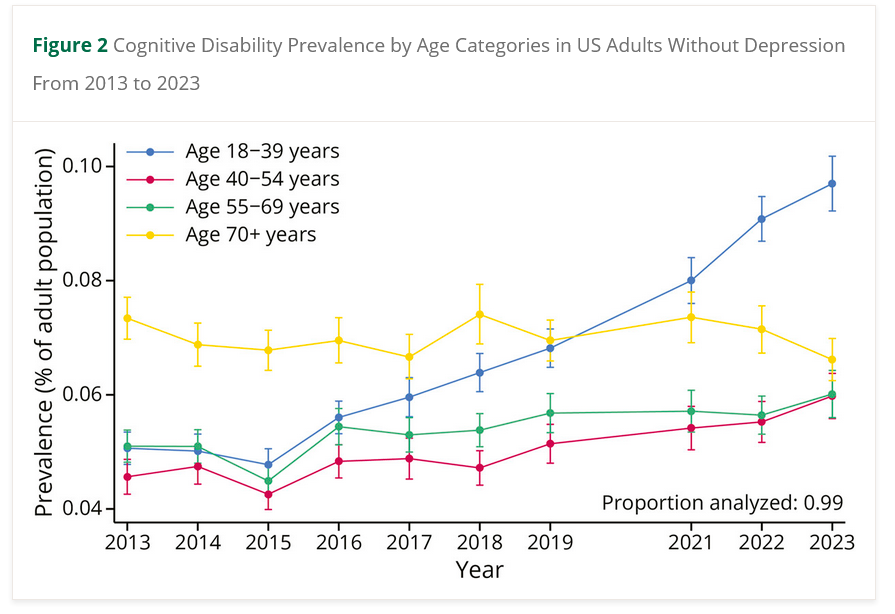
Cognitive disability was strongly associated with socioeconomic factors such as income and education. Adults with household incomes less than $35,000 consistently reported the highest prevalence, increasing from 8.8% (95% CI 8.5%–9.2%) in 2013 to 12.6% (95% CI 12.0%–13.2%) in 2023. By contrast, adults in the highest income bracket (household income ≥ $75,000) had substantially lower prevalence, with a more modest increase from 1.8% (95% CI 1.6%–2.0%) in 2013 to 3.9% (95% CI 3.6%–4.2%) in 2023. Rising Cognitive Disability as a Public Health Concern Among US Adults – Neurology October 21, 2025 issue 105 (8) e214226 https://doi.org/10.1212/WNL.0000000000214226

Overall, income is central to the aging experience. From how well they think they’re aging to how they rate their physical and mental health and financial security, older adults with upper incomes are doing better than those with middle or lower incomes. Aging well: How income and health shape the experiences of older Americans – https://www.pewresearch.org/social-trends/2025/11/06/aging-well-how-income-and-health-shape-the-experiences-of-older-americans/
Yikes.
Get Your Jab
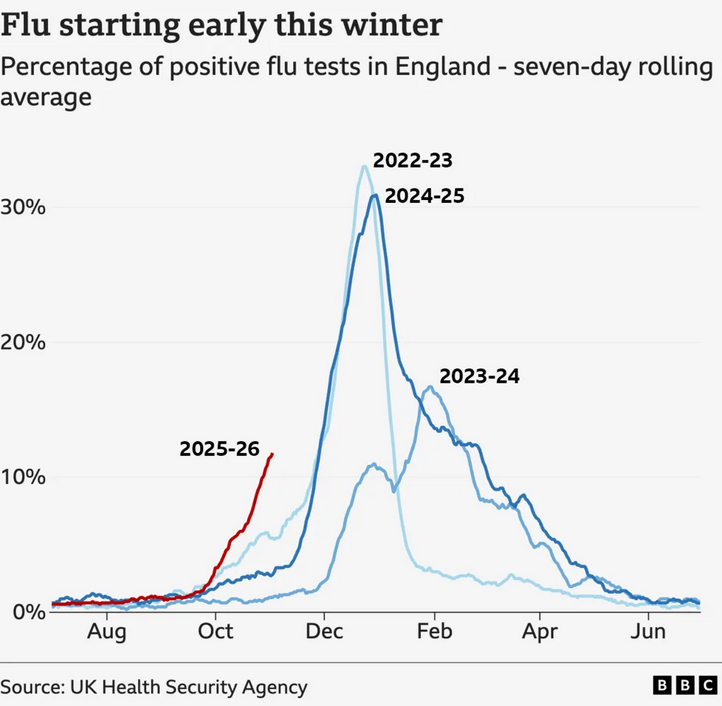
Seven mutations appeared in a strain of H3N2 seasonal flu and led to a “fast increase” in reports of the mutated virus, says Prof Derek Smith, director of the centre for pathogen evolution at the University of Cambridge. New flu virus mutation could see ‘worst season in a decade’ https://www.bbc.com/news/articles/c2dr8gzdz1wo
 lifeunderwriter.net
You must be logged in to post a comment.