Today, the U.S. Food and Drug Administration, in coordination with the Centers for Disease Control and Prevention (CDC), released federal data from the 2022 National Youth Tobacco Survey (NYTS) on e-cigarette use among U.S. youth. The findings, published in Morbidity & Mortality Weekly Report, show that youth use of e-cigarettes remains high, with 2.5 million (9.4%) of the nation’s middle and high school students reporting current e-cigarette use.
New Data Show More Than 2.5 Million U.S. Youth Currently Use E-Cigarettes — https://www.fda.gov/news-events/press-announcements/new-data-show-more-25-million-us-youth-currently-use-e-cigarettes
addiction
News Addiction
The results revealed that 16.5% of people surveyed showed signs of ‘severely problematic’ news consumption. Such individuals frequently became so immersed and personally invested in news stories that the stories dominated the individual’s waking thoughts, disrupted time with family and friends, made it difficult to focus on school or work, and contributed to restlessness and an inability to sleep.
73.6% of those recognized to have severe levels of problematic news consumption reported experiencing mental ill-being “quite a bit” or “very much” — whilst frequent symptoms were only reported by 8% of all other study participants.
61% of those with severe levels of problematic news reported experiencing physical ill-being “quite a bit” or “very much” compared to only 6.1% for all other study participants.
Taylor & Francis Group. “News addiction linked to not only poor mental wellbeing but physical health too, new study shows.” ScienceDaily. http://www.sciencedaily.com/releases/2022/08/220824102936.htm (accessed October 5, 2022).
Social media use can lead to low quality sleep and harm mental health — Health Secrets of a SuperAger

Many people in today’s world live with their smartphones as virtual companions. These devices use electronic social media networks that alert users to updates on friends, favorite celebrities, and global events. Social media has become firmly integrated into a lot of people’s daily lives. According to the Pew Research Center, 72% of people in the […]
Social media use can lead to low quality sleep and harm mental health — Health Secrets of a SuperAger
Thank you Tony.
Marijuana and hallucinogen use among young adults reached all-time high in 2021
Alcohol remains the most used substance among adults in the study, though past-year, past-month, and daily drinking have been decreasing over the past decade. Binge drinking (five or more drinks in a row in the past two weeks) rebounded in 2021 from a historic low in 2020, during the early stages of COVID-19 pandemic. On the other hand, high-intensity drinking (having 10 or more drinks in a row in the past two weeks) has been steadily increasing over the past decade and in 2021 reached its highest level ever recorded since first measured in 2005.
Marijuana and hallucinogen use among young adults reached all-time high in 2021 — https://www.nih.gov/news-events/news-releases/marijuana-hallucinogen-use-among-young-adults-reached-all-time-high-2021
Yikes!
Got Kids? READ THIS
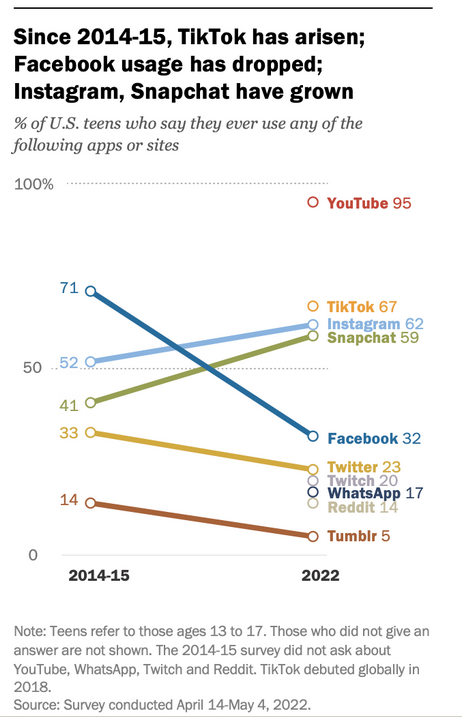
Beyond just online platforms, the new survey finds that the vast majority of teens have access to digital devices, such as smartphones (95%), desktop or laptop computers (90%) and gaming consoles (80%). And the study shows there has been an uptick in daily teen internet users, from 92% in 2014-15 to 97% today. In addition, the share of teens who say they are online almost constantly has roughly doubled since 2014-15 (46% now and 24% then).These are some of the findings from an online survey of 1,316 teens conducted by the Pew Research Center from April 14 to May 4, 2022
Teens, Social Media and Technology 2022 — https://www.pewresearch.org/internet/2022/08/10/teens-social-media-and-technology-2022/

Remember my earlier post I Thought I Told You To Put That Phone Down! This earlier post has additional links to other posts on the topic of social media addiction.
Technology addictions, also commonly known as digital addictions or internet addictions, are often overlooked due to the acceptance that society has placed on using digital devices. Technology addictions often go unnoticed by loved ones because the addicted individual may appear as though they are tending to something important such as work-related tasks on their digital device, when in reality hiding behind the screen is something extraneous. When a technological problem does develop and is noticed it is often not viewed as being an imminent risk akin to an addiction to alcohol or drugs because not only is it more acceptable, but it is also not viewed as being acute or deadly. Despite these beliefs, pathological technology use can indeed be pervasive and detrimental to one’s health and well being. In a growing digital age there is a rapid expansion of digital use and subsequent potential for problematic pathological technology use to ensue.
https://www.familyaddictionspecialist.com/blog/the-6-most-common-types-of-technology-addiction
The link provided above is neither an endorsement or evidence of a previous or existing patient-therapist relationship.
Although I will admit to a quasi-addiction to You Tube for new music.
Cannabinoid Hyperemesis Syndrome
It’s not entirely clear how cannabis hyperemesis syndrome occurs though there are several theories. One is that since cannabinoids have long-half lives and are lipid soluble, they accumulate in the brain and over time cause symptoms, particularly in young people who may have genetic variations in enzymes which lead to further accumulation. Another theory is that there is a thermoregulatory and autonomic imbalance in the limbic system caused by chronic use. Other suggestions are that with long-term consumption cannabis becomes a receptor antagonist, or that they become down-regulated or de-sensitised over time. This reverses the antiemetic effect of cannabis. It seems that chronic over-stimulation of receptors leads to dysregulation of the body’s control of nausea and vomiting, leading to CHS.
Owen Hibberd . What you need to know about Cannabinoid Hyperemesis Syndrome, Don’t Forget the Bubbles, 2022. Available at: https://doi.org/10.31440/DFTB.48627
I am so glad I never inhaled.
Showing Cajones in the Obesity Wars
In Mexico obesity reached epidemic proportions after it joined NAFTA with the United States and Canada in the early 1990s, making processed food more easily available. Diets quickly changed as many people, particularly those on lower incomes, replaced largely healthy traditional staples (corn tortilla, frijoles, Jamaica Water) with highly processed alternatives (hotdogs, nuggets, sodas). Sugar consumption soared and waistlines exploded. In the past 20 years the number of obese and overweight people has tripled, with 75% of the population now overweight.
Mexico also has the sixth highest mortality rate from Covid-19, which has spurred the government to escalate its war against obesity.
Mexico’s War on Obesity Sends Global Junk-Food & Sugary-Drink Giants Scrambling — https://wolfstreet.com/2021/04/13/mexicos-war-on-obesity-sends-global-junk-food-sugary-drink-giants-scrambling/#comments
Alcoholic Hepatitis
We are seeing an increased volume of alcoholic liver disease due to the COVID pandemic. Previously admissions to ICU for alcoholic hepatitis were rare, but these are now occurring with regularity.
IBCC – Alcoholic hepatitis — https://emcrit.org/pulmcrit/alcoholic-hepatitis/
Duh.
Increase in pleasurable effects of alcohol over time can predict alcohol use disorder
A new study out of the University of Chicago Medicine following young adult drinkers for 10 years has found that individuals who reported the highest sensitivity to alcohol’s pleasurable and rewarding effects at the start of the trial were more likely to develop an alcohol use disorder (AUD) over the course of the study.
University of Chicago Medical Center. “Increase in pleasurable effects of alcohol over time can predict alcohol use disorder: New research challenges existing dogma that higher tolerance for stimulating and rewarding effects of alcohol leads to addiction.” ScienceDaily. http://www.sciencedaily.com/releases/2021/01/210105084649.htm (accessed January 7, 2021).
Journal Reference: Andrea King, Ashley Vena, Deborah S. Hasin, Harriet deWit, Sean J. O’Connor, Dingcai Cao. Subjective Responses to Alcohol in the Development and Maintenance of Alcohol Use Disorder. American Journal of Psychiatry, 2021; appi.ajp.2020.2 DOI: 10.1176/appi.ajp.2020.20030247
Uh oh.

The Other Pandemic
Even under the best circumstances, however, addiction is a disease prone to relapse. An estimated 40-60% of people who misuse drugs will return to using them at some point during recovery—and it’s this time that leaves them most vulnerable to overdose, since their tolerance has dropped, often dramatically, during their period of abstinence.
The US covid pandemic has a sinister shadow—drug overdoses — BMJ 2020; 371 doi: https://doi.org/10.1136/bmj.m4751 (Published 17 December 2020)


You must be logged in to post a comment.