Type 2 Diabetes Risk and…Sardines?

Older people with prediabetes who followed a diet rich in sardines for 1 year show significant reductions in risk of developing type 2 diabetes compared with those placed on a similarly healthy diet but without the sardines, results from a new randomized trial show.

 “A 1-year, sardine-enriched type 2 diabetes-preventive diet in an elderly population with prediabetes exerts a greater protective effect against developing type 2 diabetes and cardiovascular events, by improving anthropometric parameters, blood chemistry profile, lipid composition in erythrocytes membranes, and metabolomics data,” report the authors in research published in Clinical Nutrition by Diana Díaz-Rizzolo, PhD, of the Hospital Clinic of Barcelona, Spain, and colleagues.

Sardines Linked to Reduced Type 2 Diabetes Risk — https://www.medscape.com/viewarticle/951528?src=rss#vp_1

Very small study with very interesting findings.

If I only liked sardines.

Diet Matters – You Studied What?

When the researchers looked at the functions of the genes in the three sample types, they found that the ancient and non-industrial groups contained a diverse array of genes linked with the breakdown of starches. This indicates that the diets of the ancient and non-industrialised populations were high in complex carbohydrates, like vegetables and grains.

What 2,000-year-old poo says about our gut bugs – https://www.abc.net.au/news/science/2021-05-13/what-two-thousand-year-old-poo-says-about-our-gut-bugs/100131336

I’m not quite sure what this research tells us other than eat more complex carbohydrates, the Paleo Diet and low-carb people are wrong, and the vegans of the world just might be onto something.

AND I think I missed my calling in life. Studying and researching ancient shit sounds like cool work.

HT – https://www.nakedcapitalism.com/2021/05/links-5-13-2021.html

Update:

Here’s the mortality aspect from a different research study.

Salosensaari, A., Laitinen, V., Havulinna, A.S. et al. Taxonomic signatures of cause-specific mortality risk in human gut microbiome. Nat Commun 12, 2671 (2021). https://doi.org/10.1038/s41467-021-22962-y

Eating Leafy Green Vegetables (just a wee bit) Lowers Heart Disease Risk

Researchers examined data from over 50,000 people residing in Denmark taking part in the Danish Diet, Cancer, and Health Study over a 23-year period. They found that people who consumed the most nitrate-rich vegetables had about a 2.5 mmHg lower systolic blood pressure and between 12 to 26 percent lower risk of heart disease.

Lead researcher Dr Catherine Bondonno from ECU’s Institute for Nutrition Research said identifying diets to prevent heart disease was a priority.

“Our results have shown that by simply eating one cup of raw (or half a cup of cooked) nitrate-rich vegetables each day, people may be able to significantly reduce their risk of cardiovascular disease,” Dr Bondonno said.

Edith Cowan University. “One cup of leafy green vegetables a day lowers risk of heart disease.” ScienceDaily. http://www.sciencedaily.com/releases/2021/05/210504112604.htm (accessed May 9, 2021).

One cup raw or a half cup cooked daily. I’ll be the first to admit I don’t leafy greens on a daily basis. But now since my awareness level is higher I simply need to try harder.

I love spinach.

I don’t understand kale at all.

I have a package of organic baby bok choy leaves in the fridge which I actually bought before I read this article.

I wonder if parsley counts?

Alcohol (just a wee bit) Lowers CVD Mortality Risk

Moderate alcohol intake – defined as no more than one alcoholic drink for women and two for men per day – may be associated with a lower risk of dying from cardiovascular disease when compared with individuals who abstain from drinking or partake in excessive drinking, according to a new study. Of the 53,064 participants, 7,905 (15%) experienced a major adverse cardiovascular event: 17% in the low alcohol intake group and 13% in the moderate alcohol intake group. People who reported moderate alcohol intake were found to have a 20% lower chance of having a major event compared to low alcohol intake (in adjusted analysis), and also had lower stress-related brain activity. Kenechukwu Mezue, MD, the study’s lead author, cautions that these findings should not encourage alcohol use, but that they could open doors to new therapeutics or prescribing stress-relieving activities like exercise or yoga to help minimize stress signals in the brain.

SOURCE: American College of Cardiology, news release, May 6, 2021 accessed 05.08.21 — https://www.acc.org/latest-in-cardiology/articles/2021/05/05/14/48/new-acc-21-research-explores-flu-vaccines-sleep-htn-secondhand-smoke-alcohol-and-stress-acc-2021

My liver understands but does not necessarily agree with the findings of this study.

Showing Cajones in the Obesity Wars

In Mexico obesity reached epidemic proportions after it joined NAFTA with the United States and Canada in the early 1990s, making processed food more easily available. Diets quickly changed as many people, particularly those on lower incomes, replaced largely healthy traditional staples (corn tortilla, frijoles, Jamaica Water) with highly processed alternatives (hotdogs, nuggets, sodas). Sugar consumption soared and waistlines exploded. In the past 20 years the number of obese and overweight people has tripled, with 75% of the population now overweight.

Mexico also has the sixth highest mortality rate from Covid-19, which has spurred the government to escalate its war against obesity.

Mexico’s War on Obesity Sends Global Junk-Food & Sugary-Drink Giants Scrambling — https://wolfstreet.com/2021/04/13/mexicos-war-on-obesity-sends-global-junk-food-sugary-drink-giants-scrambling/#comments

NAFLD: not a benign disease

Non-alcoholic fatty liver disease (NAFLD) is the leading cause of chronic liver disease worldwide, affecting at least a quarter of the global adult population. It is rapidly becoming one of the most common indications for liver transplantation in Western countries. NAFLD is widely considered as the hepatic manifestation of the metabolic syndrome. It is particularly common among patients with type 2 diabetes and obesity. Nonetheless, emerging data suggest that NAFLD is present in a significant proportion of lean individuals. In a systematic review and meta-analysis of 93 studies (involving over 10 million individuals), Ye et al found that 19.2% and 40.8% of patients with NAFLD were lean and non-obese, respectively, according to ethnic-specific body mass index (BMI) cut-offs.1 However, over 80% of the studies included in this systematic review were from Asia, raising the suspicion that NAFLD in lean individuals is a unique phenomenon among Asians, especially as Asians are known to have more central fat deposition and develop NAFLD and metabolic complications at a lower BMI.2

NAFLD in lean individuals: not a benign disease — https://gut.bmj.com/content/early/2021/03/11/gutjnl-2021-324162?rss=1

80% of the studies reviewed were from Asia which helps to explain why NAFLD was found in lean and non-obese people. I wonder how their diets have changed from traditional cuisines to cause this incidence level? Western style fast food?

Also see previous posts:

NAFLD – Why are Life Insurers Taking This Risk at Standard Rates?

NAFLD

NAFLD and Obesity: What Is the Mortality Risk? | Medpage Today

NAFLD = Higher Mortality Rate

Alkaline phosphatase 59 U/L, AST 28. ALT 10 as of September 2020. GGTP 36 as of December 2015. Sharing these numbers for all of my friends from the past who thought I would never live long enough to boast about these numbers.

How to make COVID vaccines more effective: give people vitamin and mineral supplements

For the immune system to fight off infection or generate good protection against a disease following vaccination, it needs a variety of micronutrients. This is likely to be just as true for COVID-19 as for other diseases. Given that malnutrition is common among elderly people, raising their vitamin and mineral levels before they get vaccinated could be a way of boosting the effectiveness of COVID-19 vaccines.

How to make COVID vaccines more effective: give people vitamin and mineral supplementshttps://theconversation.com/how-to-make-covid-vaccines-more-effective-give-people-vitamin-and-mineral-supplements-154974

Follow the link above to read the entire article. And take your multivitamin.

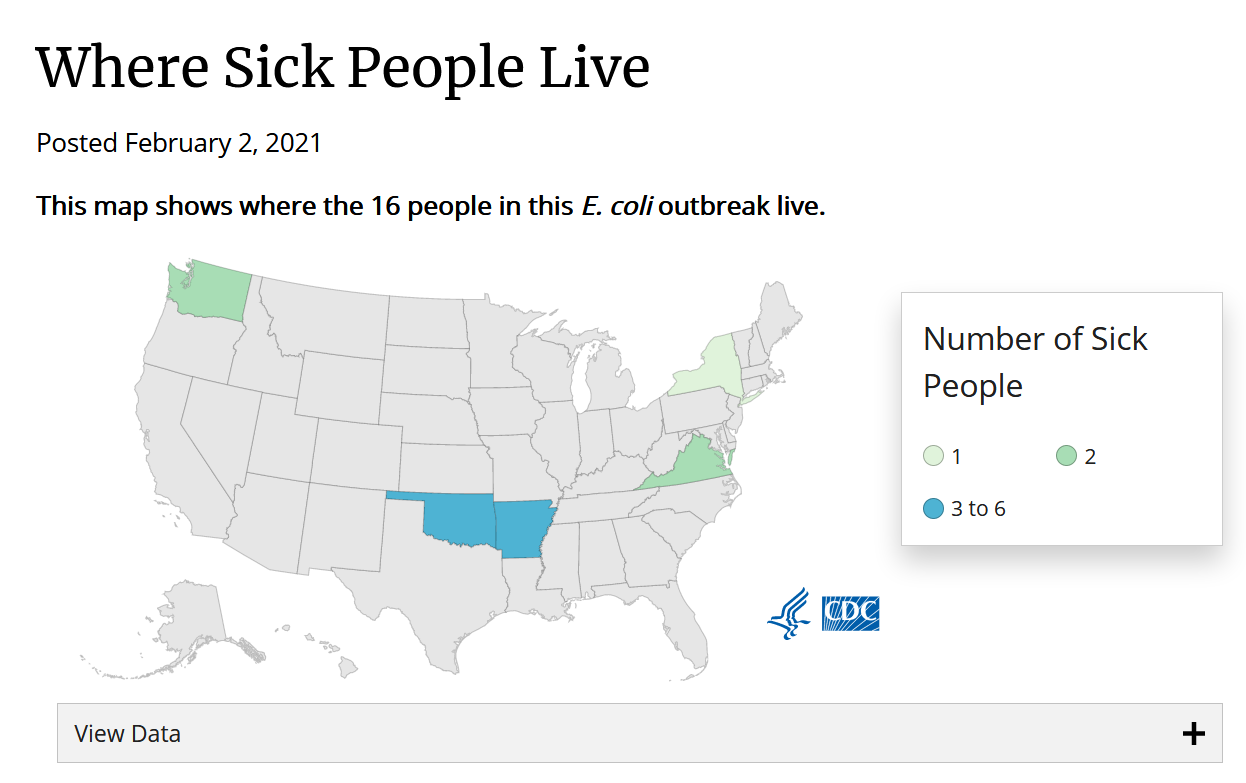
E. coli Outbreak with Unknown Food Source – CDC

As of February 1, 2021, a total of 16 people infected with the outbreak strain have been reported from 5 states. This map shows where sick people live.

Illnesses started on dates ranging from December 23, 2020, to January 7, 2021. This chart shows when people got sick. Recent illnesses may not yet be reported as it usually takes 2 to 4 weeks to link illnesses to an outbreak.

Sick people range in age from 10 to 95 years, with a median age of 31, and 88% are female. Of 12 people with information available, 9 have been hospitalized. Of 11 people with information, 3 developed a type of kidney failure called hemolytic uremic syndrome (HUS). One death has been reported from Washington.

Investigation Details — https://www.cdc.gov/ecoli/2021/o157h7-02-21/details.html

“Unknown food source” bothers me.

Poor gut health is Associated With Severe COVID-19

In a review published this week in mBio, microbiologist Heenam Stanley Kim, Ph.D, from Korea University’s Laboratory for Human-Microbial Interactions, in Seoul, examined emerging evidence suggesting that poor gut health adversely affects COVID-19 prognosis. Based on his analysis, Kim proposed that gut dysfunction — and its associated leaky gut — may exacerbate the severity of infection by enabling the virus to access the surface of the digestive tract and internal organs. These organs are vulnerable to infection because they have widespread ACE2 — a protein target of SARS-CoV-2 — on the surface.”There seems to be a clear connection between the altered gut microbiome and severe COVID-19,” Kim said.

American Society for Microbiology. “Poor gut health connected to severe COVID-19, new review shows.” ScienceDaily. http://www.sciencedaily.com/releases/2021/01/210112085347.htm (accessed January 15, 2021).

Journal Reference: Heenam Stanley Kim. Do an Altered Gut Microbiota and an Associated Leaky Gut Affect COVID-19 Severity? mBio, 2021; 12 (1) DOI: 10.1128/mBio.03022-20

Eat more legumes, plants and other sources of dietary fiber.

Eat less meat, dairy, and eggs.

Vitamin D Deficiency Is Inversely Associated with COVID-19 Incidence and Disease Severity in Chinese People

In the general linear model adjusted for age, sex, comorbidities, and BMI, serum 25(OH)D concentrations were significantly lower among COVID-19 patients than the 2018–2019 controls [ln transformed values of 3.32 ± 0.04 vs. 3.46 ± 0.022 ln (nmol/L), = 0.014]. Multivariable logistic regression showed that male sex (OR: 2.26; 95% CI: 1.06, 4.82), advanced age (≥65 y) (OR: 4.93; 95% CI: 1.44, 16.9), and vitamin D deficiency (<30 nmol/L) (OR: 2.72; 95% CI: 1.23, 6.01) were significantly associated with COVID-19 severity (all < 0.05).

These findings suggested that vitamin D deficiency impacts COVID-19 hospitalization and severity in the Chinese population.

Vitamin D Deficiency Is Inversely Associated with COVID-19 Incidence and Disease Severity in Chinese People — The Journal of Nutrition, Volume 151, Issue 1, January 2021, Pages 98–103, https://doi.org/10.1093/jn/nxaa332

More links are in my last post Vitamin D – What’s Your Level?

I am hoping all of my Chinese relatives read this.