The Latest in COVID-19 News: Week Ending 11.07.20 – NEJM Journal Watch

Over the past week, U.S. researchers reported a secondary infection rate of 53% among household contacts of people with COVID-19. In another study, risk factors for transmission among close contacts of infected people — like sharing a vehicle or being spoken to by the infected person within 2 meters — were detailed. Elsewhere, the FDA warned about false-positives with rapid antigen tests for SARS-CoV-2. And in Denmark, all farmed minks were set to be killed after reports that a SARS-CoV-2 mutation had jumped from minks to humans.

https://www.jwatch.org/fw117204/2020/11/07/latest-covid-19-news-week-ending-nov-7

Click on the link above for the NEJM Journal Watch weekly update. 

Meanwhile in El Paso…

A fourth mobile morgue has been sent to El Paso as the Texas border town grapples with an ever-growing COVID-19 crisis.

Citation: El Paso Gets Fourth Mobile Morgue as COVID-19 Deaths Surge – Medscape – Nov 05, 2020. — https://www.medscape.com/viewarticle/940459?src=rss

Covid-19 Data and Rapid Testing

Rapid Covid-19 tests are being deployed by the millions across the nation. The federal government is sending these tests, which can provide results in minutes, to states for educators, students, nursing home patients, first responders, and other sites. That’s a good thing. But in a rush to get individual test results, we’re making a dangerous public health mistake: We’re losing critical data about Covid-19.

For months, the U.S. has struggled to get accurate information about Covid-19 cases and testing about different demographic groups. As rapid tests surge — and are performed at sites that don’t follow specific Covid-19 data reporting processes — even more information will be lost.

The hidden public health hazard of rapid Covid-19 tests — https://www.statnews.com/2020/11/05/rapid-covid-19-tests-hidden-public-health-hazard/?utm_campaign=rss

More on Vitamin D and Covid-19

As of this article’s writing, there are over two hundred fifty articles on PubMed about the connection between vitamin D and COVID-19. As the research studies are undergoing, evidence is mounting that adequate vitamin D levels may be a protective factor against COVID-19 infection and severity. Here’s what the research shows.

Is there a role for vitamin D in the treatment of COVID-19? — https://www.kevinmd.com/blog/2020/11/is-there-a-role-for-vitamin-d-in-the-treatment-of-covid-19.html

Yesterday I was going to post a link to an article “Over 80 percent of 200 COVID-19 patients in a hospital in Spain have vitamin D deficiency” when I realized I was unable to access or read the original study. It was late, I was tired, and I didn’t feel like crawling through PubMed to find the study. Well someone out there did the crawling for me. If you follow the link to the original article above you’ll find more links to more research on Vitamin D and Covid-19 like the following:

Evidence suggests that vitamin D supplementation could potentially be effective either in treatment or prevention of coronavirus disease 2019 (Covid‐19). Indeed, several studies and trials have begun to investigate the impact of vitamin D supplementation on patients with severe acute respiratory syndrome coronavirus 2 (SARS‐CoV‐2) infection. In this review, we focus on the potential mechanisms of vitamin D in the pathogenesis of Covid‐19. We consider whether deficiency of vitamin D may be one of the underlying biological factors that could explain the excess mortality seen among non‐Caucasians. We also raise several important questions which need to be addressed to provide a clear picture of the extent to which vitamin D supplementation may benefit patients with Covid‐19, particularly those with underlying risk factors.

Vitamin D and Covid‐19: From potential therapeutic effects to unanswered questions — https://doi.org/10.1002/rmv.2159

A little over a month ago I had my annual wellness check up. The medical nerd in me jotted a list of discussion items I wanted to cover during my visit. After catching up on family and checking off the items on my list I asked my doctor if there was anything else she wanted to talk to me about.

No, your list covered all of the things I wanted to talk about except for one. Tell your wife to start taking a Vitamin D supplement.

True story.

Scary Charts From 91-DIVOC

New Confirmed Covid-19 Cases per Dayhttp://91-divoc.com/

91-DIVOC is home to many data-forward, high-quality, interactive, and informative visualizations made during the global pandemic created by Prof. Wade Fagen-Ulmschneider a Teaching Associate Professor of Computer Science at the University of Illinois at Urbana-Champaign (UIUC). With a passion for data, he often teaches thousands of students each year in his courses on Data Structures, Data Visualization, and Data Science. He was selected as one of the National Academy of Engineering’s Frontiers of Engineering Education scholars, awarded the Collins Award for Innovation Teaching, and has been consistently ranked as an excellent instructor by his students for the past ten years. His work on data visualizations has been used by governors of multiple states, featured by websites including Popular Mechanics and The Verge, and has been viewed by millions of readers. [Full Curriculum Vitae, PDF]

https://waf.cs.illinois.edu/

The chart I’ve posted is a simple screenshot. Charts at http://91-divoc.com/ are fully interactive.

Older Adults Living with Younger People Face Increased Risk for COVID-19 Mortality (if you’re Swedish)

Older adults who live with younger people, including those of working age, are at increased risk for COVID-19 mortality, according to a study in The Lancet Healthy Longevity.

Using Swedish population and death registries, researchers studied nearly 275,000 adults aged 70 or older in Stockholm. Roughly 3400 died between March and May 2020, 38% from COVID-19.

Those who lived with at least one person younger than 66 years had a 60% increased risk for COVID-19 death relative to those living with older people. In addition, those living in the most densely populated neighborhoods had a 70% higher risk than those in the least densely populated areas, and those living in care homes had over four times the risk of those in independent housing.

NEJM Journal Watch — https://www.jwatch.org/fw117174/2020/10/27/older-adults-living-with-younger-people-face-increased

Check out the recent Time article for an excellent overview of the Swedish Covid-19 response:

The Swedish way has yielded little but death and misery. And, this situation has not been honestly portrayed to the Swedish people or to the rest of the world.

The Swedish COVID-19 Response Is a Disaster. — https://time.com/5899432/sweden-coronovirus-disaster/

Meanwhile in Houston D614G Mutation – 10.31.20

During the initial wave of the pandemic, 71% of the novel coronaviruses identified in patients in Houston had this mutation. When the second wave of the outbreak hit Houston during the summer, this variant had leaped to 99.9% prevalence. This mirrors a trend observed around the world. A study published in July based on more than 28,000 genome sequences found that variants carrying the D614G mutation became the globally dominant form of SARS-CoV-2 in about a month. SARS-CoV-2 is the coronavirus that causes COVID-19.

University of Texas at Austin – https://medicalxpress.com/news/2020-10-coronavirus-mutation-contagious.htmlMore information: Molecular Architecture of Early Dissemination and Massive Second Wave of the SARS-CoV-2 Virus in a Major Metropolitan Area, mBIO, DOI: 10.1128/mBio.02707-20 , mbio.asm.org/content/11/6/e02707-20

Kind of spooky if you ask me.

Covid-19 in the House? The CDC Says Do This

Forty percent (41 of 102) of infected household members reported symptoms at the time SARS-CoV-2 was first detected by RT-PCR. During 7 days of follow-up, 67% (68 of 102) of infected household members reported symptoms, which began a median of 4 days (IQR = 3–5) after the index patient’s illness onset. The rates of symptomatic and asymptomatic laboratory-confirmed SARS-CoV-2 infection among household members was 36% (95% CI = 29%–43%) and 18% (95% CI = 13%–24%), respectively.

Because prompt isolation of persons with COVID-19 can reduce household transmission, persons who suspect that they might have COVID-19 should isolate, stay at home, and use a separate bedroom and bathroom if feasible. Isolation should begin before seeking testing and before test results become available because delaying isolation until confirmation of infection could miss an opportunity to reduce transmission to others. Concurrently, all household members, including the index patient, should start wearing a mask in the home, particularly in shared spaces where appropriate distancing is not possible. Close household contacts of the index patient should also self-quarantine, to the extent possible, particularly staying away from those at higher risk of getting severe COVID-19. To complement these measures within the household, a potential approach to reduce SARS-CoV-2 transmission at the community level would involve detecting infections before onset of clinical manifestations; this would require frequent and systematic testing in the community with rapidly available results to enable prompt adoption of preventive measures. The feasibility and practicality of this approach is undergoing extensive discussion (9) and study. This ongoing household transmission study will provide critical data regarding the recommended timing and frequency of testing.

citation for this article: Grijalva CG, Rolfes MA, Zhu Y, et al. Transmission of SARS-COV-2 Infections in Households — Tennessee and Wisconsin, April–September 2020. MMWR Morb Mortal Wkly Rep. ePub: 30 October 2020. DOI: http://dx.doi.org/10.15585/mmwr.mm6944e1external icon

I was in the grocery store yesterday and The Defiant Ones were obvious. Granted the majority of the shoppers were wearing masks, mandatory by city decree. But The Defiant Ones were strutting about mask-less not caring whether or not they infected others or potentially get infected themselves. It’s going to be a long, hard cold winter.

Update:

After posting my perspective on The Defiant Ones I stumbled upon a small (n=104) study on grocery store workers. Here are the key findings:

The present study fills in the knowledge gap of COVID-19 impacts on grocery/retail market workers during the pandemic, from both physical and psychological perspectives.

In this single store sample (n=104), we found an alarming infection rate of 20% positive SARS-CoV-2 RT-PCR assay result among these workers and the majority (76%) of them were asymptomatic at the time of testing.

Furthermore, employees with direct customer exposure were five times more likely to test positive for SARS-CoV-2.

Our study also found the inability to practice social distancing consistently at work was a significant risk factor for anxiety and depression.

At the same time, commuting to work by public transportation/shared rides was significantly associated with depressive state.

Association between SARS-CoV-2 infection, exposure risk and mental health among a cohort of essential retail workers in the USA — https://oem.bmj.com/content/early/2020/10/11/oemed-2020-106774

I wonder if any of The Defiant Ones know about this study?

Chinese American Families Suffer Discrimination Related to COVID-19

For their research published Oct. 29 in Pediatrics, Cheah and colleagues recruited a cohort of 543 Chinese American parents of school-age children, and 230 of their children aged 10-18 years, to complete online surveys between mid-March and late May 2020. Parents in the cohort were largely foreign born, with all identifying as ethnically Chinese, while their children were mostly U.S. born.

Half of parents and their children (51% of parents and 50% of youth) reported experiencing at least one in-person incident of direct discrimination (assessed using questions derived from a validated scale of racial aggression) related to the pandemic. Cheah and colleagues also reported a high incidence of direct discrimination online (32% of parents and 46% of youth). Additionally, the researchers measured reports of vicarious or indirect discrimination – such as hearing jokes or disparaging remarks about one’s ethnic group – which they used a different adapted scale to capture. More than three-quarters of the cohort reported such experiences.

Chinese American Families Suffer Discrimination Related to COVID-19 – Medscape – Oct 29, 2020. — https://www.medscape.com/viewarticle/940025?src=rss#vp_1
You got a problem with Chinese-Americans?
Go ahead. Pick out the Chinese-American.
I’m Chinese-American too!!! You got a problem with that?
Papa, what’s a Chinese-American?

Papa says no worries. It’s not 1882.

But Papa is just a blues guitarist from the streets of Newark NJ AND who says a Chinaman can’t play the blues?

OK I was never this good and will never be endorsed by Buddy Guy.

Tiny (and not so tiny) Human Disease Vectors – the Princeton-led Study

Children and young adults were found to be potentially much more important to transmitting the virus — especially within households — than previous studies have identified, according to a paper by researchers from the United States and India published Sept. 30 in the journal Science.

Researchers from the Princeton Environmental Institute (PEI), Johns Hopkins University and the University of California, Berkeley, worked with public health officials in the southeast Indian states of Tamil Nadu and Andhra Pradesh to track the infection pathways and mortality rate of 575,071 individuals who were exposed to 84,965 confirmed cases of COVID-19, the disease caused by SARS-CoV-2. It is the largest contact tracing study — which is the process of identifying people who came into contact with an infected person — conducted in the world for any disease.

Lead researcher Ramanan Laxminarayan, a senior research scholar in PEI, said that the paper is the first large study to capture the extraordinary extent to which SARS-CoV-2 hinges on “superspreading,” in which a small percentage of the infected population passes the virus on to more people. The researchers found that 71% of infected individuals did not infect any of their contacts, while a mere 8% of infected individuals accounted for 60% of new infections.

Largest COVID-19 contact tracing study to date finds children key to spread, evidence of superspreaders — https://www.princeton.edu/news/2020/09/30/largest-covid-19-contact-tracing-study-date-finds-children-key-spread-evidence

My original Tiny Human Disease Vector post is below:

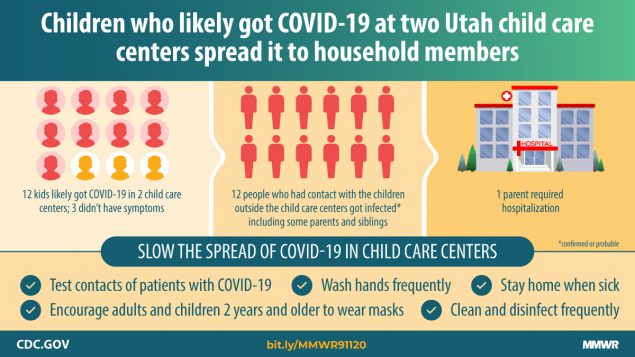
Twelve children acquired COVID-19 in child care facilities. Transmission was documented from these children to at least 12 (26%) of 46 nonfacility contacts (confirmed or probable cases). One parent was hospitalized. Transmission was observed from two of three children with confirmed, asymptomatic COVID-19.

Transmission Dynamics of COVID-19 Outbreaks Associated with Child Care Facilities — Salt Lake City, Utah, April–July 2020 — https://www.cdc.gov/mmwr/volumes/69/wr/mm6937e3.htm?s_cid=mm6937e3_w

Handing out sugar to tiny humans this year is not happening at our house. AND Thanksgiving is going to be very, very tricky this year.