A lot of us now realize barbershops and hair salons are not considered “essential” businesses. Last week I did a shelter in place buzz cut.
03.29.20
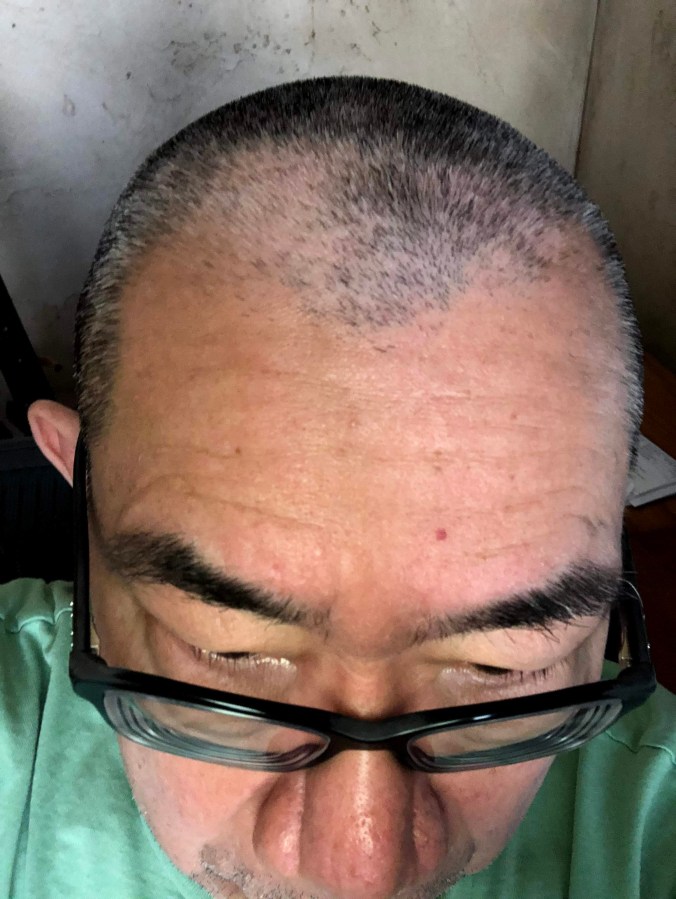
Backside view.
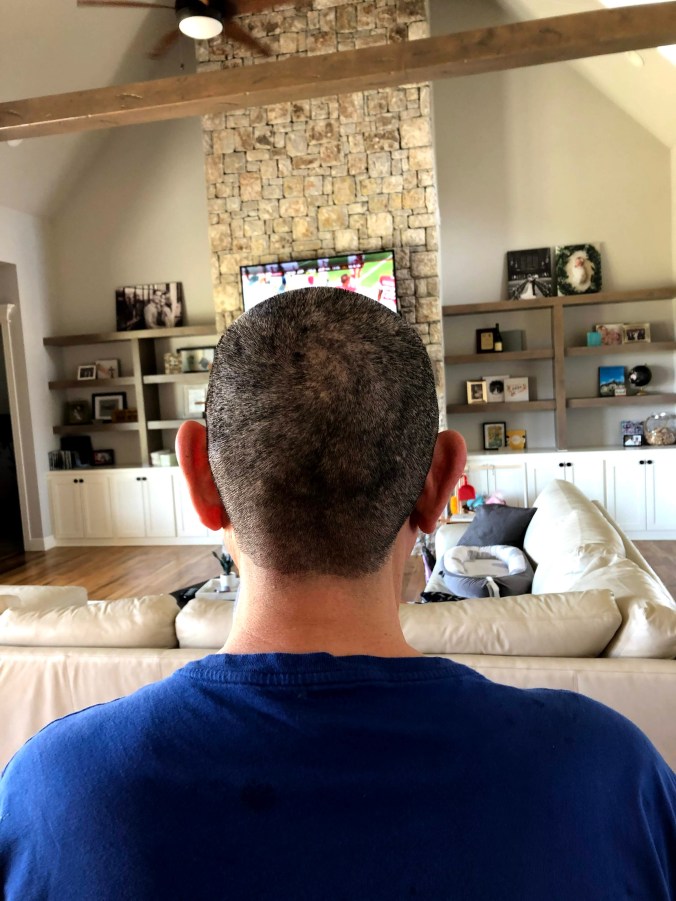
04.05.20

Still short.
A lot of us now realize barbershops and hair salons are not considered “essential” businesses. Last week I did a shelter in place buzz cut.
03.29.20
Backside view.
04.05.20
Still short.
I am back in my home office learning and sharing about shelter in place. Yesterday my son helped me cut my hair. He’s been cutting his own hair since medical school. As the doctor inspected my work he said,
“You missed a few spots.”
So he finished up what I started.
Today I researched “essential” businesses.
Barbershops are not considered “essential”
I expected this hence the shelter in place buzz cut.
Yes, it’s real short. Top view.
Backside view.
How to maintain your mental health while working from home
Pretty good article online at Fast Company.
I’ve been working from home since 2006. As a result social distancing and hoarding come naturally now. The article has several good suggestions and well worth reading.
Personally I would add one more suggestion to the list: your favorite music. Today is a Willie Day.
I roll in my bed, unable to sleep. I listen to BBC talk about the craziness that took over the world, preoccupied with this one question. What question? It’s not: “Why, Corona?” For that, I already have more answers than I want. Scientists say that COVID19 is an animal virus. It spread to humans from…
What does cable news do to your brain? A neurosurgeon explains.
The availability of up to the minute information, presented 24/7/365, could assist a democratic society in making the best choices in determining its future. That was the promise of cable news. Unfortunately, cable news has fallen short of its potential and has led to the further polarization of America. More than that, it has changed the way your brain works.
Does cable news change how your brain works?
Possibly. But I take no chances. I don’t watch cable news networks.
Daddy always told me you go to college so that they can teach you how to think.
Unfortunately nowadays institutions of higher “education” teach the young what to think, not how to think.
Think about this for a while.
If you can.
More Social Media Use Linked to More Depression and Anxiety in Teens
Bupropion? Xanax?
No. Just take their phones away.
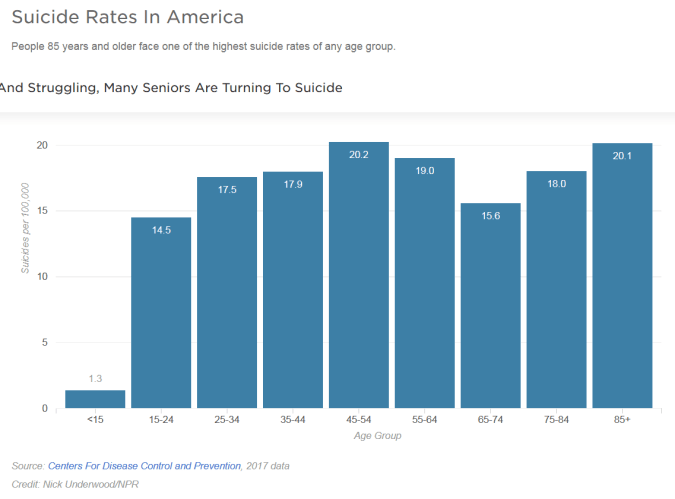
Across the country, suicide rates have been on the rise, and that rise has struck the nation’s seniors particularly hard. Of the more than 47,000 suicides that took place in 2017, those 65 and up accounted for more than 8,500 of them, according to the Centers for Disease Control and Prevention. Men who are 65 and older face the highest risk of suicide, while adults 85 and older, regardless of gender, are the second most likely age group to die from suicide.
Isolated And Struggling, Many Seniors Are Turning To Suicide
BMJ 2019; 365 doi: https://doi.org/10.1136/bmj.l1255 (Published 10 April 2019) Cite this as: BMJ 2019;365:l1255
Conclusion Stress related disorders are robustly associated with multiple types of cardiovascular disease, independently of familial background, history of somatic/psychiatric diseases, and psychiatric comorbidity.
This study is Open Access and a PDF can be downloaded at the link above.
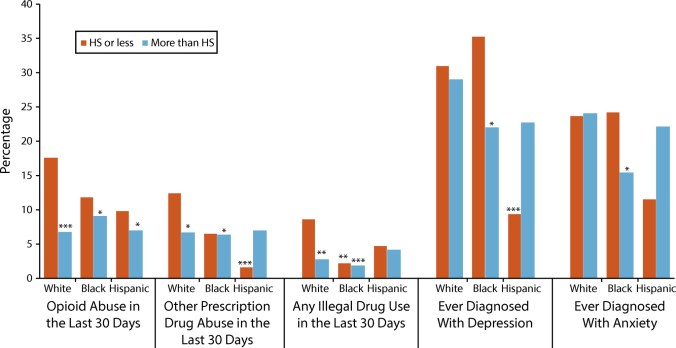
Cross-Sectional Weighted Prevalence of Despair by Race/Ethnicity and Education: United States, 2016–2017
Note. HS = high school. The figure shows results for wave V of the study. The average age was 37 years. Non-Hispanic White with high school or less education was the reference category. We conducted a χ2 test of independence to compare proportions in each group to the reference category. *P < .05; **P < .01; ***P < .001.
The Depths of Despair Among US Adults Entering Midlife
Conclusions. Results suggest that generally rising despair among the young adult cohort now reaching midlife that cuts across racial/ethnic, educational, and geographic groups may presage rising midlife mortality for these subgroups in the next decade.
Our study had potential limitations. We measured despair using several indicators of mental and emotional health and substance use. These indicators do not completely capture all domains of despair; for example, we were unable to account for economic anxiety, reports of physical pain, or hopelessness. We did not examine mortality.


You must be logged in to post a comment.