“In the end, obviously, laughter is serious business, and the inability to laugh, at the world and at ourselves, is often, I believe, a sign of mental illness.”
Richard Russo author of The Destiny Thief
Mental Health
ATTENTION PARENTS – (What that does to the brain, we don’t know…)
Concerns about the mental health impacts of social media activity are longstanding, and have only intensified in recent years. In 2021, for example, internal research at Instagram made public by Frances Haugen showed the drastic mental health impacts of the photo app on teen users – including increased rates of eating disorders among teen girls – and sparked widespread calls for stronger regulation.But TikTok hosts similar harmful content, and experts warn a host of innovative features of the platform raise unique concerns.
What TikTok does to your mental health: ‘It’s embarrassing we know so little’ — https://www.theguardian.com/technology/2022/oct/30/tiktok-mental-health-social-media
All social media is not bad.
But some platforms are worse than others.
Some earlier posts:
More Social Media Use Linked to More Depression and Anxiety in Teens
Quit Social Media – Dr. Cal Newport
I Thought I Told You To Put That Phone Down!
Twitter and Facebook ‘harming children’s development’ – Telegraph
Unhealthful Eating – Pandemic Style
Mindless eating and snacking;
Increased food consumption;
Generalized decrease in appetite or dietary intake;
Eating to cope;
Pandemic-related reductions in dietary intake;
And, a re-emergence or marked increase in eating disorder symptoms.
Approximately 8% of those studied reported extreme unhealthy weight control behaviors, 53% had less extreme unhealthy weight control behaviors and 14% reported binge eating. The study revealed that these outcomes were significantly associated with poorer stress management, greater depressive symptoms and moderate or extreme financial difficulties.
University of Minnesota Medical School. “COVID-19 pandemic has been linked with six unhealthy eating behaviors: Study shows a slight increase in eating disorders, one of the deadliest psychiatric health concerns.” ScienceDaily. http://www.sciencedaily.com/releases/2021/04/210412114740.htm (accessed May 1, 2021).
Pandemic or no pandemic at times I am guilty of number one on the list. I found the absolute best pita crackers, crispy and salty, and…
Emotional Support…Squids and Shrimp
“It has shrimp, it’s great, it’s so relaxing,” they said. “And then at the one hour and 22-minute mark, it gets inexplicably funky for about four minutes, and then goes back to being chill. It’s a whole experience.”
“Wow. This is truly the pinnacle of human creation,” one comment on the shrimp video reads. “The internet was made so I could chill alongside two shrimps.”
https://www.latimes.com/travel/story/2022-09-16/monterey-bay-aquarium-lofi-hiphop-squid-jellyfish-shrimp
I’ve got the shrimp playing now. Maybe I’ll do the squid later.
The pinnacle of human creation!
Social media use can lead to low quality sleep and harm mental health — Health Secrets of a SuperAger

Many people in today’s world live with their smartphones as virtual companions. These devices use electronic social media networks that alert users to updates on friends, favorite celebrities, and global events. Social media has become firmly integrated into a lot of people’s daily lives. According to the Pew Research Center, 72% of people in the […]
Social media use can lead to low quality sleep and harm mental health — Health Secrets of a SuperAger
Thank you Tony.
Got Kids? READ THIS
Beyond just online platforms, the new survey finds that the vast majority of teens have access to digital devices, such as smartphones (95%), desktop or laptop computers (90%) and gaming consoles (80%). And the study shows there has been an uptick in daily teen internet users, from 92% in 2014-15 to 97% today. In addition, the share of teens who say they are online almost constantly has roughly doubled since 2014-15 (46% now and 24% then).These are some of the findings from an online survey of 1,316 teens conducted by the Pew Research Center from April 14 to May 4, 2022
Teens, Social Media and Technology 2022 — https://www.pewresearch.org/internet/2022/08/10/teens-social-media-and-technology-2022/
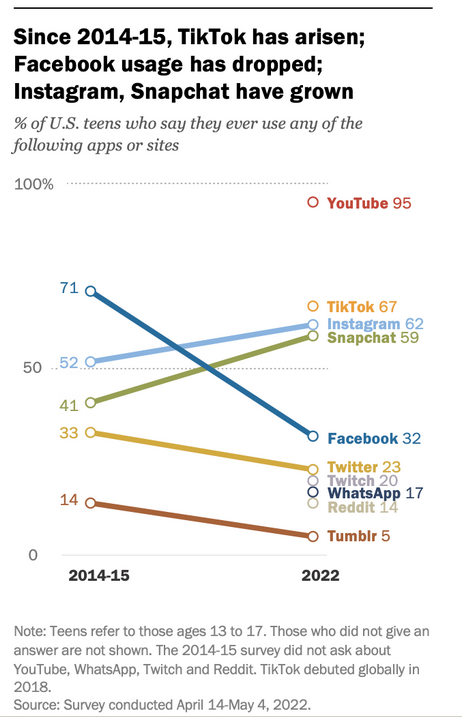

Remember my earlier post I Thought I Told You To Put That Phone Down! This earlier post has additional links to other posts on the topic of social media addiction.
Technology addictions, also commonly known as digital addictions or internet addictions, are often overlooked due to the acceptance that society has placed on using digital devices. Technology addictions often go unnoticed by loved ones because the addicted individual may appear as though they are tending to something important such as work-related tasks on their digital device, when in reality hiding behind the screen is something extraneous. When a technological problem does develop and is noticed it is often not viewed as being an imminent risk akin to an addiction to alcohol or drugs because not only is it more acceptable, but it is also not viewed as being acute or deadly. Despite these beliefs, pathological technology use can indeed be pervasive and detrimental to one’s health and well being. In a growing digital age there is a rapid expansion of digital use and subsequent potential for problematic pathological technology use to ensue.
https://www.familyaddictionspecialist.com/blog/the-6-most-common-types-of-technology-addiction
The link provided above is neither an endorsement or evidence of a previous or existing patient-therapist relationship.
Although I will admit to a quasi-addiction to You Tube for new music.
Loneliness and Mortality
The discomfort of loneliness eases with time. You come to accept solitude like a cracked tile in a corner of the bathroom floor. Eventually, you just stop noticing the defect. For older people, however, one crack could easily, quietly, lead to more. Living in isolation, for people over 50, can spur a 50 percent increased risk of dementia, according to the CDC, and a 32 percent increased risk of stroke. Loneliness is also associated with higher rates of anxiety, depression, and suicide. Prolonged isolation is the equivalent to smoking 15 cigarettes a day. (And older members of marginalized communities are at an even higher risk for all of the above when they’re socially secluded.) In the years since my mom lost her husband and her friends in Florida, her health declined and her shine dimmed. The woman who owns more makeup than Dolly Parton — including Stila compacts from the early aughts she audaciously calls “my vintage cosmetics” — stopped putting on her face.
My Mom Has No Friends — https://www.thecut.com/2022/08/helping-my-mom-make-friends.html
A beautifully written article. I hope you choose to read the entire piece.
Wednesday 08.10.22 – You Need This
Cannabis and Psychosis
Californians voted to legalize recreational pot in 2016. Three years later, emergency room visits for cannabis-induced psychosis went up 54% across the state, from 682 to 1,053, according to state hospital data. For people who already have a psychotic disorder, cannabis makes things worse — leading to more ER visits, more hospitalizations, and more legal troubles, said Dr. Deepak Cyril D’Souza, a psychiatry professor at Yale University School of Medicine who also serves on the physicians’ advisory board for Connecticut’s medical marijuana program.
California May Require Labels on Pot Products to Warn of Mental Health Risks — https://khn.org/news/article/california-marijuana-warning-labels/
Listen to the article above here: https://www.npr.org/sections/health-shots/2022/06/17/1105494283/california-pot-warning-labels
Recreational cannabis use is linked to a heightened risk of emergency care and hospital admission for any cause, finds research published in the open access journal BMJ Open Respiratory Research.
Cannabis use linked to heightened emergency care and hospital admission risks — https://medicalxpress.com/news/2022-06-cannabis-linked-heightened-emergency-hospital.html
 lifeunderwriter.net
You must be logged in to post a comment.