People who think positively about aging are more likely to recover memory

A new study has found that older persons with mild cognitive impairment (MCI), a common type of memory loss, were 30% more likely to regain normal cognition if they had taken in positive beliefs about aging from their culture, compared to those who had taken in negative beliefs.

Yale School of Public Health. “People who think positively about aging are more likely to recover memory.” ScienceDaily. http://www.sciencedaily.com/releases/2023/04/230412131116.htm (accessed April 18, 2023).

Journal Reference – Becca R. Levy, Martin D. Slade. Role of Positive Age Beliefs in Recovery From Mild Cognitive Impairment Among Older Persons. JAMA Network Open, 2023; 6 (4): e237707 DOI: 10.1001/jamanetworkopen.2023.7707

I cannot believe how wonderful the aging process is said no one ever.
Depression and Accelerated Biological Aging

“These patients show evidence of accelerated biological aging, and poor physical and brain health,” which are the main drivers of this association, says Breno Diniz, a UConn School of Medicine geriatric psychiatrist and author of the study, which appears in Nature Mental Health on March 22.

Diniz and colleagues from several other institutions looked at 426 people with late-in-life depression. They measured the levels of proteins associated with aging in each person’s blood. When a cell gets old, it begins to function differently, less efficiently, than a “young” cell. It often produces proteins that promote inflammation or other unhealthy conditions, and those proteins can be measured in the blood. Diniz and the other researchers compared the levels of these proteins with measures of the participants’ physical health, medical problems, brain function, and the severity of their depression.

University of Connecticut. “Depressed, and aging fast: Older adults with late-in-life-depression age biologically older than their chronological peers..” ScienceDaily. http://www.sciencedaily.com/releases/2023/03/230322190947.htm (accessed March 25, 2023).

Journal Reference:

Johanna Seitz-Holland, Benoit H. Mulsant, Charles F. Reynolds III, Daniel M. Blumberger, Jordan F. Karp, Meryl A. Butters, Ana Paula Mendes-Silva, Erica L. Vieira, George Tseng, Eric J. Lenze, Breno S. Diniz. Major depression, physical health and molecular senescence markers abnormalities. Nature Mental Health, 2023; 1 (3): 200 DOI: 10.1038/s44220-023-00033-z

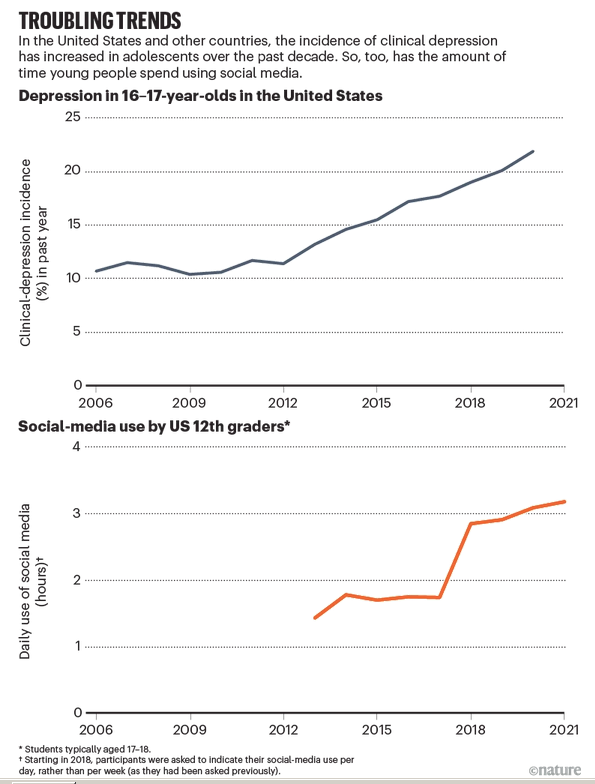
Troubling Trends

Early adolescence is characterized by wide-reaching hormonal changes, as well as physiological changes throughout the body. At the same time, all sorts of neural, cognitive and social shifts are happening. These changes could make social-media environments, such as those provided by Snapchat or TikTok, particularly alluring, but also especially impactful on mental health9–11. Several developmental-psychology studies have shown, for instance, that adolescents — particularly those in early to mid-adolescence — place increased importance on being able to interact with their peers, and on what their peers think of them12. Other studies suggest that although young children tend to view themselves positively, as they become adolescents, their ideas about themselves come to more closely align with what they perceive others to think of them13,14. Still more work has shown that being rejected or not being included has a greater impact on mood for those in early to mid-adolescence than for people older than 2515.

How social media affects teen mental health: a missing link — Nature 614, 410-412 (2023) — https://www.nature.com/articles/d41586-023-00402-9

I Thought I Told You To Put That Phone Down!

If I have to tell you one more time to Put The Phone Away…

Yikes!

Reefer Madness

ADVERTISEMENT

Violence associated with psychosis has also been well-documented. Marijuana use may be associated with increased impulsivity on the same day and the following day relative to days when marijuana was not used. It is also associated with increased hostile behaviors and perceptions of hostility in others on the same day compared to days when marijuana was not used. Cannabis use disorder appears to increase the risk of aggression towards others, particularly among youths. There is also evidence of a moderate association between cannabis use and physical violence.

Psychosis can be caused by various conditions, including licit and illicit substances, particularly cannabis. Cannabis has a higher conversion rate to psychosis than other substances. 32 percent of patients with substance-induced psychosis convert to either bipolar or schizophrenia-spectrum disorders, with the highest conversion rate found with cannabis-induced psychosis (47 percent). There is debate about the causal relationship between cannabis and psychosis. However, this can be demonstrated using Bradford-Hill criteria. Despite this, psychosis is often multifactorial in many instances. Cannabis exposure increases the risk of psychosis, from transient psychotic states to chronic recurrent psychosis. In individuals with established psychosis, cannabis has a negative impact on the course and expression of the illness.

The dark side of cannabis: increased risk of psychosis — https://www.kevinmd.com/2023/01/the-dark-side-of-cannabis-increased-risk-of-psychosis.html

But really, Does Marijuana Have Any Bad Side Effects?

You must be joking about Cannabis and Psychosis, right?

Marijuana and hallucinogen use among young adults reached all-time high in 2021

Marijuana Tied to Ongoing, Subclinical Psychosis in Teens

Social Isolation and Dementia Risk

A study by Huang and colleagues is the first nationally representative cohort study examining the association between social isolation and incident dementia for older adults in community dwelling settings. A cohort of 5,022 older adults participating in the National Health and Aging Trends Study was followed from 2011 to 2020. When adjusting for demographic and health factors, including race, level of education, and number of chronic health conditions, socially isolated adults had a greater risk of developing dementia, compared with adults who were not socially isolated (hazard ratio, 1.27; 95% CI, 1.08 – 1.49). Potential mechanisms to explain this association include the increased risk of cardiovascular disease and depression in older adults who are socially isolated, thereby increasing dementia risk.

Mengru Wang. Geriatrician Advises on Use of Vitamin D Supplementation, Lecanemab, and Social Media for Her Patients – Medscape – Jan 20, 2023 — https://www.medscape.com/viewarticle/987285?src=rss#vp_2

One week ago we had our older adult friends over for dinner. Midweek my wife went out with her friends while I gathered with my friends. Last night was date night and we got out of the house. This evening we’re having dinner at a friend’s house.

Dementia risk reduction activities!

ATTENTION PARENTS – (What that does to the brain, we don’t know…)

Concerns about the mental health impacts of social media activity are longstanding, and have only intensified in recent years. In 2021, for example, internal research at Instagram made public by Frances Haugen showed the drastic mental health impacts of the photo app on teen users – including increased rates of eating disorders among teen girls – and sparked widespread calls for stronger regulation.But TikTok hosts similar harmful content, and experts warn a host of innovative features of the platform raise unique concerns.

What TikTok does to your mental health: ‘It’s embarrassing we know so little’ — https://www.theguardian.com/technology/2022/oct/30/tiktok-mental-health-social-media

All social media is not bad.

But some platforms are worse than others.

Some earlier posts:

Social media use can lead to low quality sleep and harm mental health — Health Secrets of a SuperAger

More Social Media Use Linked to More Depression and Anxiety in Teens

Quit Social Media – Dr. Cal Newport

I Thought I Told You To Put That Phone Down!

Twitter and Facebook ‘harming children’s development’ – Telegraph