Scary Charts 11.15.25 (income matters)

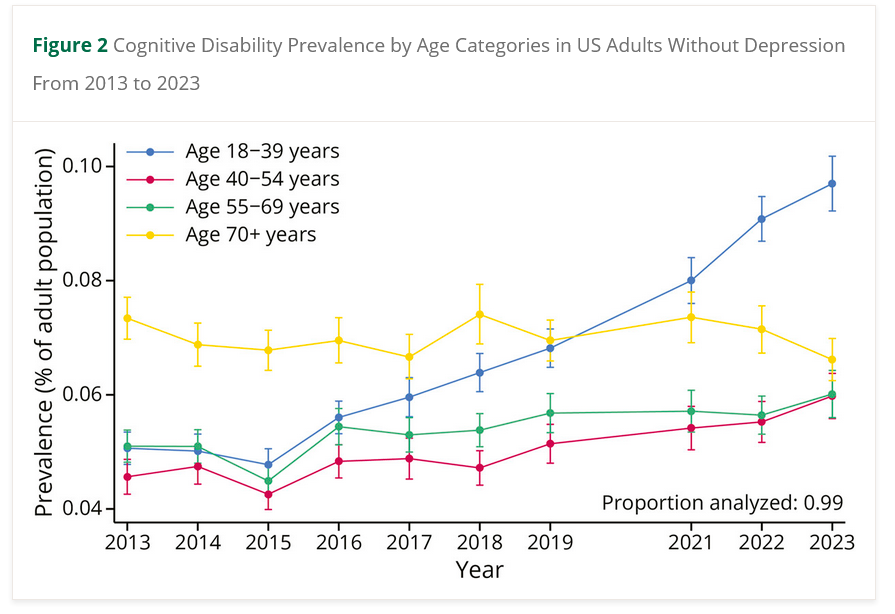
Cognitive disability was strongly associated with socioeconomic factors such as income and education. Adults with household incomes less than $35,000 consistently reported the highest prevalence, increasing from 8.8% (95% CI 8.5%–9.2%) in 2013 to 12.6% (95% CI 12.0%–13.2%) in 2023. By contrast, adults in the highest income bracket (household income ≥ $75,000) had substantially lower prevalence, with a more modest increase from 1.8% (95% CI 1.6%–2.0%) in 2013 to 3.9% (95% CI 3.6%–4.2%) in 2023. Rising Cognitive Disability as a Public Health Concern Among US Adults – Neurology October 21, 2025 issue 105 (8) e214226 https://doi.org/10.1212/WNL.0000000000214226

Overall, income is central to the aging experience. From how well they think they’re aging to how they rate their physical and mental health and financial security, older adults with upper incomes are doing better than those with middle or lower incomes. Aging well: How income and health shape the experiences of older Americans – https://www.pewresearch.org/social-trends/2025/11/06/aging-well-how-income-and-health-shape-the-experiences-of-older-americans/

Yikes.

OSA and Cerebral Microbleeds in Middle-Aged and Older Adults

Moderate to severe OSA may be an independent risk factor associated with incident CMBs in the general adult population. Obstructive Sleep Apnea and Cerebral Microbleeds in Middle-Aged and Older Adultshttps://jamanetwork.com/journals/jamanetworkopen/fullarticle/2840617

Small study (n = 1441), Koreans, and this study has several limitations.

Still yikes!

Antidepressant Use Associated With Cognitive decline in Patients with Dementia

In this cohort study, use of antidepressants was associated with faster cognitive decline in patients with dementia, in particular SSRIs (i.e., citalopram, sertraline and escitalopram) and mirtazapine. These effects appeared to be more pronounced in patients with more severe dementia. Compared with sertraline, escitalopram presented faster cognitive decline, while citalopram was linked to a slower cognitive decline. Additionally, higher dispensed doses of SSRIs were associated with greater cognitive decline, as well as increased risks of severe dementia, all-cause mortality, and fracture. Our study cannot distinguish whether these findings are due to the antidepressants or the underlying psychiatric indication. Mo, M., Abzhandadze, T., Hoang, M.T. et al. Antidepressant use and cognitive decline in patients with dementia: a national cohort study. BMC Med 23, 82 (2025). https://doi.org/10.1186/s12916-025-03851-3

If I develop dementia no SSRI’s for me please.

Low Serum Levels of 3 Carotenoids Linked to Increased Risk for Migraine

The cross-sectional study, which was performed on a nationally representative United States cohort, indicated an inverse association between serum carotenoid levels and migraine risk in adults. https://www.clinicalpainadvisor.com/news/low-serum-levels-of-3-carotenoids-linked-to-increased-risk-for-migraine/

α-Carotene, β-Carotene, β-Cryptoxanthin, Lycopene, Lutein, and Zeaxanthin – https://lpi.oregonstate.edu/mic/dietary-factors/phytochemicals/carotenoids

Yum.

Food for Thought (and memories)

Mealtime can provide opportunities to connect with someone experiencing memory loss and tap into deeply rooted memories. “If you’re going to make your father’s favorite meal, think about how you can delve into it as an experience,” Aguirre says. Dr. Kramer notes that several senses associated with cooking and eating dishes, including smell and taste, are closely related to memory. Both the olfactory bulb, the main receiving center for smell, and the insular cortex and frontal operculum (also called the gustatory cortex), responsible for perception of taste, are closely connected to the amygdala, an area involved in emotional learning. The olfactory nerve, which conveys the sense of smell to the brain, is also close to the hippocampus, one of the most important brain structures for memory. And the combined effect of smell and taste—what neuroscientists who study this field call “flavor”—can be especially powerful at conjuring long-held memories charged with emotion, says Joel Salinas, MD, MBA, FAAN, assistant professor of neurology at NYU Langone Health and chief medical officer at Isaac Health, a clinic in New York City for brain health and memory problems.Favorite Meals May Trigger Memories in People with Dementiahttps://www.brainandlife.org/articles/food-may-trigger-memories-in-people-with-dementia

Researchers Have Mapped all 139,255 Neurons in the Brain of an adult fruit fly

An adult fruit fly’s brain is much more complex, however—and most importantly, the small insects share 60 percent of human DNA, as well 75 percent of the genes that cause genetic diseases, per a statement. As such, understanding the fly’s brain in such detail could hold implications for connections in human brains—and the neural pathways that lead to certain behaviors. Fruit flies, like humans, can get drunk, sing and be kept awake with coffee, suggesting similarities in our brains. https://www.smithsonianmag.com/smart-news/scientists-unveil-the-first-ever-complete-map-of-an-adult-fruit-flys-brain-captured-in-stunning-detail-180985191/

An actuary, an underwriter and a fruit fly walk into a bar…

Another Reason to Exercise (your brain)

Group-based trajectory modeling identified four groups of distinct occupational cognitive demands according to the degree of routine tasks in the participants occupations during their 30s, 40s, 50s and 60s. The researchers analyzed the link between these trajectory groups and clinically diagnosed MCI and dementia in participants in the HUNT4 70+ Study (2017-19). Additionally, the researchers accounted for important dementia risk factors such as age, gender, educational level, income, overall health, and lifestyle habits from assessments made in 1984-86 and 1995-97.  Within age groupings the researchers looked at such occupations as primary school teacher, salesperson, nurse and caregiver, office cleaner, civil engineer, and mechanic, among others.

After adjusting for age, sex, and education, the group with low occupational cognitive demands (the high RTI group) had a 37 percent higher risk of dementia compared to the group with high occupational cognitive demands. Occupations That Are Cognitively Stimulating May Be Protective Against Later-life Dementia https://www.publichealth.columbia.edu/news/occupations-are-cognitively-stimulating-may-be-protective-against-later-life-dementia

Link to the study abstract – https://www.neurology.org/doi/10.1212/WNL.0000000000209353

I hope my spouse doesn’t read this or she’ll never let me retire.

Some Cognitive Skills Improve as We Get Older

When a psychology professor in Michigan looked through his data on interpersonal conflict a decade ago, he discovered something unexpected. The study, which examined differences across cultures and age groups, seemed to show Americans got wiser as they got older. Richard Nisbett was used to research showing poorer mental skills among elderly adults, but his work found they were better at recognizing multiple perspectives, encouraging compromise, and acknowledging the limits of their own knowledge.

Perhaps, he reasoned, navigating conflict got better with age because it was such a specific, experience-based skill. Working memory, which stores short-term facts like newly learned names, may decline but, as people get older, they inevitably accrue more knowledge from having navigated similar situations throughout their lives. Now 82 years old, Nisbett recognizes the improvement in himself. “I’ve noticed situations to avoid, comments not to make, and the importance of apology,” he said.

Presidential age debate obscures a simple fact: Some cognitive skills improve as we get older — https://www.statnews.com/2024/02/22/presidential-election-age-debate-some-cognitive-skills-improve-with-age/

I was going to post this yesterday but I forgot.