Plant Protein Linked to Longer Life

Plant Protein Linked to Longer Life

Link above is to NEJM Journal Watch article.

Conclusions and Relevance  In this large prospective study, higher plant protein intake was associated with lower total and CVD-related mortality. Although animal protein intake was not associated with mortality outcomes, replacement of red meat protein or processed meat protein with plant protein was associated with lower total, cancer-related, and CVD-related mortality.

JAMA Internal Medicine article (Free abstract)

Note: Study focused on Japanese adults.

Low-Fat Dietary Pattern among Postmenopausal Women Influences Long-Term Cancer, Cardiovascular Disease, and Diabetes Outcomes

Conclusions

Reduction in dietary fat with corresponding increase in vegetables, fruit, and grains led to benefits related to breast cancer, CHD, and diabetes, without adverse effects, among healthy postmenopausal US women.

Source: Low-Fat Dietary Pattern among Postmenopausal Women Influences Long-Term Cancer, Cardiovascular Disease, and Diabetes Outcomes

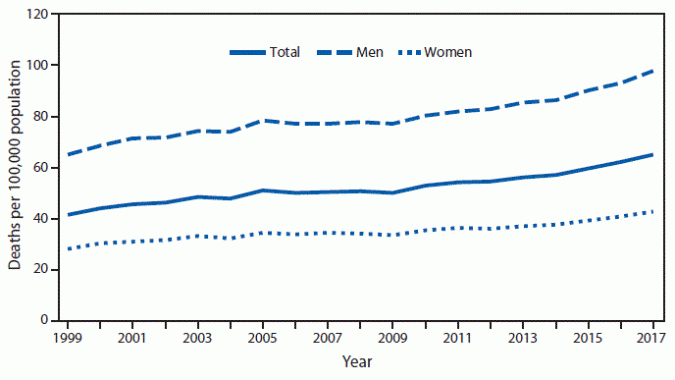
Death by Parkinson Disease

Parkinsons mm6835a6-F

From 1999 to 2017, age-adjusted death rates for Parkinson disease among adults aged ≥65 years increased from 41.7 to 65.3 per 100,000 population. Among men, the age-adjusted death rate increased from 65.2 per 100,000 in 1999 to 97.9 in 2017. Among women, the rate increased from 28.4 per 100,000 in 1999 to 43.0 in 2017. Throughout 1999–2017, the death rates for Parkinson disease for men were higher than those for women.

Source: National Center for Health Statistics, National Vital Statistics System, Mortality Data 1999–2017. https://www.cdc.gov/nchs/data_access/vitalstatsonline.htm.

QuickStats: Age-Adjusted Death Rates for Parkinson Disease Among Adults Aged ≥65 Years — National Vital Statistics System, United States, 1999–2017. MMWR Morb Mortal Wkly Rep 2019;68:773. DOI: http://dx.doi.org/10.15585/mmwr.mm6835a6external icon.

Eat More Fiber

According to Dr. Sadeghi, fiber-rich foods are generally enough to boost and maintain a healthy gut biome. While companies claim to have packaged the secret to digestion via fermented foods—such as yogurt, sauerkraut, kombucha, wine, and cheese—the truth is there is no recognized scientific evidence to support these claims. Dr. Sadeghi stated, “There are no studies which have actually looked at whether these probiotics get incorporated into the gut mucosa or get discarded into the stool. In fact, we don’t even know for sure they aren’t harmful. In a recent study published in Cell, researchers looked at whether probiotics get incorporated into the mucosa post antibiotic therapy to restore gut health.[1] They did colonoscopies on two groups of individuals and samples their biome. Both groups received antibiotics. One group received probiotics and the other group did not receive probiotics. They wanted to know whether taking probiotics restored the health of the gut faster. To their surprise, the group that didn’t get probiotics recovered the biome faster!”

Gastroenterologist Busts Link Between Fermented Dairy and Gut Health

Link to Dr. Angie Sadeghi’s website.


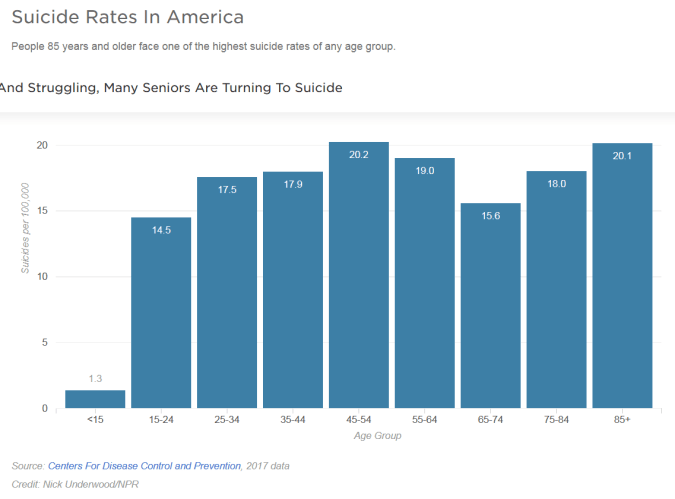
Older Age Suicide

Across the country, suicide rates have been on the rise, and that rise has struck the nation’s seniors particularly hard. Of the more than 47,000 suicides that took place in 2017, those 65 and up accounted for more than 8,500 of them, according to the Centers for Disease Control and Prevention. Men who are 65 and older face the highest risk of suicide, while adults 85 and older, regardless of gender, are the second most likely age group to die from suicide.

Isolated And Struggling, Many Seniors Are Turning To Suicide

Screenshot_2019-07-27 Isolated And Struggling, Many Seniors Are Turning To Suicide(1)

Plant‐Based Diets Are Associated With a Lower Risk of Incident Cardiovascular Disease, Cardiovascular Disease Mortality, and All‐Cause Mortality in a General Population of Middle‐Aged Adults

Plant‐Based Diets Are Associated With a Lower Risk of Incident Cardiovascular Disease, Cardiovascular Disease Mortality, and All‐Cause Mortality in a General Population of Middle‐Aged Adults

In this community‐based cohort of US adults without cardiovascular disease at baseline, we found that higher adherence to an overall plant‐based diet or a pro-vegetarian diet, diets that are higher in plant foods and lower in animal foods, was associated with a lower risk of incident cardiovascular disease, cardiovascular disease mortality, and all‐cause mortality. Healthy plant‐based diets, which are higher in whole grains, fruits, vegetables, nuts, legumes, tea, and coffee and lower in animal foods, were associated with a lower risk of cardiovascular disease mortality and all‐cause mortality.

Our study is one of the few studies that used data from a general population. Prospective studies of Seventh‐Day Adventists in the United States and Canada found that vegetarians had a lower risk of cardiovascular disease mortality and all‐cause mortality compared with nonvegetarians.4 The EPIC (European Prospective Investigation Into Cancer and Nutrition)‐Oxford study of vegetarians, vegans, and health‐conscious individuals reported that the risk of incident ischemic heart disease and deaths caused by circulatory disease was lower in vegetarians than nonvegetarians.5, 24 However, these findings were not replicated in population‐based studies in Australia and the United States.6, 13 Notably, a prior study that used data from a nationally representative sample administered a brief questionnaire that assessed the frequency with which participants consumed specific types of animal food (red meat, processed meat, poultry, or fish or seafood) to characterize participants’ dietary intakes.6 Such dietary measurement may not have adequately represented dietary patterns on the basis of abundance of plant foods relative to animal foods. The plant‐based diet indexes we used in this study captured a wider spectrum of intake of plant foods and animal foods, leveraging the available dietary data, and allowed us to move away from defining plant‐based diets strictly based on exclusion of animal foods.