
Cluttered Memories From a Lifetime of Knowledge
As we age, many of us have difficulty retrieving memories. Researchers propose an explanation for why this might be happening: the brains of older adults allocate more space to accumulated knowledge and have more material to navigate when attempting to access memories.
Cell Press. “Lifetime of knowledge can clutter memories of older adults.” ScienceDaily. http://www.sciencedaily.com/releases/2022/02/220211111852.htm (accessed February 11, 2022).
But this still doesn’t explain why I can’t remember where I put my coffee cup.
More on Vitamin D and Covid-19 – 02.06.22
The records of 1,176 patients admitted between April 2020 and February 2021 to the Galilee Medical Center (GMC) with positive PCR tests were searched for vitamin D levels measured two weeks to two years prior to infection. Patients with vitamin D deficiency (less than 20 ng/mL) were 14 times more likely to have severe or critical case of COVID than those with more than 40 ng/mL. Strikingly, mortality among patients with sufficient vitamin D levels was 2.3%, in contrast to 25.6% in the vitamin D deficient group.
Bar-Ilan University. “Pre-infection deficiency of vitamin D is associated with increased disease severity and mortality among hospitalized COVID-19 patients: Study affirms that sufficient vitamin D levels may positively influence the outcome of infection.” ScienceDaily. http://www.sciencedaily.com/releases/2022/02/220203161135.htm (accessed February 6, 2022).
Links to a few older posts on the same topic.
Vitamin D Treatment and Covid-19 Related Outcomes – Hospital del Mar, Barcelona, Spain
Does Vitamin D Deficiency Raise COVID-19 Risk? – JAMA
More on Vitamin D and Covid-19 Vitamin D and Mortality Risk in People With CVD
Long Term Cannabis Use and Lung Damage
The findings come from the long-running Dunedin Multidisciplinary Health and Development Study, which has documented cannabis use and measured lung function throughout adult life up to age 45 in more than 1000 individuals born in Dunedin in 1972/73.
University of Otago. “How long-term cannabis use can damage lungs.” ScienceDaily. http://www.sciencedaily.com/releases/2022/02/220203192317.htm (accessed February 4, 2022).
Inhaling hot smoke into your lungs over a long period of time. What could possibly go wrong?
Meanwhile in Oklahoma 01.31.22

Since we are not in Southern California you won’t hear about this event on world news tonight.
Fatigue and Higher Mortality
Glynn and her colleagues administered the Pittsburgh Fatigability Scale to 2,906 participants aged 60 or older in the Long Life Family Study, an international study that follows family members across two generations. Participants ranked from 0 to 5 how tired they thought or imagined that certain activities — such as a leisurely 30-minute walk, light housework or heavy gardening — would make them. Follow-up for this work concluded at the end of 2019, to avoid any increased mortality impact from the COVID-19 pandemic, which gave the team an average of 2.7 years of data on each participant. After accounting for a variety of factors that influence mortality, such as depression, pre-existing or underlying terminal illness, age and gender, the team found that participants who scored 25 points or higher on the Pittsburgh Fatigability Scale were 2.3 times more likely to die in the 2.7 years after completing the scale, compared to their counterparts who scored below 25.
University of Pittsburgh. “Feelings of fatigue predict early death in older adults.” ScienceDaily. http://www.sciencedaily.com/releases/2022/01/220124084616.htm (accessed January 27, 2022).
What Supply Chain Issues?
Scary Chart for Sunday 01.23.22
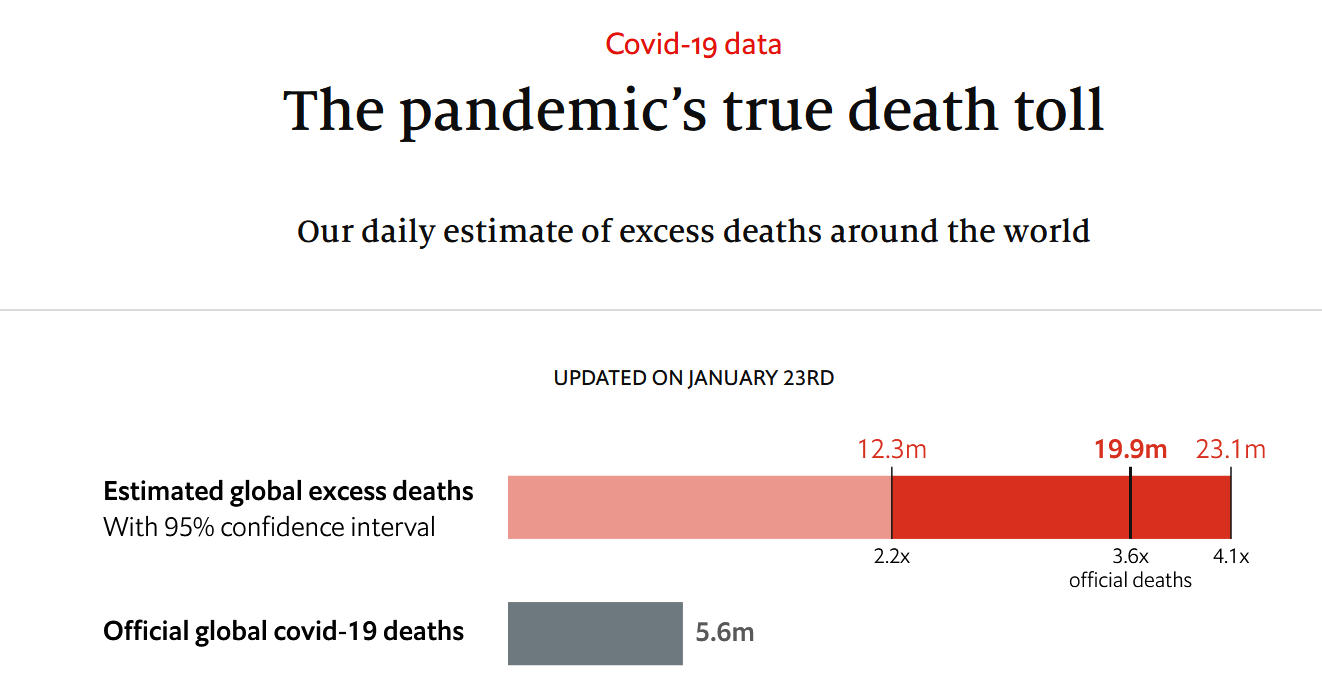
I cannot comment on the study methodology since I am too cheap to buy a subscription to The Economist https://www.economist.com/.
Research Roundup on Aging – nature.com
Frailty measures, microbial ‘fountains of youth’, screening for social isolation, and other highlights from studies into ageing.
https://www.nature.com/articles/d41586-022-00076-9
Aging fascinates me now that I am an aging older adult. I didn’t pay much as much attention to aging when I was younger.
The App That Helps Me Be a More Patient Centered Physician — A Country Doctor Writes:
One of the most rewarding things I do in my clinic happens on my iPhone. When I sit down with a middle aged patient to talk about their cardiovascular risk, I open the risk calculator created by the American Heart Association and the American College of Cardiology. I talk my way through as I enter […]
The App That Helps Me Be a More Patient Centered Physician — A Country Doctor Writes:
The risk calculator is quite useful but I re-blogged this post for its link to the Hale study, which was news to me. This study published in 2004 showed older people between the ages of 70 and 90 who followed a Mediterranean diet have 50% lower rate of all-cause and cause-specific mortality than people who dine on the SAD Western diet. The four primary risk factors were diet, moderate alcohol intake, physical activity, and non-smoking.
Lifestyle matters.


You must be logged in to post a comment.