Know Your Risk – the Three C’s

Know Your Risk – Texas Medical Association was a post that generated a lot of interest.  So today I’ve decided to stay on topic and add to this series to continue offering my insights as a mortality risk assessment professional.  I’ll share both personal strategies and other professional opinions for dealing with Covid-19. I’ve had a long career of researching, learning and understanding what kills people.  Maladaptive and malfunctional behaviors do an incredible amount of damage. A lot of people kill themselves doing stupid things.  Unfortunately with Covid-19 a lot of people might kill others doing stupid things.

We all must adapt different behaviors to deal with a highly infectious disease.  Estimates range between 40 and 45% of Covid-19 infected individuals may be asymptomatic spreaders.  Thus the combination of maladaptive and malfunctional behaviors by others is a huge problem. None of us can control nor influence the behaviors of everyone we come in contact with. We can only control and modify our own personal behaviors to minimize the risk of infection. Risk identification is the first step.

Stay safe.  Wear a mask.

COVID-19 is primarily a respiratory pathogen that spreads through droplets from infected people who talk, shout or sing. Closed spaces make it more likely you could inhale these droplets because the droplets are not diluted.

Mary-Claire Roghmann, MD, MS, is a Professor of Epidemiology and Public Health and Medicine and Associate Dean for Physician Scientist Training at the University of Maryland School of Medicine. She is also a Staff Physician and Epidemiologist for the VA Maryland Health Care System.

I tell family and friends that, as a general rule of thumb, they should avoid the three C’s: crowds, closed spaces with poor ventilation and close contact with anyone outside their household. Crowds bring you into contact with many people who could have COVID-19 even if they’re asymptomatic. The more people around you, the greater your chance of getting infected, particularly if you’re in a hot spot area with a rising number of cases.

Close contact through a hug or close conversation, for example, also enhances this risk. The risk of COVID-19 spread is greatest when the three C’s converge: chatting with a group in a crowded indoor bar is one of the highest risk activities.
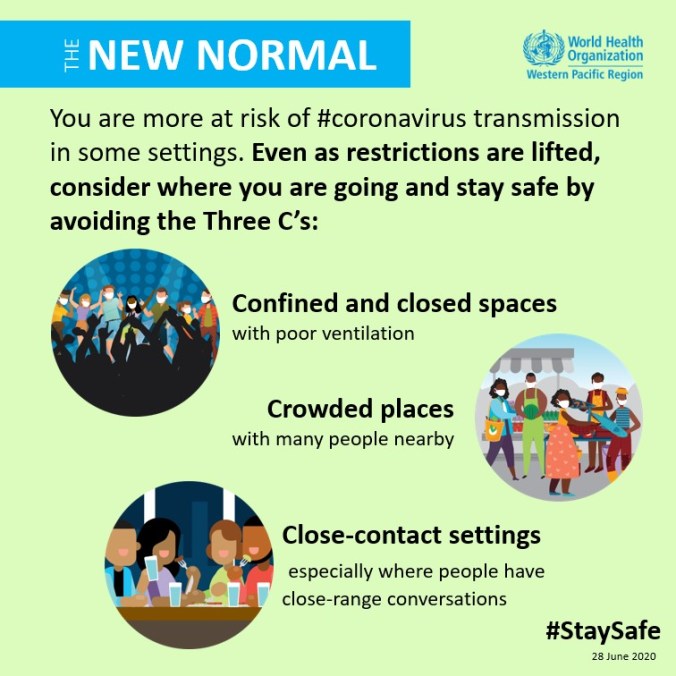
Follow the Three C’s to Reduce COVID-19 Risk

slide8a7868645e0044a5e98d411ea94cbbbfe

img_2009

I’m on the right.  The other guy is my barber.

Everything is Bigger in Texas

Today’s post is not intended to offend anyone or to plainly demonstrate how dumb some Texans are.  I married a Texan.  My two most successful projects are Texans.  I lived for over 20 years in Texas.  But you can’t make this stuff up:

Nearly 22 new cases per 100k people (7 day moving average) as of 07.02.20

In Galveston county less than an hour away by car:

54 new cases per 100k people (7 day moving average) as of 07.02.20

While down at the border:

EMERGENCY ALERT:  STARR COUNTY RESIDENTS:  Today it is with a heavy heart that we announce that we have had 18 deaths in Starr County due to COVID-19, and we had two (2) severely ill patients flown out of the valley for medical assistance, one was flown to San Antonio and one to Dallas. The local and valley hospitals are at full capacity and have no more beds available.

I urge all of our residents to please shelter-in-place, wear face coverings, practice social distancing and AVOID GATHERINGS.
– Your Judge Eloy Vera

Nearly 66 new cases per 100k people (7 day moving average) as of 07.02.20

Meanwhile in Oklahoma County:

No fireworks today.  We’ll have a quiet July 4th, burgers on the grill, potatoes, slaw and some beer.

13 new cases per 100k people (7 day moving average) as of 07.02.20

All statistics are from the Harvard Global Health Institute.  See my previous post Do You Live in a Covid-19 Hotspot?

And if you are offended by my comments on your intelligence I don’t care.

Watch Your Quarantini Intake

Nielsen reports alcohol sales in stores were up 54% in late March compared to that time last year, while online sales were up nearly 500% in late April. According to a Morning Consult poll of 2,200 U.S. adults conducted in early April, 16% of all adults said they were drinking more during the pandemic, with higher rates among younger adults: One in 4 Millennials and nearly 1 in 5 Gen Xers said they had upped their alcohol intake.

COVID-19 pandemic brings new concerns about excessive drinking

Copyright is owned or held by the American Heart Association, Inc., and all rights are reserved. Permission is granted, at no cost and without need for further request, to link to, quote, excerpt or reprint from these stories in any medium as long as no text is altered and proper attribution is made to the American Heart Association News. See full terms of use.

I stumbled upon the same AHA news article in several other websites.  The entire article was reprinted in its entirety and just one website provided attribution to the source.  The copyright notice and proper attribution is included above.

Comparing Drivers of Pandemic Economic Decline 2020 – NBER

The collapse of economic activity in 2020 from COVID-19 has been immense. An important question is how much of that resulted from government restrictions on activity versus people voluntarily choosing to stay home to avoid infection. This paper examines the drivers of the collapse using cellular phone records data on customer visits to more than 2.25 million individual businesses across 110 different industries. Comparing consumer behavior within the same commuting zones but across boundaries with different policy regimes suggests that legal shutdown orders account for only a modest share of the decline of economic activity (and that having county-level policy data is significantly more accurate than state-level data). While overall consumer traffic fell by 60 percentage points, legal restrictions explain only 7 of that. Individual choices were far more important and seem tied to fears of infection. Traffic started dropping before the legal orders were in place; was highly tied to the number of COVID deaths in the county; and showed a clear shift by consumers away from larger/busier stores toward smaller/less busy ones in the same industry. States repealing their shutdown orders saw identically modest recoveries–symmetric going down and coming back. The shutdown orders did, however, have significantly reallocate consumer activity away from “nonessential” to “essential” businesses and from restaurants and bars toward groceries and other food sellers.

Fear, Lockdown, and Diversion: Comparing Drivers of Pandemic Economic Decline 2020

I admit to having a short attention span.  My mind tends to wander a bit, sometimes a lot.  The reason for my cognitive wandering is usually a question which sends me down yet another path of discovery.  So here’s another post in my intermittent series on Post Pandemic Changes in Consumer Behavior

My July 4th weekend will be a quiet weekend.  I’ve downloaded the pdf of this working paper to read.  I’m hoping for some insights that I might have missed.

Do You Live in a Covid-19 Hotspot?

Do You Live in a Covid-19 Hotspot?

Researchers at the Harvard Global Health Institute, in collaboration with a team of scientists, have launched a new interactive map and dashboard that allows you to quickly identify your risk level by state and county. It uses a four-color system, where green represents the lowest level of risk and red represents the highest.

The Harvard map is a nice addition to our trustworthy Covid-19 data sources.


Diabulimia

I live with “the world’s most dangerous” eating disorder

I have been struggling with diabulimia on and off since my diagnosis of type 1 diabetes in 2011, at age 30. I had just started a PhD and spent the first semester walking around campus with all the classic symptoms of type 1 diabetes: famished, dehydrated, constantly needing to urinate, and experiencing rapid weight loss. After my diabetes diagnosis, when I started injecting insulin, I gained the weight back—and then some. It didn’t take long to figure out that omitting insulin was not only an effective weight loss tool, compared with vomiting, it was a much less violent way to purge. Having a history of bulimia nervosa, I thought I had found the holy grail. I could eat what I wanted, not use insulin, and not gain weight.

And I thought Orthorexia Nervosa was bad.

Just One Percent

Potent antibodies found in people recovered from COVID-19Potent antibodies found in people recovered from COVID-19

The researchers first isolated antibodies that could bind to the receptor binding domain (RBD), a crucial region on the virus’s spike protein. They then tested whether the antibodies could neutralize SARS-CoV-2—that is, bind to the virus and stop infection.

Most participants had low or very low levels of antibodies against SARS-CoV-2. Only 1% of the study participants had high levels of antibodies that could neutralize the virus.

Wear a mask.


Researchers report nearly 300 cases of inflammatory syndrome tied to Covid-19 in kids

Researchers report nearly 300 cases of inflammatory syndrome tied to Covid-19 in kids

Addendum to Post Pandemic Changes in Consumer Behavior.

Home schooling.  A lot more home schooling.

With approximately 1000 cases of MIS-C (including, here and below, those that have been classified as PIMS-TS) reported worldwide, do we now have a clear picture of the new disorder, or, as in the story of the blind men and the elephant, has only part of the beast been described? What are its cause and pathogenesis? How should it be diagnosed and treated, and are there wider implications for our understanding of Covid-19?

Link to the NEJM article.

Update 07.02.20

COVID-19 in Kids: New Neurologic, Radiographic Findings