Substantial coronavirus spread seen before symptoms show up — Science Chronicle

A study published in Nature Medicine found that people infected with novel coronavirus (SARS-CoV-2) start shedding the virus two-three days before symptoms show up. Studying 77 pairs of injector-infected pairs, the researchers estimate that 44% of secondary infected people can spread the virus even before symptoms show up. In a study published recently, researchers […]

Since the proportion of pre-symptomatic transmission is substantial, maintaining hand hygiene and social distancing can play an important role in containing virus spread in the community.

via Substantial coronavirus spread seen before symptoms show up — Science Chronicle

Unusual Presentations of COVID-19

“Even in a bad flu season, you never see something like this; it’s just unheard of,” said Harlan Krumholz, MD, a Yale cardiologist…”When they get to the ICU, we are seeing lots of people with acute kidney injuries; lots of people developing endocrine problems; people having blood sugar control issues, coagulation issues, blood clots. We are just waking up to the wide range of ways this virus can affect people. Our ignorance is profound,” but physicians “recognize that this thing has the capability of attacking almost every single organ system, and it may or may not present with respiratory symptoms.”

Read the entire Medscape article at Unusual Presentations of COVID-19

This shit is real and it is scary.

But hey, let’s go to the beach!

Floridamorons

Photo credit: as noted in the photo but stolen shamelessly from the Twitter feed #FloridaMorons


PulmCrit – Hydroxychloroquine fails first meaningful RCT

This is now the third anti-viral therapy to disappoint us within a few weeks (preliminary data on lopinavir/ritonavir and remdesivir were both unimpressive). This raises a question of whether any anti-viral therapies will be beneficial. Especially among the critically ill, patients often present relatively late (at a time-point when viral load is already falling anyway). Much of the pathogenesis of critical illness seems to result from dysregulated inflammation, rather than direct viral cytopathic effect. This raises a question of whether any antiviral treatment will be beneficial for late-presenting patients with severe illness.

PulmCrit – Hydroxychloroquine fails first meaningful RCT

FREE Life Insurance (MA and CT only, other restrictions may apply)

Massachusetts Mutual Life Insurance Company (MassMutual) today announced the launch of MassMutual HealthBridge, which will provide free term life insurance to the brave and resilient frontline healthcare workers across Massachusetts and Connecticut risking their lives during the COVID-19 pandemic.

MassMutual Donates $3B Of Free Life Insurance To Healthcare Workers

Even if you’re a big insurance company hater you have to admit this is pretty awesome.

Vietnam’s Low-Cost COVID-19 Strategy

theaseanpost.com – Hong Kong Nguyen, 13 April 2020 As COVID-19 expands across the southern hemisphere, governments there have a lot to learn from Vietnam’s approach. Clear communication and government-citizen cooperation that leveraged technology are the main reasons why the country has had relatively few cases. Much attention has been paid to other models in Asia. Taiwanese […]

via Vietnam’s Low-Cost COVID-19 Strategy — CVD

Counting The Dead

Data source nature.com article link below the graph.

d41586-020-01008-1_17880850

Why daily death tolls have become unusually important in understanding the coronavirus pandemic

Although figures might not always be comparable, more approaches to counting the dead are useful. Diseases have always cut differing paths through communities, says Maia Majumder, an epidemiologist at Harvard Medical School and Boston Children’s Hospital in Massachusetts. “This disease is going to look enormously different from one context to another, and we need to get comfortable with that,” says Majumder.

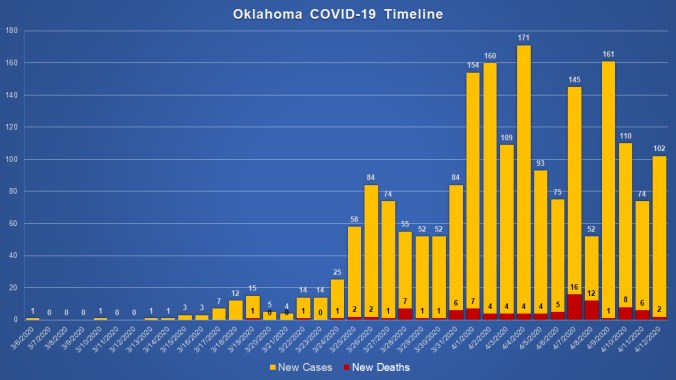
Meanwhile in Oklahoma…

newcasesbargraph041220

linegraph041220

Data Source: Acute Disease Service, Oklahoma State Department of Health.
*As of 2020-04-12 at 7:00 AM.


Why hospitals are hotbeds for coronavirus transmission — Science Chronicle

At 31.9%, the intensive care unit specialised for taking care of COVID-19 patients was the most contaminated in the hospital. And nearly 14% of all commonly used hospital objects and medical equipment had the virus on them. Across the world, hospitals have become the hotspot for novel coronavirus (SARS-CoV-2) infection. And hundreds of healthcare workers […]

via Why hospitals are hotbeds for coronavirus transmission — Science Chronicle