How To Reduce Your Risk of Developing Diabetes

The researchers, from 23 universities in Spain and Harvard Chan School, split 4,746 PREDIMED-Plus participants into an intervention group and a control group and followed their health outcomes for six years. The intervention group adhered to a Mediterranean diet; reduced their caloric intake by about 600 calories per day; engaged in moderate physical activity, such as brisk walking and strength and balance exercises; and received professional support for weight loss control. The control group adhered to a Mediterranean diet without calorie restriction, exercise guidance, or professional support. Participants ranged from age 55 to 75, were overweight or obese, and had metabolic syndrome, but were free of T2D at baseline.

The study found that those in the intervention group had a 31% lower risk of developing T2D compared to those in the control group. Additionally, the intervention group lost an average of 3.3 kilograms and reduced their waist circumference by 3.6 centimeters, compared to 0.6 kilograms and 0.3 centimeters in the control group. Scientists found 3 simple tweaks that cut diabetes risk by 31%https://www.sciencedaily.com/releases/2025/08/250829022835.htm Harvard T.H. Chan School of Public Health. ScienceDaily. http://www.sciencedaily.com/releases/2025/08/250829022835.htm (accessed August 29, 2025).

Guess I’ll cut out beer.

Got Back Pain? Take a Walk

With all due respect to copyright law here’s the link to the Nat Geo article How walking can prevent lower back painhttps://www.nationalgeographic.com/science/article/walking-lower-back-pain-prevention-treatment

And here’s the link to The Lancet study Effectiveness and cost-effectiveness of an individualised, progressive walking and education intervention for the prevention of low back pain recurrence in Australia (WalkBack): a randomised controlled trial https://www.thelancet.com/journals/lancet/article/PIIS0140-6736(24)00755-4/fulltext

I’ve been on and off a heating pad for a week. I finally felt good enough to back to the Y and do some resistance training which included back stretches on one of those medieval looking torture devices. I went for a short walk today and my back feels better.

Keep moving.

The T2D-GENE Trial

The prevalence of type 2 diabetes was significantly lower in the lifestyle intervention group than in the control group.

University of Eastern Finland. “Type 2 diabetes can be prevented by diet and exercise even in individuals with a high genetic risk.” ScienceDaily. http://www.sciencedaily.com/releases/2024/08/240807122749.htm (accessed August 10, 2024).

Effects of Genetic Risk on Incident Type 2 Diabetes and Glycemia: The T2D-GENE Lifestyle Intervention Trial – The Journal of Clinical Endocrinology & Metabolism, dgae422, https://doi.org/10.1210/clinem/dgae422

Remember, Stay as Thin as You Can as Long as You Can.

This Is a Post For Old People – Move More, Take Vitamin D, Statins are not Evil

Quotes are taken from summaries of three different studies. Source: Statins, Vitamin D, and Exercise in Older Adults – Medscape – July 26, 2024. https://www.medscape.com/s/viewarticle/statins-vitamin-d-and-exercise-older-adults.

On a personal level I’ve been taking a low dose statin forever, 100 IU Vitamin D3 and a multivitamin daily, need to move more, Fexofenadine prn, and still not a vegan or drive an EV.

The study found that among older adults aged 75-84, initiation of statin therapy led to a 1.2% risk reduction in major CVD over a 5-year period. For older adults aged 85 and greater, initiation of statins had an even larger impact, leading to a 4.4% risk reduction in major CVD over a 5-year period. The study found that there was no significant difference in adverse effects including myopathy or liver dysfunction in both age groups.

For older adults aged 75 or greater, empiric vitamin D supplementation is recommended because of the possible reduction of risk in all-cause mortality in this population. Of note, this was a grade 2 recommendation by the panel, indicating that the benefits of the treatment probably outweigh the risks. The panel stated that vitamin D supplementation could be delivered through fortified foods, multivitamins with vitamin D, or as a separate vitamin D supplement.

The study found that participants who were more sedentary were less likely to age healthfully, with each additional 2 hours of TV watching per day associated with a 12% reduction in likelihood of healthy aging. Light physical activity was associated with a significant increase in healthy aging, with a 6% increase in the likelihood of healthy aging for each additional 2 hours of light activity. Each additional 1 hour of moderate to vigorous activity was associated with a 14% increase in the likelihood of healthy aging. These findings support discussions with patients that behavior change, even in small increments, can be beneficial in healthy aging.

Aerobic + Resistance (do both)

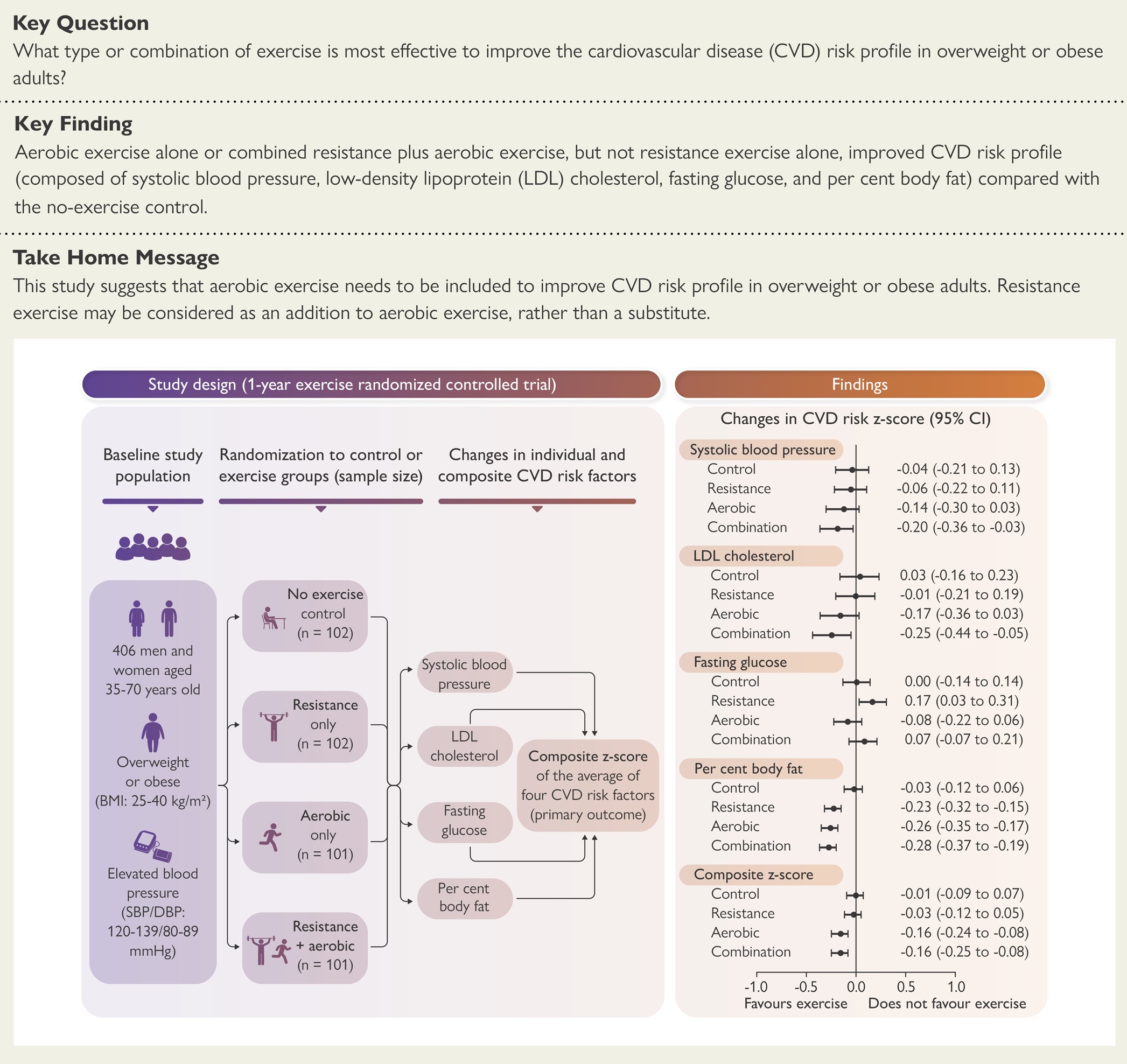
Conclusions: In adults with overweight or obesity, aerobic exercise alone or combined resistance plus aerobic exercise, but not resistance exercise alone, improved composite CVD risk profile compared with the control.

Aerobic, resistance, or combined exercise training and cardiovascular risk profile in overweight or obese adults: the CardioRACE trial – European Heart Journal https://doi.org/10.1093/eurheartj/ehad827

Effects of 1-year resistance, aerobic, or combined exercise training on cardiovascular disease (CVD) risk profile: the CardioRACE trial. Aerobic exercise alone or combined aerobic plus resistance exercise, but not resistance exercise alone, improved CVD risk profile (composite Z-score) compared with no-exercise control (Z-score values below 0 indicate favourable changes in CVD risk factors). BMI, body mass index; CI, confidence interval; CVD, cardiovascular disease; DBP, diastolic blood pressure; SBP, systolic blood pressure.

Exercise Alters Brain Chemistry – May Protect Aging Synapses

When elderly people stay active, their brains have more of a class of proteins that enhances the connections between neurons to maintain healthy cognition.

University of California – San Francisco. “Exercise alters brain chemistry to protect aging synapses: Enhanced nerve transmission seen in older adults who remained active.” ScienceDaily. http://www.sciencedaily.com/releases/2022/01/220107100955.htm (accessed January 8, 2022).

I was about to write a snarky comment but I forgot what it was.

Journal Reference – Kaitlin Casaletto, Alfredo Ramos‐Miguel, Anna VandeBunte, Molly Memel, Aron Buchman, David Bennett, William Honer. Late‐life physical activity relates to brain tissue synaptic integrity markers in older adults. Alzheimer’s & Dementia, 2022; DOI: 10.1002/alz.12530

Exercise intensity not linked to mortality risk in older adults

Of these 1,567 participants, 400 were assigned to two weekly sessions of high intensity interval training (HIIT), 387 were assigned to moderate intensity continuous training (MICT), and 780 to follow the Norwegian guidelines for physical activity (control group), all for five years.

After five years, the overall mortality rate was 4.6% (72 participants).

The researchers found no difference in all cause mortality between the control group (4.7%, 37 participants) and combined HIIT and MICT group (4.5%, 35 participants).

They also found no differences in cardiovascular disease or cancer between the control group and the combined HIIT and MICT group.

BMJ. “Exercise intensity not linked to mortality risk in older adults, finds trial.” ScienceDaily. http://www.sciencedaily.com/releases/2020/10/201007193656.htm (accessed October 8, 2020). — https://www.sciencedaily.com/releases/2020/10/201007193656.htm

Finally some scientific justification for my lack of exercise.

Step It Up!

Previous studies have been done on step counts and mortality. However, they were conducted primarily with older adults or among people with debilitating chronic conditions. This study tracked a representative sample of U.S. adults aged 40 and over; approximately 4,800 participants wore accelerometers for up to seven days between 2003 and 2006. The participants were then followed for mortality through 2015 via the National Death Index. The researchers calculated associations between mortality and step number and intensity after adjustment for demographic and behavioral risk factors, body mass index, and health status at the start of the study.

They found that, compared with taking 4,000 steps per day, a number considered to be low for adults, taking 8,000 steps per day was associated with a 51% lower risk for all-cause mortality (or death from all causes). Taking 12,000 steps per day was associated with a 65% lower risk compared with taking 4,000 steps. In contrast, the authors saw no association between step intensity and risk of death after accounting for the total number of steps taken per day.

Higher daily step count linked with lower all-cause mortality

I am so screwed.

OA is a Pain in the Hands (try exercises)

The source article is here.

For many people, hand strength declines with age, especially if arthritis sets in, making it hard to go about daily tasks. A study published in 2017 in Arthritis & Rheumatology estimated that the overall lifetime risk of hand osteoarthritis is close to 40 percent, with twice as many women as men developing it. People who are obese are also more susceptible—possibly because obesity increases chronic low-level inflammation, which contributes to joint damage.

All of a sudden I’m paying more attention to those infomercials that are selling electric jar openers.  An older friend recommended naproxen sodium.  I’m thinking exercise, thus the link to this short informative article.