

The Covid-19 case totals above are current as of 06.20.20.
At least we still have beds.

The adult ICU bed count is current as of 06.19.20.
The Covid-19 case totals above are current as of 06.20.20.
At least we still have beds.
The adult ICU bed count is current as of 06.19.20.
Dr. Bruce Dart of the Tulsa Health Department reported Monday that the positive rate by our Health Department has spiked to 15%, suggesting the increase in positive cases is not solely due to increased testing. Anecdotally, many of my colleagues report seeing more positive cases on a shift than ever before.
I’m a Tulsa emergency physician and conservative, and the Trump rally is a terrible idea
I’m not a Tulsa emergency physician and I also think the rally is a terrible idea.
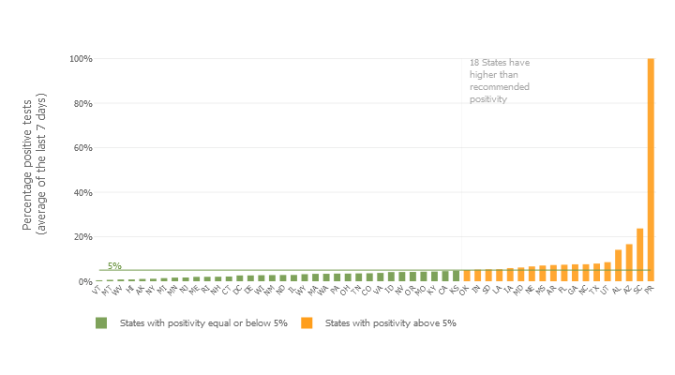
Chart source: Johns Hopkins Coronavirus Resource Center
We have crossed the line. What a difference a day makes.
We just need to test more to find more negatives to get our positivity rate down.
Right?
Wrong.

The graph below compares states’ rate of positivity to the recommended positivity rate of 5% or below. States that meet the WHO’s recommended criteria appear in green, while the states that are not testing enough to meet the positivity benchmark are in orange. Source – Johns Hopkins Coronavirus Resource Center

Oklahoma is teetering on the edge. But Florida is over the edge. New cases in Florida below.

Meanwhile in Oklahoma…


I learned you can grab graphs easily from the Johns Hopkins Coronavirus Resource Center.
I also heard there was a political rally on Saturday in Tulsa.
I have no intentions of being anywhere near downtown Tulsa on Saturday.
But for those of you who plan on going at least we have plenty of beds.

Data source nature.com article link below the graph.

Why daily death tolls have become unusually important in understanding the coronavirus pandemic
Although figures might not always be comparable, more approaches to counting the dead are useful. Diseases have always cut differing paths through communities, says Maia Majumder, an epidemiologist at Harvard Medical School and Boston Children’s Hospital in Massachusetts. “This disease is going to look enormously different from one context to another, and we need to get comfortable with that,” says Majumder.
Meanwhile in Oklahoma…
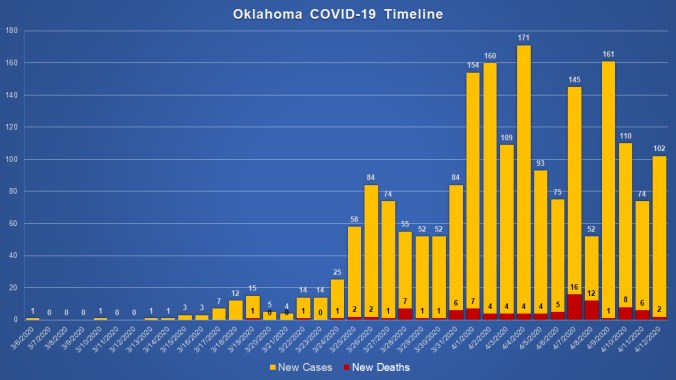

Data Source: Acute Disease Service, Oklahoma State Department of Health.
*As of 2020-04-12 at 7:00 AM.

I am watching the yellow line carefully.
Please stay at home.
I’ve spent most of my life learning about what kills people. Hey, it’s a job and I love it.
The numbers in Oklahoma are blessedly small. Too small for statistical significance but there are some interesting aspects to these numbers. The 2 out of state positives are professional basketball players. We shouldn’t expect a huge increase from out of state since Oklahoma is not exactly a vacation tourist type destination and no one is traveling much nowadays. The first positives were in Tulsa county. That number hasn’t really moved much but Oklahoma county numbers have, a clear indicator of community spread.
The most disturbing numbers are the positives ages 18-64. This is not Wuhan. This is not Italy. This is not Iran. This is not Spain. This is Oklahoma.
Stay safe and act accordingly to your specific locale.
| Positive (In-State) | 29 |
| Positive (Out-of-State) | 2 |
| Negative | 378 |
| PUIs Pending Results | 110 |
| County | COVID-19 Cases by County* |
|---|---|
| Canadian | 2 |
| Cleveland | 4 |
| Jackson | 1 |
| Kay | 2 |
| Oklahoma | 14 |
| Payne | 1 |
| Tulsa | 4 |
| Pawnee | 1 |
| Total | 29 |
| Age Group, Years | COVID-19 Cases* |
|---|---|
| 00-04 | 1 |
| 05-17 | 0 |
| 18-49 | 13 |
| 50-64 | 10 |
| 65+ | 5 |
| Total | 29 |
| Age Range | 0-75 yrs |
| COVID-19 Cases by Gender | |
|---|---|
| Female | 13 |
| Male | 16 |
| Total | 29 |
Data Source: Acute Disease Service, Oklahoma State Department of Health.
*As of 2020-03-18 at 07:00 AM.
A year after Tulsa Remote launched, the first participants — a mix of expats from expensive coastal cities, wanderlusty young adults, and those with roots in the region — say they’ve found many of the things they were looking for: a more comfortable and affordable quality of life, new neighbors they like, enough of an economic cushion to ease the stress of buying new furniture, and a fresh start. Many say they’ll stick around past the end of the one-year program. More than that: Some of them tell stories of positive personal transformation that are so dramatic, they might appear too perfect, almost canned. But after checking in with participants over the course of eight months, I found that many of them remained just as effusive. Maybe it’s something about Tulsa. Or maybe it’s something about Tulsa Remote.
According to an analysis of U.S. Census and Bureau of Labor Statistics data by the remote work consultancy Global Workspace Analytics and Flexjobs, telecommuting grew more than 150% between 2005 and 2017. This year, the American Community Survey found that the fastest-growing commute was no commute, as work-from-home arrangements become more popular everywhere.
I love Tulsa. It’s kind of like a really great restaurant you want to tell all of your friends about but you don’t because if everyone knows about it the place gets too crowded or the food quality slips. But for a city to pay remote workers to come live and work is certainly a grand experiment.
My #1 Project currently lives in Owasso, a suburb of Tulsa. He could have gotten a job anywhere but decided to settle and stick roots in the Tulsa metro.
The Citylab article is long but worth reading if you’re interested in tele-commuting and remote work issues.
Here’s a taste of Oklahoma for y’all.
Link to The Oklahoman article.
(The article may be behind a paywall).

The Paradox
The National Center for Health Statistics narrowed its life expectancy data to census tracts of a few thousand people, which can be a small town, a large rural area or a neighborhood in a large city. Oklahoma’s least healthy areas are small towns and rural areas, but so are some of its healthiest, according to the life expectancy figures.
The highest life expectancy in Oklahoma — 89.4 years — is in a Caddo County census tract that surrounds, but doesn’t include, Anadarko. McCurtain County, in far southeast Oklahoma, is home to the second-highest life expectancy at 89 years. Sparsely populated parts of Pushmataha County, also in rural southeast Oklahoma, have an average life expectancy of 88 years.
Other long-living parts of Oklahoma include the area around Grand Lake State Park in Mayes County (86.7 years), southwest neighborhoods of Stillwater (86.6 years) and rural areas south of Kingfisher (86.1 years).
All of this bothers and intrigues me at the same time.
 lifeunderwriter.net
You must be logged in to post a comment.