Antidepressant Prescriptions Increase 130% for Teenage Girls

The increasing rate of mental health disorders among children and adolescents is a concerning trend that has been observed for several decades, with survey studies revealing dramatic increases in anxiety, depression, and suicidal ideation.1 In the United States, suicide ranks as the second leading cause of death for those aged 10 to 19 years and the third leading cause of death for those aged 15 to 24 years.2 Antidepressant Prescriptions and Mental Healthhttps://publications.aap.org/pediatrics/article/153/3/e2023064677/196661/Antidepressant-Prescriptions-and-Mental-Health

Between January 2016 and December 2022, the monthly antidepressant dispensing rate increased 66.3%, from 2575.9 to 4284.8. Before March 2020, this rate increased by 17.0 per month (95% confidence interval: 15.2 to 18.8). The COVID-19 outbreak was not associated with a level change but was associated with a slope increase of 10.8 per month (95% confidence interval: 4.9 to 16.7). The monthly antidepressant dispensing rate increased 63.5% faster from March 2020 onwards compared with beforehand. In subgroup analyses, this rate increased 129.6% and 56.5% faster from March 2020 onwards compared with beforehand among females aged 12 to 17 years and 18 to 25 years, respectively. In contrast, the outbreak was associated with a level decrease among males aged 12 to 17 years and was not associated with a level or slope change among males aged 18 to 25 years. Antidepressant Dispensing to US Adolescents and Young Adults: 2016–2022https://publications.aap.org/pediatrics/article/153/3/e2023064245/196655/Antidepressant-Dispensing-to-US-Adolescents-and?autologincheck=redirected

Between 2020 and 2022, antidepressant prescriptions for girls aged 12-17 skyrocketed by 130%. Antidepressants Increase 130% for Teen Girls, Drop 7% For Boyshttps://brownstone.org/articles/antidepressants-increase-130-for-teen-girls-drop-7-for-boys/

Yikes.
FDA Announces Recall for Duloxetine

Nitrosamine impurities have prompted a number of drug recalls in recent years, including oral anticoagulants, metformin, and skeletal muscle relaxants.FDA Announces Recall of More than 7000 Bottles of Duloxetine – Medscape – October 28, 2024. – https://www.medscape.com/viewarticle/fda-announces-recall-more-than-7000-bottles-duloxetine

Depressing. But will be very depressing for people on this medication.

Depression and Accelerated Biological Aging

“These patients show evidence of accelerated biological aging, and poor physical and brain health,” which are the main drivers of this association, says Breno Diniz, a UConn School of Medicine geriatric psychiatrist and author of the study, which appears in Nature Mental Health on March 22.

Diniz and colleagues from several other institutions looked at 426 people with late-in-life depression. They measured the levels of proteins associated with aging in each person’s blood. When a cell gets old, it begins to function differently, less efficiently, than a “young” cell. It often produces proteins that promote inflammation or other unhealthy conditions, and those proteins can be measured in the blood. Diniz and the other researchers compared the levels of these proteins with measures of the participants’ physical health, medical problems, brain function, and the severity of their depression.

University of Connecticut. “Depressed, and aging fast: Older adults with late-in-life-depression age biologically older than their chronological peers..” ScienceDaily. http://www.sciencedaily.com/releases/2023/03/230322190947.htm (accessed March 25, 2023).

Journal Reference:

Johanna Seitz-Holland, Benoit H. Mulsant, Charles F. Reynolds III, Daniel M. Blumberger, Jordan F. Karp, Meryl A. Butters, Ana Paula Mendes-Silva, Erica L. Vieira, George Tseng, Eric J. Lenze, Breno S. Diniz. Major depression, physical health and molecular senescence markers abnormalities. Nature Mental Health, 2023; 1 (3): 200 DOI: 10.1038/s44220-023-00033-z

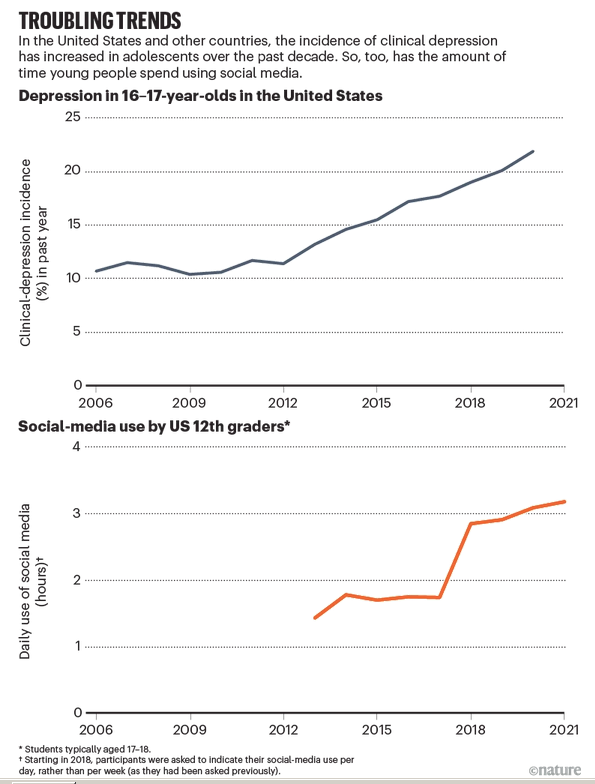
Troubling Trends

Early adolescence is characterized by wide-reaching hormonal changes, as well as physiological changes throughout the body. At the same time, all sorts of neural, cognitive and social shifts are happening. These changes could make social-media environments, such as those provided by Snapchat or TikTok, particularly alluring, but also especially impactful on mental health911. Several developmental-psychology studies have shown, for instance, that adolescents — particularly those in early to mid-adolescence — place increased importance on being able to interact with their peers, and on what their peers think of them12. Other studies suggest that although young children tend to view themselves positively, as they become adolescents, their ideas about themselves come to more closely align with what they perceive others to think of them13,14. Still more work has shown that being rejected or not being included has a greater impact on mood for those in early to mid-adolescence than for people older than 2515.

How social media affects teen mental health: a missing link — Nature 614, 410-412 (2023) — https://www.nature.com/articles/d41586-023-00402-9

I Thought I Told You To Put That Phone Down!

If I have to tell you one more time to Put The Phone Away

Yikes!

I Thought I Told You To Put That Phone Down!

Compared with participants who used less than 120 minutes per day of social media, for example, young adults who used more than 300 minutes per day were 2.8 times as likely to become depressed within six months.The study, which will be published online Dec. 10 and is scheduled for the February 2021 issue of the American Journal of Preventive Medicine, is the first large, national study to show a link between social media use and depression over time.

University of Arkansas. “Increased social media use linked to developing depression.” ScienceDaily. http://www.sciencedaily.com/releases/2020/12/201210074722.htm (accessed December 13, 2020).

Journal Reference

  1. Brian A. Primack, Ariel Shensa, Jaime E. Sidani, César G. Escobar-Viera, Michael J. Fine. Temporal Associations Between Social Media Use and Depression. American Journal of Preventive Medicine, 2020; DOI: 10.1016/j.amepre.2020.09.014

A few more posts for your reading pleasure.

Mental Health, Substance Use, and Suicidal Ideation During the COVID-19 Pandemic — United States, June 24–30, 2020

MentalHealthCOVID19_IMAGE_14Aug20_1200x675-medium

The survey results are in line with recent data from Mental Health America, which indicate dramatic increases in depression, anxiety, and suicidality since the start of the COVID-19 pandemic.

Citation: Czeisler MÉ , Lane RI, Petrosky E, et al. Mental Health, Substance Use, and Suicidal Ideation During the COVID-19 Pandemic — United States, June 24–30, 2020. MMWR Morb Mortal Wkly Rep 2020;69:1049–1057. DOI: http://dx.doi.org/10.15585/mmwr.mm6932a1external icon.


‘Staggering’ Increase in COVID-Linked Depression, Anxiety

Since the start of the COVID-19 pandemic, there has been a dramatic increase in depression, anxiety, psychosis, and suicidality, new research shows.

The most profound health problems were found among adults younger than 25 years. Roughly 90% screened positive for moderate to severe depression, and 80% screened positive for moderate to severe anxiety.

One of the most alarming findings was that in June, 25,498 participants who screened positive for depression reported thinking of suicide or self-harm on “more than half of days to nearly every day.” A total of 14,607 participants said they had these thoughts every day.

‘Staggering’ Increase in COVID-Linked Depression, Anxiety

Sadly, not surprising.

Rising Despair

ajph.2019.305002f3

Cross-Sectional Weighted Prevalence of Despair by Race/Ethnicity and Education: United States, 2016–2017

Note. HS = high school. The figure shows results for wave V of the study. The average age was 37 years. Non-Hispanic White with high school or less education was the reference category. We conducted a χ2 test of independence to compare proportions in each group to the reference category. *P < .05; **P < .01; ***P < .001.

The Depths of Despair Among US Adults Entering Midlife

Conclusions. Results suggest that generally rising despair among the young adult cohort now reaching midlife that cuts across racial/ethnic, educational, and geographic groups may presage rising midlife mortality for these subgroups in the next decade.

Our study had potential limitations. We measured despair using several indicators of mental and emotional health and substance use. These indicators do not completely capture all domains of despair; for example, we were unable to account for economic anxiety, reports of physical pain, or hopelessness. We did not examine mortality.

How One Colorado Town Is Tackling Suicide Prevention

Eight of the top ten states with the highest suicide rates in the nation are in the rural mountain West, including Colorado. The region has been labeled “the suicide belt.” Even scenic mountain resort towns like Aspen and Durango, Colo., have reported upticks in suicide. Suicide is a problem everywhere in rural America though. More than half of those surveyed in a poll conducted by NPR, the Robert Wood Johnson Foundation and the Harvard T.H. Chan School of Public Health said they knew someone personally affected by suicide.

HT Kaiser. 

Link to source article.