Long Covid…(yeah, it’s real)

A total of 669 people were followed (mean age 43 years, 60% female, 25% of healthcare professionals and 69% without underlying risk factors that could be related to complications from COVID-19). At 6 weeks from diagnosis, nearly a third of participants still had one or more symptoms related to COVID-19, mainly fatigue (14%), shortness of breath (9%) and loss of taste or smell (12%). In addition, 6% reported a persistent cough and 3% reported headaches. Dr. Mayssam Nehme, Senior Resident in Professor Guessous’s team and first author of this work, also explains how these patients felt: “In addition to the physical distress of their symptoms, many were very worried: how much longer would it last? Were some after-effects irrecoverable? Even without a clear medical answer, in the current state of knowledge, it is important to accompany concerned patients and to listen to them,” she adds. With this in mind, the HUG has set up a specific consultation for long COVID patients in order to improve their care and guide them through the health system.

Université de Genève. “COVID-19: persistent symptoms in one third of cases.” ScienceDaily. http://www.sciencedaily.com/releases/2020/12/201208111551.htm (accessed December 8, 2020) — https://www.sciencedaily.com/releases/2020/12/201208111551.htm

Journal Reference

  1. Mayssam Nehme, Olivia Braillard, Gabriel Alcoba, Sigiriya Aebischer Perone, Delphine Courvoisier, François Chappuis, Idris Guessous. COVID-19 Symptoms: Longitudinal Evolution and Persistence in Outpatient Settings. Annals of Internal Medicine, 2020; DOI: 10.7326/M20-5926

I’ve been quiet for a few days, no writing, no posting. I conducted a small experiment of allowing contact with tiny human petri dishes while not wearing a mask. Naturally I caught whatever those tiny disease vectors had. The good news? My life partner wore a mask during the encounter. She’s fine.

Masks work.
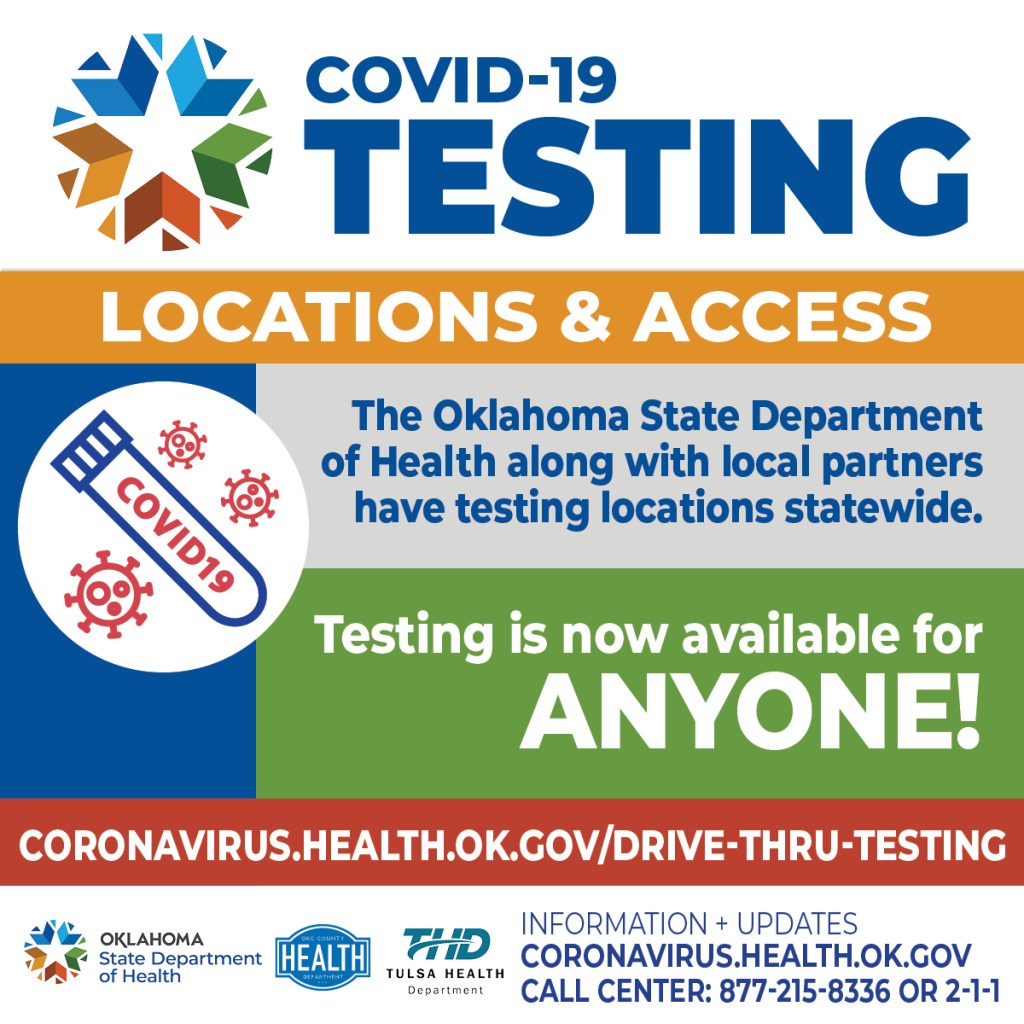
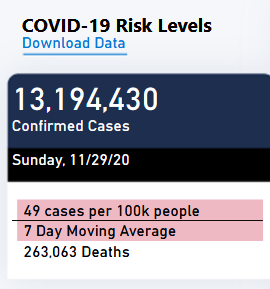
Meanwhile in Oklahoma – 12.04.20

Meanwhile at the CDC…

We don’t have enough vaccine yet for all health care workers. We will eventually, but we don’t yet.

Helen Keipp Talbot — who is known by her middle name — raised serious concerns during the meeting of the Advisory Committee on Immunization Practices about using the vaccines in the frail elderly, noting there are no data yet to suggest the vaccines work in this population.

CDC advisory panel’s lone dissenter on why long-term care residents shouldn’t receive Covid-19 vaccine first — https://www.statnews.com/2020/12/03/cdc-advisory-panels-lone-dissenter-on-why-long-term-care-residents-shouldnt-receive-covid-19-vaccine-first/

Talbot is an associate professor of infectious diseases at Vanderbilt University. Despite the fact no one seems to be listening to her opinions, she makes some excellent observations.

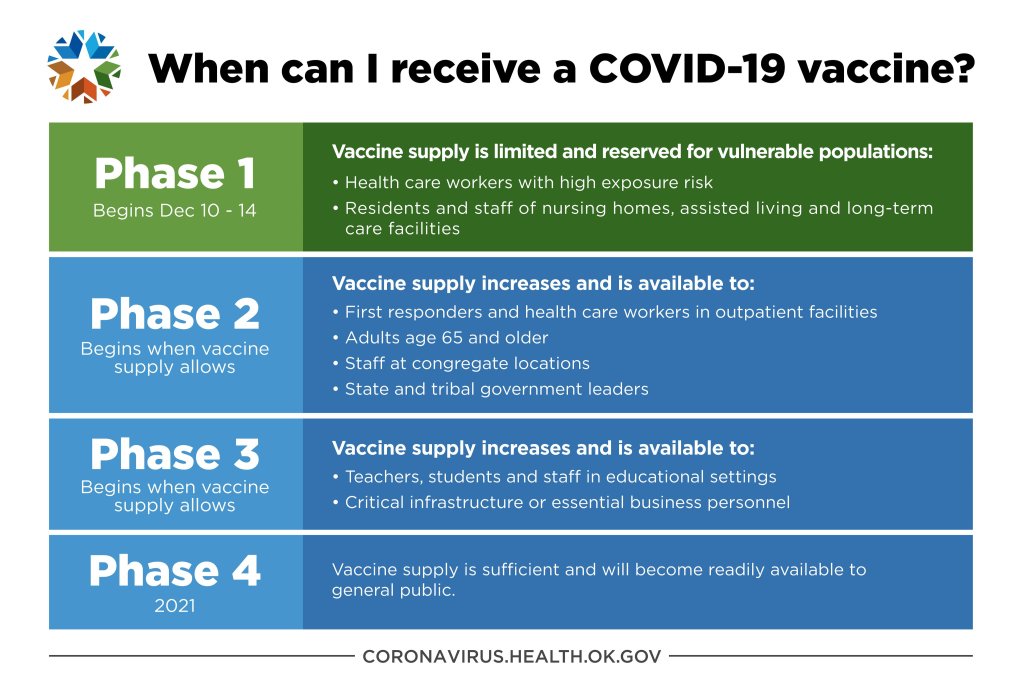
Meanwhile back in Oklahoma

I’m confused as to why people are confused.

Demographic Shift in Covid-19 (not just for old folks anymore)

An October 2 Centers for Disease Control and Prevention (CDC) Morbidity and Mortality Weekly Report documented COVID-19’s demographic changes. Between May and July, the median age of confirmed US cases fell from 46 years to 37 years. The pandemic’s age distribution had already shifted by June, when new cases were highest among people aged 20 through 29 years. From August 2 to September 5, the weekly incidence among people aged 18 through 22 years roughly doubled from 10.5% to 22.5% of total new cases, some of which was likely due to college students going back to school.

Of the almost 7 million COVID-19 cases included in the CDC’s COVID Data Tracker, about 76% have occurred among adults younger than 65 years, with 18- through 29-year-olds making up the largest chunk. The hospitalization and death rates continue to be far greater among seniors but, importantly, not all younger adults experience mild disease. As of late October, death certificate data show that COVID-19 has killed almost 45 000 people aged 15 through 64 years, including about 6300 adolescents and adults younger than 45 years.

Younger Adults Caught in COVID-19 Crosshairs as Demographics Shift — Abbasi J. Younger Adults Caught in COVID-19 Crosshairs as Demographics Shift. JAMA. 2020;324(21):2141–2143. doi:10.1001/jama.2020.21913 – https://jamanetwork.com/journals/jama/fullarticle/2773055

Please stop all comparisons with the flu.

CDC estimates that the burden of illness during the 2019–2020 season was moderate with an estimated 38 million people sick with flu, 18 million visits to a health care provider for flu, 400,000 hospitalizations for flu, and 22,000 flu deaths

Estimated Influenza Illnesses, Medical visits, Hospitalizations, and Deaths in the United States — 2019–2020 Influenza Season — https://www.cdc.gov/flu/about/burden/2019-2020.html

No comparison in my opinion. https://globalepidemics.org/key-metrics-for-covid-suppression/

Shhh…Want to help stop COVID? Be quiet.

There’s another extremely simple thing that might help reduce COVID transmission – quieting down.  This is a bit of a sensitive topic, because we all talk.  And sometimes we all talk too loudly.  But hospitals are filling up so, well, it’s time to talk about talking.

Human beings are wind instrument that generate aerosols.  Small particles are produced as exhaled gas rushes past vibrating vocal cords.  As this gas passes further through the tongue, lips, and teeth, sounds from the vocal cords are modulated – generating additional particles.​1​ Aerosol generation is exacerbated by speaking at higher volumes and at higher pitches.​2,3​ Scientists have dissected this down to specific sounds which generate more particles than others.​4​

There’s no solid, RCT-level evidence that being quiet reduces the spread of COVID. Nor will there ever be (some things are just too difficult to study with an RCT). But quieting down makes sense and it’s very easy and safe to do. There is literally zero cost or risk involved.

PulmCrit – Want to help stop COVID? Be quiet — https://emcrit.org/pulmcrit/quiet-covid/

Shhh…

Covid-19 Jeopardy – Green Tea, Two Varieties of Muscadine Grapes, Cacao Powder and Dark Chocolate

Chemical compounds in foods or beverages like green tea, muscadine grapes and dark chocolate can bind to and block the function of a particular enzyme, or protease, in the SARS-CoV-2 virus, according to a new study by plant biologists at North Carolina State University.

North Carolina State University. “Chemical compounds in foods can inhibit a key SARS-CoV-2 enzyme, study finds.” ScienceDaily. http://www.sciencedaily.com/releases/2020/11/201130131445.htm (accessed November 30, 2020).

Journal Reference:

  1. Yue Zhu, De-Yu Xie. Docking Characterization and in vitro Inhibitory Activity of Flavan-3-ols and Dimeric Proanthocyanidins Against the Main Protease Activity of SARS-Cov-2. Frontiers in Plant Science, 2020; 11 DOI: 10.3389/fpls.2020.601316

I don’t think this is a game changer but it is interesting nonetheless.

Blood Glucose on Admission Predicts COVID-19 Severity

The retrospective, multicenter study was based on data from 11,312 adult patients with confirmed COVID-19 in 109 hospitals participating in Spain’s SEMI-COVID-19 registry as of May 29, 2020. They had a mean age of 67 years, 57% were male, and 19% had a diagnosis of diabetes. A total of 20% (n = 2289) died during hospitalization.

Overall all-cause mortality was 41.1% among those with admission blood glucose levels above 180 mg/dL, 33.0% for those with glucose levels 140-180 mg/dL, and 15.7% for levels below 140 mg/dL. All differences were significant (P < .0001), but there were no differences in mortality rates within each blood glucose category between patients with or without a previous diagnosis of diabetes.

After adjustment for confounding factors, elevated admission blood glucose level remained a significant predictor of death. Compared to < 140 mg/dL, the hazard ratios for 140-180 mg/dL and > 180 mg/dL were 1.48 and 1.50, respectively (both P < .001). (Adjustments included age, gender, hypertension, diabetes, chronic obstructive pulmonary disease, lymphopenia, anemia (hemoglobin < 10 g/dL), serum creatinine, C-reactive protein > 60 mg/L, lactate dehydrogenase > 400 U/L and D-dimer >1000 ng/mL.)

Cite this: Blood Glucose on Admission Predicts COVID-19 Severity in All – Medscape – Nov 30, 2020. — https://www.medscape.com/viewarticle/941716?src=rss#vp_2

Journal abstract link – https://www.tandfonline.com/doi/abs/10.1080/07853890.2020.1836566

“Everybody has a plan until they get punched in the mouth”

“Everybody has a plan until they get punched in the mouth.”

Mike Tyson

The drop in the volume of employment in a given sector always has a ripple effect in the national economy. The loss of so many high-paying jobs in a short time will be a dent in the coffers of Los Angeles County and for New York state in the short term. Michele Evermore, senior policy analyst for the Washington, D.C.-based National Employment Law Project, says it hits at a time when other industries are undergoing similar sweeping realignments with huge human toll.

“Nobody’s got a plan for how to transition these massive sectors of the workforce into a different thing,” Evermore says.

Hollywood Grapples With Mass Layoffs as the Biz Redefines Itself for Streaming Future — https://variety.com/2020/tv/news/hollywood-layoffs-streaming-future-1234838650/

I sat for a few minutes thinking about what to write next when Charlie Hunter popped into my head. Hunter titled one of his albums with the Tyson quote.

Which was then followed by some great advice from Charlie on his strategy for success and survival in the years to come.

Don’t wait until you get punched in the mouth to make your Plan B. And while you’re at it you might want to come up with a Plan C as well.

Mugged at Thanksgiving!

A mug every four years to commemorate milestones in a physician’s career.

Just another Saturday morning except this day starts the second half of a long four day Thanksgiving holiday break. We have given our thanks for the things we are grateful for. Today I’m asking all who read this post to give thanks for all of our front line healthcare workers for whom there is no break from work. We have many dedicated people who are spending the holiday away from their families while most of us are spending time with our families. These brave souls are putting their own health and safety on the line for the rest of us.

  • Thanksgiving – 3:00-11:00 PM
  • Friday Nov. 27 – 1:00-9:00 PM
  • Saturday Nov. 28 – 1:00-9:00 PM
  • Sunday Nov. 29 – 6:00 AM-2:00 PM
  • Is it too hard to wear a mask?

I’m getting better at writing effective click-bait blog post titles.

First It Was Masks; Now Some Refuse Testing for SARS-CoV-2

Test avoidance appears to be a growing problem, at least anecdotally. Many of the same people who dismiss the need to test feel the same way about wearing a mask, in part because they think no one has the right to tell them to do either.

First It Was Masks; Now Some Refuse Testing for SARS-CoV-2 – JAMA. 2020;324(20):2015-2016. doi:10.1001/jama.2020.22003 – https://jamanetwork.com/journals/jama/fullarticle/2772860

I am speechless.